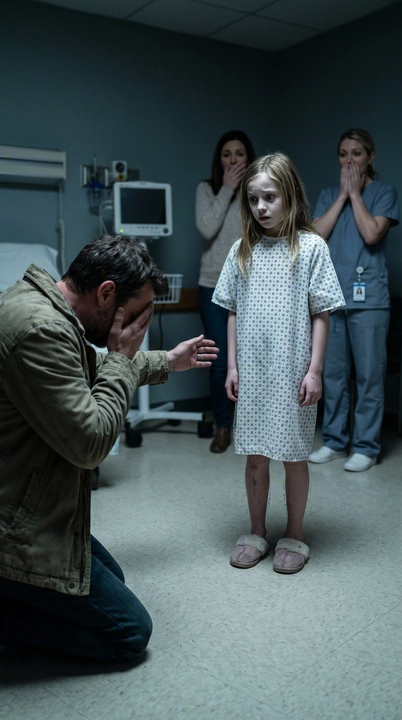
Her father refused to let go of her hand.
“No,” he kept repeating. “No, she was walking. I saw her. You all saw her.”
But the doctors weren’t looking at him anymore. They were staring at the scans that had just come in—new scans, rushed, confused, impossible.
One of them stepped back.
“This… doesn’t match her condition,” the doctor said quietly. “It’s like her nervous system responded temporarily… then shut down again.”
Her mother shook her head.
“That’s not possible,” she whispered. “People don’t just… borrow their legs.”
Silence fell again.
Then a soft voice interrupted it.
The girl.
Her eyes were open now, calmer, almost distant.
“Daddy…” she said weakly.
He leaned in immediately.
“I’m here, baby. I’m here.”
She gave a faint smile.
“I think… I wasn’t supposed to walk yet.”
Her father’s grip tightened.
“What are you talking about?”
Tears slid down her cheeks, but her voice stayed strangely peaceful.
“When I stood up… it didn’t hurt like before. It felt like… someone else was helping me.”
The room went cold.
The doctor slowly turned toward the chart again, flipping pages like he was searching for a mistake that could explain what no science could.
But the girl only looked at her father.
“And when I stopped… it felt like they let go.”
Her father’s voice broke completely.
“Who let go?”
She didn’t answer right away.
Instead, she squeezed his hand one last time.
“I think… I just proved I can come back to you.”
And the heart monitor steadied into a long, unbroken tone that no one dared interrupt.