was thirty-five the night of her graduation.
The auditorium was alive with excitement — flowers everywhere, cameras flashing, families celebrating as if they had finally reached the finish line.I sat alone in the third row.
My clothes were simple. My feet throbbed. And beside my chair, next to my purse, was a diaper bag that didn’t belong in a moment like this.For eighteen years, my life hadn’t been about celebrations — it had been about survival.
I had Adriana when I was seventeen. Her father, Caleb, didn’t drift away slowly — he disappeared overnight. One day he was there, the next his closet was empty, his phone was off, and every promise he made vanished with him.So it was always just us.
Adriana grew up in the spaces between my exhaustion — between double shifts, overdue bills, and quiet nights where I stretched every dollar just to get by. She wasn’t a demanding child. She didn’t ask for much.
But she noticed everything.
She noticed when I skipped meals. When I cried where no one could see. When staying felt harder than leaving — but I stayed anyway.
By her senior year, I thought the hardest part was behind us. Her grades were strong. Scholarships were lined up. Her future finally looked steady.
Then something changed.
She started coming home late. Working extra hours. Keeping things to herself — or rather, keeping things entirely to herself.
Some nights, she looked scared. Other nights… strangely calm — like someone carrying a weight too heavy to share.
Three days before graduation, she stood in the kitchen doorway, nervously tugging at her sleeve.
“Mom,” she said softly, “please listen before you decide how to feel.”
My heart dropped.
Then she told me everything.
About Jonah. About the pregnancy. About the baby girl who had been born just two weeks earlier. About the hospital visits she had hidden from me.
And the promise she made to herself — that no matter how afraid she was, she would never walk away the way her father did.
Then she asked me something I wasn’t ready for.
“If I bring her to graduation… will you still be there?”
I didn’t sleep that night.
And when the moment came… I still wasn’t prepared.
The ceremony went on like normal — names called, applause echoing, speeches filling the room.
Then Adriana stepped out of line.
She walked straight toward me.
“Mom,” she whispered, holding out her arms, “can you give her to me?”
Before I could think, I placed the baby in her arms.
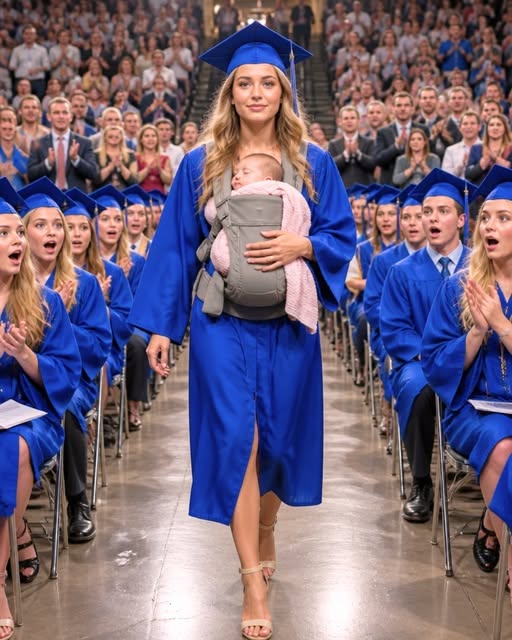
She held her carefully, wrapping her beneath her gown, her tiny face peeking out from a soft pink blanket.
Then she turned — and walked toward the stage.
The whispers started immediately. Then the laughter. Soft at first… then spreading.
“Is this real?” “You’ve got to be kidding…”
And then, just behind me, someone whispered—
“Just like her mother.”
It hit like a slap.
For a second, I couldn’t breathe. I wanted to disappear. To undo everything that had led us here.
But Adriana didn’t stop. She didn’t look down. She didn’t hesitate.
She climbed those steps one by one, holding her daughter like she belonged exactly where she was.
She accepted her diploma. Then… she didn’t leave. She walked straight to the microphone.
And suddenly, the entire room went still.
The principal, caught off guard, took a half-step forward before deciding to let her speak. Adriana adjusted the baby gently against her shoulder and looked out at the sea of faces — the ones laughing thirty seconds earlier now silent, unsure what they were about to witness.
“My name is Adriana Reyes,” she said, her voice shaking only slightly, steadying more with every word. “And this is my daughter, Wren. She’s two weeks old.”
A ripple moved through the crowd, but no one laughed this time.
“I know what a lot of you are thinking right now,” Adriana continued. “I heard some of it walking up here. ‘Just like her mother.’ I actually want to talk about that, if you’ll let me, because you’re right. I am just like my mother. I just don’t think you meant it the way I’m about to.”
She found me in the third row, and for a moment it felt like the whole auditorium disappeared and it was just the two of us again, like all those nights at our kitchen table.
“My mother had me when she was seventeen,” Adriana said. “Alone. My father left before I could remember his face. She worked double shifts at a diagnostic lab for twelve years so that I could have new shoes instead of hand-me-downs, so I could take the SAT prep course instead of just hoping for the best, so I could stand up here today with a diploma in my hand and a full ride to State in the fall. She never once made me feel like I was a mistake, even when the whole world seemed determined to tell her I was one.”
I felt the tears start before I could stop them.
“Two months ago, I found out I was pregnant,” Adriana said. “I was terrified. I thought about every version of the future I’d been planning and watched it seem to disappear. I thought about Jonah, who’s here somewhere tonight too, and who has shown up for every single doctor’s appointment since the day I told him. And I thought about my mother, who taught me — not with a lecture, just by living it in front of me every single day — that showing up is a decision you make over and over again, not just once.”
She looked down at Wren, sleeping peacefully through the entire speech, blissfully unaware she’d just become the reason for a standing ovation still thirty seconds away from happening.
“So when someone behind my mother whispered ‘just like her mother’ as I walked up here holding my daughter,” Adriana said, “I want you to know — I heard that as the highest compliment anyone’s ever given me. Because my mother built an entire life out of nothing so that I could have choices she never got. And the choice I’ve made is to be exactly like her. To stay. To show up. To work as hard as it takes so that Wren never has to wonder if she was wanted.”
She turned back toward the crowd, her voice steadier now, almost fierce.
“I’m not embarrassed to be standing up here with my daughter. I’m proud. This diploma doesn’t belong just to me — it belongs to my mother, who sacrificed for eighteen years so I could earn it, and it belongs to Wren, because everything I do from now on is for her too.”
The silence held for one more second.
Then the applause started — first from a woman near the front, then spreading, row by row, until the entire auditorium was on its feet. I stood too, tears streaming freely now, no longer caring who saw.
The woman who’d whispered “just like her mother” sat frozen in her seat, not clapping, though several people near her had turned to look, and I watched her eventually, slowly, awkwardly, raise her hands to join the applause too — whether out of genuine shame or simple social pressure, I never learned and never much cared.
Adriana walked off that stage to a reception line of teachers and classmates who wanted to hold Wren, congratulate her, tell her stories about their own mothers or grandmothers who’d walked similar roads. Jonah met her at the bottom of the steps, visibly overwhelmed, wrapping both of them in his arms in front of everyone.
She started at State that fall, exactly as planned, commuting rather than living on campus so Wren could stay close to both of us. I watched my daughter build a schedule around 2 a.m. feedings and 8 a.m. lectures with the same quiet determination I remembered from my own hardest years, except now she had two of us in her corner instead of none.
A year later, Wren is walking, chasing my old cat around my living room every Sunday when Adriana brings her by, and Adriana is halfway through her sophomore year, still on the dean’s list, still exhausted in the particular way only young mothers understand, still, every single day, showing up.
I think about that whispered comment sometimes — “just like her mother” — meant as an insult, landing instead as the truest thing anyone said in that auditorium all night. I’ve decided to keep it, the way Adriana did, as the compliment it always should have been.
THE END
A Note to the Reader
The whispered insult in this story does exactly what cruelty often does when it meets someone who’s already done the harder work of understanding their own story: it lands, and then it gets reclaimed. Adriana doesn’t deny the comparison to her mother — she embraces it fully, publicly, and redefines it in real time for a room that assumed “just like her mother” was meant as a diagnosis rather than a legacy worth claiming.
It’s worth sitting with what actually made that moment possible, though — not a single act of bravery on a stage, but eighteen years of a mother modeling exactly what showing up looks like, day after unglamorous day, long before her daughter ever needed to draw on that example herself. Adriana’s speech isn’t really about defending herself against laughter. It’s a public acknowledgment of a debt she clearly understood long before that auditorium ever forced her to say it out loud.
If you’re a young parent who’s ever felt like a room full of assumptions had already decided your story for you, this story is a reminder that the people whispering judgments rarely know the actual history behind the moment they’re mocking — and that the truest response is often not defending yourself against their comparison, but simply living well enough to redefine it.