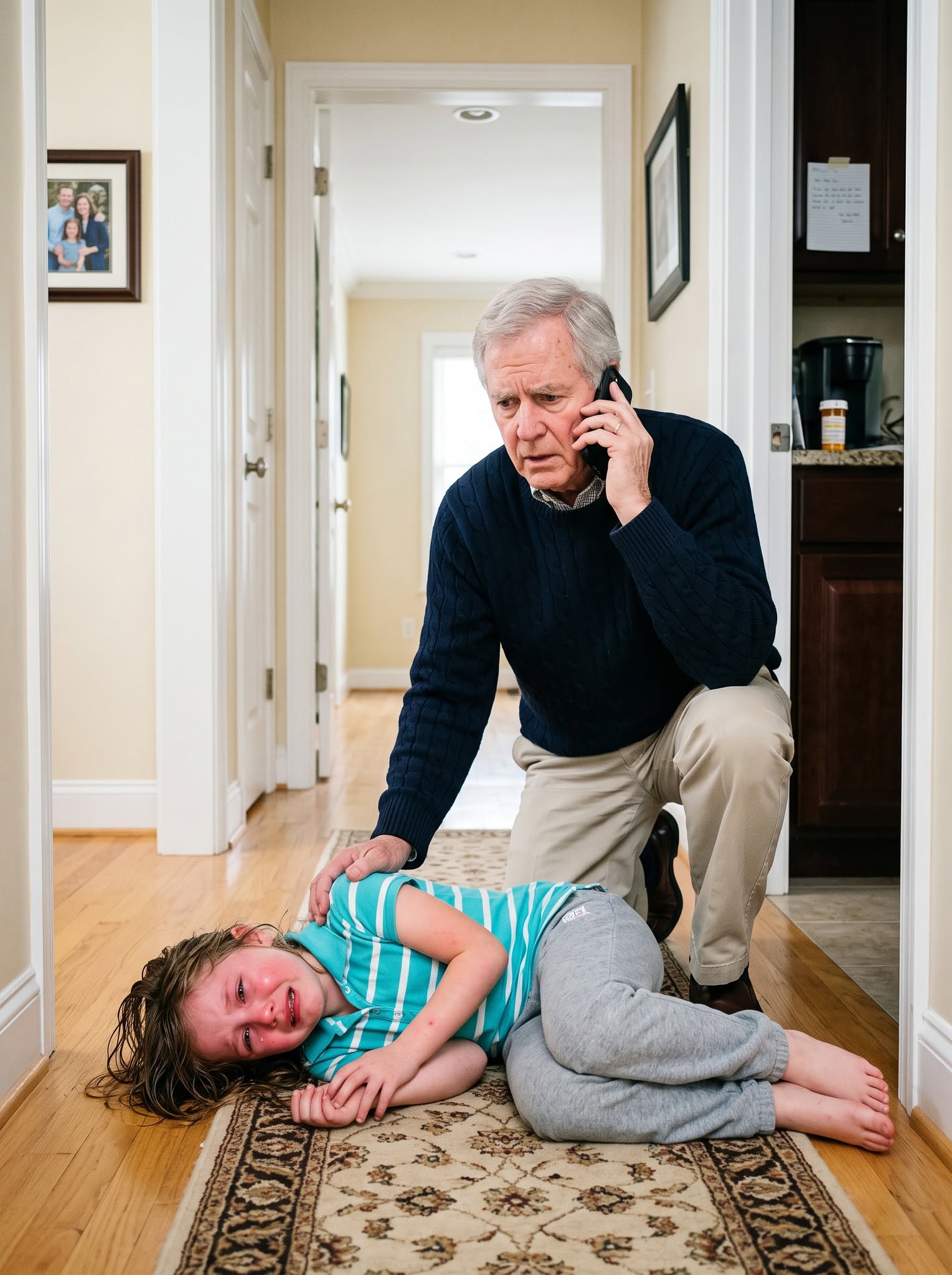
My eight-year-old granddaughter called me at exactly 1:58 in the morning and whispered that she felt too sick to stand. Less than twenty minutes later, I found her burning with fever on the hallway floor of an empty house, while a handwritten note from my own son told me not to call anyone.
My name is Thomas, and I had always believed I knew my son Brian well enough to recognize when something was wrong. That belief began falling apart the moment I saw Lily’s name glowing on my phone in the dark.
I almost missed the call because I had been asleep.When I answered, Lily did not speak immediately.
I heard her breathing first.
It was shallow and uneven.
Then she whispered:
“Grandpa, I feel really hot.”
I sat up and reached for my glasses.
“Where are you, sweetheart?”
“At home.”
That answer confused me.
Brian and his wife Marissa had told me Lily would be staying with Marissa’s sister for the weekend because she had a mild cold. They were supposedly taking her ten-year-old brother Mason on a short birthday trip.
“Where’s your aunt?”
Lily did not answer.
“Where’s your mom?”
Another pause.
Then she said:
“They left.”
I was already getting dressed.
“Is Mason there?”
Lily hesitated again.
“I don’t know.”
That frightened me.
I told her to stay on the phone and promised I was coming.
Brian lived about fifteen minutes from me.
I do not remember much about the drive except checking repeatedly that Lily was still breathing and trying to keep my voice calm enough that she would not hear how scared I was.
She barely spoke.
Once, she whispered that her head hurt.
Another time, she said she was thirsty.
Then she stopped answering for several seconds, and I almost drove through a red light before hearing her breathe again.
When I reached Brian’s street, the driveway was empty.
That was the first thing that made the story I had been given feel wrong.
If Brian and Marissa had left town with Mason, Lily should not have been inside that house at all.
I used the emergency key Brian had given me years earlier.
The moment I stepped inside, I smelled something sweet and medicinal.
“Lily?”
The kitchen light was on.
A glass of water sat near the sink.
One of Mason’s sneakers lay sideways in the hallway.
Then I saw my granddaughter.
She was curled on the hardwood floor near the kitchen in pink pajamas, one cheek pressed against the wood.
Her hair was damp with sweat.
“Grandpa…”
I dropped beside her.
The heat coming from her forehead scared me enough that I immediately called 911.
While the dispatcher asked questions, I lifted Lily carefully against my chest.
She leaned into me without really waking up.
I looked around the kitchen, trying to understand how a sick eight-year-old child had ended up alone on the floor.
That was when I noticed the orange prescription bottle.
It was sitting beside Brian’s house keys.
I picked it up.
The name on the label was not Lily’s.
The medication had been prescribed to an adult.
Beside the bottle was a folded piece of paper.
The first word inside was enough to make my stomach tighten.
Dad.
Brian had written the note for me.
He said Lily became dramatic when she was sick.
He said they had given her something to help her sleep.
Then he wrote that they would be back Sunday.
The next sentence made me stare at the paper.
Please don’t call anyone.
I looked down at Lily.
The dispatcher was still speaking in my ear.
Help was already on the way.
Whatever Brian had expected me to do, I had already made the decision he apparently wanted me to avoid.
Then I read the last line.
And don’t believe her if she says anything about the closet.
I looked toward the hallway.
The coat closet stood about ten feet away.
Lily’s fingers suddenly tightened against my shirt.
“Grandpa.”
“What is it?”
She barely opened her eyes.
“Don’t go there.”
My body went cold.
Before I could ask why, I heard something from behind the closet door.
A knock.
Soft.
Then another.
I carried Lily closer.
“Mason?”
Everything went quiet.
Then a small voice answered:
“Grandpa?”
I opened the door.
My ten-year-old grandson was sitting on the floor with his knees against his chest.
His tablet lay beside him.
One foot was bare.
The sneaker in the hallway suddenly made sense.
“Mason.”
He looked past me immediately.
“Is Lily okay?”
That question hurt.
Not because of the words.
Because he asked about his sister before asking why I was there.
“An ambulance is coming.”
He nodded.
Then he picked up his tablet and held it tightly against his chest.
I crouched as much as I could while still supporting Lily.
“Why were you in here?”
Mason stared at the floor.
“Dad said I had to stay until I stopped lying.”
I felt anger rise inside me.
I forced my voice to remain steady.
“What did he say you lied about?”
Mason looked toward the kitchen.
At the medicine bottle.
At Brian’s note.
Then at Lily.
“I told him we shouldn’t leave her.”
I stopped breathing for a second.
“What do you mean?”
“She was already sick.”
Mason tightened his arms around the tablet.
“I told them they couldn’t go.”
I looked at him.
“Go where?”
He shook his head.
“Dad said I was ruining everything.”
That was the first time I understood that Mason had not simply been punished after his parents left.
He had argued with them before they went.
“Why did he lock you in here?”
Mason swallowed.
“I recorded them.”
I looked at the tablet.
The screen was black.
“Recorded what?”
He glanced toward Lily.
“Dad and Marissa talking.”
I did not press him for details.
The paramedics were already close enough that red light had begun flashing across the front windows.
But Mason was not finished.
“Dad said if I showed anyone, they’d say we couldn’t live with him anymore.”
I felt something shift inside me.
A ten-year-old child does not hear a threat like that as a complicated adult consequence.
He hears one thing.
Tell the truth and you might lose your family.
I reached out and put my hand on his shoulder.
“You did nothing wrong by asking for help.”
Mason looked at me.
His eyes filled with tears.
“I didn’t know if Lily could wake up.”
I pulled him closer.
For a moment, both children were against me.
One burning with fever.
The other shaking.
Outside, the ambulance stopped.
Two paramedics came through the front door seconds later.
I explained what I knew.
Lily was examined first.
They asked about the medication.
I showed them the bottle.
One of the paramedics looked at the label, then at me.
“Do you know how much she was given?”
“No.”
I looked at Lily.
“I don’t even know why she was given it.”
The paramedic’s expression became serious.
Mason moved closer to me.
“They said it would make her sleep.”
The room went quiet.
The paramedic asked who “they” meant.
“My dad and Marissa.”
I closed my eyes for a second.
That was the first time I heard one of the children say it plainly.
Brian and Marissa had given Lily medication.
Then they had left.
The paramedics prepared Lily for transport.
One of them asked whether Mason had any injuries.
He said no.
But when she asked how long he had been in the closet, he looked at me instead of answering.
“I don’t know.”
I felt sick.
I told the responders I would follow the ambulance with Mason.
Before we left, I picked up Brian’s note and the prescription bottle.
Then Mason grabbed my sleeve.
“There’s something else.”
I looked down at him.
“What?”
He glanced toward the hallway.
“Dad told me to delete something before he comes back.”
I waited.
Mason held up the dead tablet.
“The recording isn’t the only thing.”
I could have asked him what he meant.
Instead, I looked at Lily being carried toward the ambulance.
She needed a hospital.
Mason needed to get out of that house.
Whatever else existed inside those walls could wait a few minutes.
“We’re leaving first.”
Mason nodded.
Then he surprised me by saying:
“He thinks you’ll believe him.”
I looked at my grandson.
“What do you mean?”
Mason’s voice became quiet.
“Dad said you always do.”
Those words followed me all the way to the hospital.
Because he was right about one thing.
For most of Brian’s life, I had believed him.
When he was a child, I believed him when he blamed his brother for broken toys.
When he was a teenager, I believed his explanations about missed curfews.
As an adult, I had accepted his complaints that Lily was dramatic and Mason was difficult without ever thinking much about what those words taught his children.
Now I had Brian’s note in my pocket.
I had an adult prescription bottle sitting beside me.
I had one grandchild in an ambulance and another sitting silently in my passenger seat.
For the first time, being Brian’s father no longer felt like a reason to defend him.
It felt like the reason I needed to understand exactly what his children had been trying to tell me.
Part 2 – The Recording Showed Why My Son Wanted Everyone to Stay Quiet
At the hospital, Lily was taken straight into a pediatric treatment room while Mason stayed beside me in the waiting area. He had not let go of the dead tablet since we left the house, and every few minutes he looked toward the entrance as if he expected Brian to walk through the doors.
I kept thinking about the sentence he had said in the car.
“Dad said you always believe him.”
The words bothered me because they were true.
Brian had always been good at explaining things after the fact. He could turn irresponsibility into bad timing, anger into stress, and someone else’s fear into an overreaction.
For years, I had accepted those explanations because he was my son.
That night, I had two grandchildren depending on me not to do it again.
A nurse came out after about twenty minutes and told me Lily was stable but dehydrated and needed monitoring. The medical team was also concerned about the medication she had been given because the dosage and prescription did not match what would normally be given to a child her age.
I handed over the bottle.
The nurse documented it and asked whether I knew who had given it to her.
Before I could answer, Mason spoke.
“My dad did.”
The nurse looked at him gently.
“Did you see him give it to her?”
Mason nodded.
“Marissa was there too.”
I felt my stomach tighten.
The nurse did not question him further in the hallway.
She simply wrote down what he said and told us a hospital social worker would be coming to speak with us.
Mason looked terrified.
“Am I in trouble?”
“No.”
I answered immediately.
“You are not in trouble.”
He looked at me as if he needed to hear it twice.
So I said it again.
“You did the right thing by telling the truth.”
For the first time that night, his shoulders dropped a little.
The social worker arrived shortly afterward.
Her name was Angela, and she explained that she would speak with Mason carefully because she did not want him repeating the same story over and over to different adults.
I appreciated that.
I was starting to understand that my job was not to investigate my own son.
My job was to make sure the children were safe enough for trained people to do theirs.
Before Angela took Mason into a private room, he handed me the tablet.
“You can charge it.”