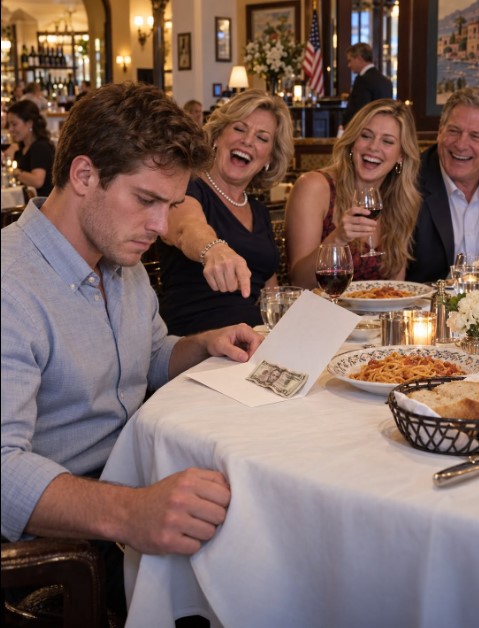
My name’s Ryan. I’m 27. And for as long as I can remember, birthdays have never really been about me. At least not in my family.
Growing up, they were always treated like some kind of performance where my parents could make a joke at my expense. My older sister could show off, and everyone else in the family just went along with it.
I used to tell myself it was harmless, that maybe I was just being too sensitive. But after a while, the little jokes piled up into something much heavier. Something that stuck to me long after the candles were blown out.
And this year, this birthday dinner, was when everything finally boiled over.
We had gone out to this semifancy Italian restaurant, the kind of place with white tablecloths and waiters who pour water into your glass every 5 minutes. I should have been excited.
I hadn’t had much time to celebrate anything in years. Not with how much I’d been grinding at work and quietly covering bills my parents had forgotten about, but I wanted to think maybe, just maybe, they’d take this night seriously.
For once, it would be about celebrating me turning 27.
Instead, the moment that card slid into my hands, I knew I was about to be reminded exactly where I stood in my own family.
I opened it with this fake, hopeful smile plastered on my face. My mom had written something on the front in big loopy handwriting.
“Happy birthday, son. Don’t get old too fast.”
Inside, though, it wasn’t the usual $20 or $50 that even my younger cousins would get from them on random holidays.
No.
Folded neatly in the center was a single crumpled $5 bill, the kind that looked like it had been dug out of a purse pocket at the last second.
And before I could even process it, my mom leaned back, smirked, and said, “Don’t spend it all in one place.”
Then she laughed.
Not a light-hearted laugh, but a full sharp cackle like she had been waiting all night just to drop that line.
The table erupted.
My dad chuckled. My sister practically doubled over. Even my uncle slapped the table like it was the funniest thing he’d ever heard.
And I sat there frozen, staring down at that wrinkled bill as if it had the weight of everything I’d endured with impressed into its fibers.
They thought it was a joke.
To them, I was the punchline.
But in that moment, as the laughter washed over me, I wasn’t humiliated. I was calculating.
Because what they didn’t realize was how much they already owed me.
The late night bailouts, the rent I had covered for them when they were short on cash, the car payments I had floated to keep their credit from tanking.
I had never once held it over them, but I had kept track every penny.
And as my mom’s laughter echoed in my ears, I knew one day soon they’d learned just how expensive their little joke was going to be.
I forced a smile. I even chuckled softly like I was in on it, though my chest felt like it was caving in.
“Thanks,” I said, tucking the bill back into the card and setting it on the table.
My voice didn’t crack, but my hands were trembling under the tablecloth.
They didn’t notice, of course.
They never did.
My sister immediately launched into a story about her latest vacation, and my dad leaned in, giving her all the attention I’d wished for just once on my own birthday.
I sat back, let the noise of their conversation blur into static, and kept replaying the moment over and over.
The way their laughter had bounced off the walls. The way no one at that table had thought to stop it.
That was when the gears started turning in my head.
Because here’s the thing: you can mock me, you can belittle me, and maybe I’ll swallow it for years. But when you laugh in my face like that, when you make my worth into a literal $5 joke, you don’t just bruise my pride.
You wake up something in me that doesn’t forget. Something that calculates.
And as I sat there stirring a plate of pasta I could barely taste, all I could think about was how one day they’d be sitting across from me again.
Only next time, the laughter would stop and the bill would come due.
And that was just the beginning of the night.
The rest of that dinner dragged on like a bad play where everyone knew their lines except me. My sister Emily took center stage as usual.
She was 30, only 3 years older than me, but in my parents’ eyes, she might as well have been a queen sitting on a throne.
She told story after story about her latest trip to Spain, how she just had to book a suite with an ocean view because she deserved it after all her hard work.
My mom nodded proudly. My dad asked her questions like he was interviewing a celebrity, and even my uncle looked genuinely impressed.
Meanwhile, I sat there swirling cold pasta on my fork, trying not to choke on the bitterness rising in my throat.
Every time Emily paused to sip her wine, my mom would throw in some little jab at me.
“Ryan, maybe if you traveled more, you’d have something exciting to talk about, too.”
Or, “Your sister has always been good at treating herself. You should take notes instead of being so frugal.”
That last word stung because it wasn’t frugality. It was responsibility.
But they didn’t know. Or maybe they didn’t want to know that the reason I didn’t travel, the reason I didn’t splurge, was because I had been too busy quietly paying off their debts and covering emergencies they never once paid back.
I kept my mouth shut, though, because I knew if I said anything, it would only feed their smuggness.
Emily caught my silence and smirked like she’d scored a point in some invisible competition between us.
Then she leaned across the table and said, “You know, Mom, Dad, maybe we should take Ryan with us on our next trip. It would be nice to show him how to enjoy life for once.”
Her tone wasn’t kind. It was dripping with condescension.
My mom laughed so hard she nearly spilled her drink.
“Sweetheart, don’t be cruel,” she said, patting Emily’s hand. “Your brother doesn’t even have the wardrobe for Spain. Can you imagine him sticking out like a sore thumb in those outdated clothes of his?”
And just like that, they were all laughing again.
I forced another smile, but inside I was burning.
Outdated clothes.
I was the one making sure the lights in their house stayed on when they conveniently forgot to pay the bills.
I was the one who had sacrificed upgrading my car so I could loan my dad money for his.
I was the one who skipped dinners out with friends so I could cover the mortgage payment that would have sunk their credit.
And here I was being mocked for not living a lifestyle I’d literally funded for them.
The tension only built as the night went on.
When the check came, I half expected my dad to pull his usual move of conveniently forgetting his wallet.
But this time he did something even worse.
He picked up the leather folder, glanced at the bill, and said, “Ryan, you’ve been doing so well at work, right? How about you treat us tonight? It’s your birthday after all.”
I froze, staring at him in disbelief.
“You want me to pay for my own birthday dinner?”
He leaned back in his chair like it was the most reasonable thing in the world.
“Well, you’re more stable than we are right now, and it’s just money. Family takes care of each other, doesn’t it?”
The hypocrisy nearly made me laugh out loud, but my jaw locked instead.
I pulled out my card, set it down slowly, and said, “Sure.”
My voice was steady, but my hand trembled as I slid the card across the table.
Not from fear.
No, this time it was something else. Something sharper.
Because in that moment, I realized just how deep their entitlement ran.
They didn’t just mock me.
They expected me to bankroll the whole show.
As the waiter walked away with my card, I sat back and let the fire inside me grow.
Every comment, every jab, every smug laugh, it was fuel.
They didn’t see it, of course.
They kept chatting like nothing had happened, like draining me dry was just a normal part of the evening.
But I saw it.
I felt it.
And I knew this wasn’t just a one-off insult anymore. This was a pattern that had been running unchecked for years.
And tonight, it had finally snapped into focus.
When the bill came back, my dad didn’t even thank me.
My mom just slipped the receipt into her purse like it was hers.
And Emily clinkedked her glass with mine as if to say, “Good boy.”
I smiled back because I had to.
But inside, I was already sketching out the blueprint of a plan.
Because sooner or later, they’d come knocking again, expecting me to save them.
And when they did, they’d find out I wasn’t the same quiet son they could laugh off anymore.
That night didn’t end with fireworks or confrontation.
It ended with me shaking hands, hugging stiffly, and walking to my car in the dark.
But as I sat in the driver’s seat, gripping the wheel, I made myself a promise.
I wasn’t going to keep bailing them out.
I wasn’t going to keep playing the fool.
I was going to make them feel the weight of every dollar, every laugh, every word they’d thrown at me.
And as I drove home, replaying the sound of my mom’s laughter echoing in my head, I knew the tension between us had only just begun.
A few weeks after that birthday dinner, the cracks in my patience widened into something I couldn’t ignore.
I tried to brush it off, told myself I was overreacting, that maybe I was just too sensitive.
But then came the call.
The one that turned irritation into betrayal. So sharp it felt like someone had carved into my chest.
It was a Tuesday evening, and I had just gotten home from work.
I was exhausted, but in a good way. The kind of tired that comes from actually accomplishing something.
I’d been grinding hard at my job, putting in long hours, and that week I’d finally landed a promotion I’d been chasing for months.
It meant more money, sure, but more than that, it meant validation.
Proof that I wasn’t just some doormat or screw up like my family liked to paint me as.
For once, I had something solid to celebrate.
My phone buzzed, and I saw my mom’s name flash across the screen.
I almost didn’t answer, but habit went out.
“Hey, Mom.”
Her voice was sweet at first, sugary in a way that set alarm bells ringing in my head.
“Ryan, honey, how are you? How’s work?”
“It’s good,” I said cautiously. “Actually, I got promoted this week.”
There was a pause, a brief silence where I expected a congratulations, maybe even pride.
Instead, she said, “Oh, that’s nice. Listen, we’ve been meaning to talk to you about something.”
My stomach dropped.
Here it comes, I thought.
“What is it?”
She cleared her throat.
“Well, you know how your dad and I have been a little strapped for cash. The mortgage is behind again, and Emily’s been helping as much as she can, but she has her own expenses, of course. We thought maybe just until we get back on our feet, you could take over the payments for us, just for a little while.”
I sat there in stunned silence.
I’d already helped them with this exact problem 6 months ago. I’d wired over 2 months worth of mortgage to keep their house from going into default, and they hadn’t paid me back a scent.
“You want me to take over your mortgage?” I asked slowly.
“Well, just for now,” she repeated, her voice liilting as if she were asking me to water the plants, not carry the weight of their home. “You’re doing so well, and it wouldn’t be fair to put all the pressure on your sister. She’s got her life to think about.”
Something inside me snapped.
“So Emily can travel the world and buy designer bags, but I’m supposed to pay for your house.”
There was a sharp inhale on the other end of the line.
“Don’t be selfish, Ryan. Your sister has worked very hard to make her life comfortable. You should be happy to help your family after everything we’ve done for you.”
I almost laughed at the audacity, but the words stuck in my throat.
“Everything you’ve done for me? Mom, I’ve been bailing you out for years. I’ve covered bills, car payments, even your credit card debt. I’m not your safety net.”
Her tone turned cold, clipped.
“If you don’t step up, Ryan, we could lose this house. Do you want to be responsible for that? For your father and me ending up on the street?”
I froze.
The guilt punching me square in the chest.
That was their game.
Always twisting it, always making me the villain if I didn’t cave.
But this time, instead of folding, something hardened in me.
“I’m sorry,” I said flatly. “I can’t do it.”
There was a long silence.
Then, almost casually, she dropped the knife I hadn’t seen coming.
“Well, maybe Emily was right. Maybe you don’t deserve to be part of this family if you can’t even help when we need you most.”
My breath caught.
“What did you just say?”
“You heard me,” she snapped, her sweetness gone. “Emily’s been saying for years that you only think of yourself, that you’d rather watch us struggle than lift a finger. And honestly, maybe she’s right. I don’t even know why we bothered inviting you to dinner the other night if this is how you’re going to act.”
That was it.
That was the moment.
The moment the invisible thread tethering me to them snapped clean in two.
I hung up without another word, my hands shaking as I set the phone down on the table.
My chest was tight, my head pounding.
But beneath it all was something new. Something cold and focused.
They hadn’t just asked for help.
They had chosen sides.
They had taken my sister’s poisonous words and weaponized them against me.
My own mother telling me maybe I didn’t deserve to be part of the family.
I sat there for hours replaying the conversation over and over, every word searing deeper into me.
By the time midnight rolled around, the grief had burned away, leaving only clarity.
This wasn’t just about money anymore.
This was about respect, dignity, and the fact that they had never, not once, seen me as anything more than a tool.
And in that moment, I knew something had changed forever.
The days after that phone call were some of the darkest I’d had in years.
At first, I told myself to shrug it off, to not let their words sink so deep.
But that’s easier said than done when it’s your own mother telling you maybe you don’t even deserve to be part of the family.
I tried to bury myself in work, throwing every ounce of energy into my new role.
But even when I was sitting in meetings or answering emails, I kept hearing her voice in my head, replaying those lines on loop.
“Emily was right. Maybe you don’t deserve to be part of this family.”
The words crawled under my skin like thorns.
I’d helped them so much, sacrificed so much, and somehow I was still the selfish one.
Nights were the hardest.
I’d come home to my quiet apartment, sit on the couch with the TV flickering in the background, and just feel hollow.
Birthdays, dinners, holidays, they all replayed in my mind like a highlight reel of mockery and dismissal.
And now, on top of everything, I had this raw wound of betrayal that wouldn’t stop bleeding.
I stopped answering their calls.
At first, it was just because I couldn’t handle the stress, but soon it became intentional.
My mom would ring. My dad would text. Even Emily sent a smug little, “You really should help out,” message one evening.
But I ignored them all.
I needed space.
I needed silence.
That silence, though, came with its own price.
My dad showed up at my apartment once unannounced.
I didn’t answer the door, just sat in the dark with my back against the wall, listening to him knock and call my name like I was some disobedient child.
Eventually, he left.
But the pounding in my chest stayed long after his footsteps faded down the hall.
Work became my only anchor.
I stayed late most nights, not because I had to, but because I didn’t want to go home to the thoughts waiting for me there.
I told myself I was climbing, that I was finally carving out something that was mine.
But in quiet moments, when the office emptied and the city lights glowed against the glass, I wondered if I’d ever really be free of them.
The loneliness cut deep.
Friends invited me out, but I found excuses not to go.
I couldn’t bear the thought of pretending everything was fine when inside. I felt like I was unraveling.
On weekends, I’d scroll through social media and see Emily posting photos from yet another trip, Paris. Time. Champagne glasses, fancy dinners, captions about hard work paying off.
And beneath it, comments from my parents, little heart emojis.
“So proud of you, sweetheart. You deserve it.”
I never got those words.
Not once, not even when I had pulled them out of financial ruin with my own hands.
The breaking point came one Saturday when I checked my mail.
Inside was a notice from my bank.
A transfer request had been flagged.
My parents had tried to move money out of the joint account I’d once used to help them cover bills.
I had left just enough in there to close it out eventually, but apparently they saw it as theirs to grab.
The request had failed because I’d quietly remove their access months earlier, but seeing that slip of paper in my hands sent me spiraling.
I sat at my kitchen table with the letter, and for the first time in a long time, I cried.
Not out of sadness, but out of something heavier.
Grief for the family I had once hoped to have.
Grief for the years I had wasted trying to win their approval, trying to be the good son.
That night, though, something shifted.
I wiped my face, set the paper down, and pulled out a notebook.
On the first page, I wrote one word in big block letters.
Enough.
And then I started listing.
Every loan I had given them. Every payment I had covered. Every time I had stepped in when they asked.
The total added up fast. Too fast.
By the end, I was staring at a number that made my chest ache.
Tens of thousands.
Money that had gone unacnowledged.
Money that had funded their vacations, their comforts, their smug superiority.
The pain was still there, heavy and raw.
But as I looked at that number, a strange calms settled over me.
I couldn’t erase the years of being treated like a joke.
But maybe, just maybe, I could make sure they never laughed at my expense again.
So while I was at my lowest, sitting alone with nothing but paper and pen, I started planning.
Not out of spite, but out of survival.
Because if I didn’t reclaim myself now, I never would.
And in that quiet, broken moment, I made myself another promise.
One day soon, the tables would turn.
The weeks that followed felt like climbing out of a pit I had been sitting in for years without even realizing it.
At first, it was shaky.
I was still carrying the weight of my family’s betrayal on my shoulders.
But as time went on, I began to notice something strange.
Without their constant calls, guilt trips, and backhanded comments in my ear, I actually started to breathe easier.
It was like stepping into fresh air after living in a smoke-filled room.
I threw myself even harder into work, not just as an escape anymore, but with real purpose.
That promotion I’d earned opened doors I hadn’t thought possible.
Suddenly, I wasn’t just some employee grinding in the background.
I was being invited into meetings where big decisions were made.
My input mattered, and for the first time in a long time.
People were looking at me with respect, not like a burden, not like a joke, but like someone who belonged at the table.
With the pay raise that came with the promotion, I started catching up on my own life.
I paid off the lingering student loan that had hung over my head since college.
I upgraded my car.
Not a flashy sports car like Emily would flaunt online, but a reliable, sharpl looking one that was mine, bought outright with no one else’s fingerprints on it.
I even started investing carefully and quietly.
Watching my savings grow dollar by dollar gave me a sense of control I had never felt before.
Socially, things shifted, too.
At first, I had isolated myself.
But as the months went on, I found myself reconnecting with old friends, the ones who had never judged me, who never asked me to be anyone but myself.
They noticed the change before I did.
“You look lighter,” one of them said during a night out, “like you finally got rid of something heavy.”
I just smiled because they were right.
But it wasn’t just about money or freedom.
It was about confidence.
For the first time, I wasn’t carrying their expectations like chains.
I didn’t have to answer every call or respond to every demand.
I was learning what it felt like to have boundaries and, more importantly, to enforce them.
Meanwhile, the distance between me and my family only seemed to fuel their resentment.
I’d hear bits and pieces through the grapevine. Comments from relatives, whispers that Ryan thinks he’s too good for us now, or he’s changed and not for the better.
They tried to paint me as the villain to anyone who would listen.
But instead of crushing me like it once would have, it only made me stronger because I knew the truth.
I wasn’t the villain.
I was just done playing their victim.
Ironically, the better my life got, the worse there seemed to unravel.
My dad had lost another job. My mom’s health expenses were stacking up.
And Emily, despite her curated social media image, was apparently drowning in credit card debt from all her hard work vacations.
They were still posting pictures of wine glasses clinking in Paris or Rome.
But the facade was cracking, and I watched from a distance, silent and steady, building my own foundation brick by brick.
It wasn’t all smooth sailing, of course.
There were nights when I’d scroll past Emily’s posts and feel that old sting of envy, or moments when guilt tried to claw its way back in, whispering that I should help them again.
But then I’d look at the notebook on my desk, the one with enough scrolled across the first page, the one where I had listed every dollar I’d ever given them, and the guilt would dissolve into clarity.
I wasn’t powerless anymore.
I was in control.
And for the first time, I realized just how much leverage I had if I ever chose to use it.
Because the truth was, I still had something they didn’t know about.
Something that could shift the entire balance of power if I wanted it to.
And as I stood taller in my own life, as success began to stack up in ways they could no longer ignore, I started to see just how close I was to having the upper hand.
And deep down, I knew when the time came, I wouldn’t waste it.
It was around the one-year mark after that infamous birthday dinner when the pieces of my revenge began to fall into place almost on their own.
By then, life looked very different for me.
My career had taken off in ways I couldn’t have predicted.
The promotion I’d earned had turned into a stepping stone, and I had moved into a new role managing client portfolios for high-netw worth accounts.
It wasn’t glamorous in the Instagram sense, but it was powerful in ways my family couldn’t begin to understand.
I had access to information, to people, and most importantly, to strategies that could turn money into security.
That was when the call started again.
Not the apologetic kind.
They never apologized.
But the desperate kind wrapped in the same tone of entitlement I’d heard all my life.
At first, it was little things.
“Ryan, can you spot us a couple hundred until payday?”
Or, “Your father’s car needs repairs, and we thought you could take care of it.”
I ignored them every time, but then the requests grew heavier.
My dad called late one night, his voice tight with panic, and let slip something I wasn’t supposed to know.
The bank was circling.
The mortgage wasn’t just behind this time.
It was on the brink of foreclosure.
I didn’t let him know it, but that information lodged itself firmly in my mind.
I asked a few careful questions at work quietly without naming names.
I learned how foreclosures worked, how properties could be bought out, or debts acquired if you were positioned correctly.
The thought hit me like a spark.
For years, they had laughed at me, mocked me, drained me dry.
But what if when the bank finally came knocking, the person holding the strings wasn’t some faceless lender, but me?
At the same time, something else happened that widened the opening.
Emily, ever the golden child, had been boasting online about a business venture she was starting.
Photos of her smiling with wine glasses, hashtags about entrepreneur life, all the usual fluff.
But one evening, a mutual acquaintance mentioned to me, almost offh hand, that Emily wasn’t running a business at all.
She was sinking money into some shaky investment scheme, one that was already eating through what little credit she had left.
That tidbit changed everything.
For years, my family had painted her as the successful one, the one who worked so hard and deserved it all.
But behind the scenes, her empire was crumbling.
And I suddenly realized they weren’t just leaning on me because I was the responsible one.
They were leaning on me because without me, they were about to collapse completely.
So, I started preparing.
I doubled down on my savings and investments, making sure my foundation was unshakable.
I kept meticulous notes, screenshots of texts, bank statements, proof of every scent I had ever given them.
If they ever tried to twist the story, I wanted the receipts in hand.
I also quietly reached out to a lawyer just to understand what my options might look like in certain scenarios.
Not because I was ready to act yet, but because I wanted to know exactly how far I could go when the time came.
And then came the family reunion.
It had been months since I’d seen any of them.
And I debated not going at all.
But something told me I needed to.
I needed to see them face to face to measure just how desperate things had gotten.
When I walked in, the difference was stark.
Emily was still dressed to impress, but there was a nervous edge in her laugh I hadn’t noticed before.
My parents looked older, more worn, their smiles stretched thin.
The conversation around the table was the same as always.
Little digs at me.
Praise for Emily.
But this time, I heard it differently.
I heard the cracks in their voices. Saw the way their eyes flickered when money came up. The way they dodged specifics.
Halfway through dinner, my mom leaned across the table and said in that faux sweet tone, “I knew too well.”
“Ryan, you’re doing so well now. Maybe you could help us out with a little investment. Your sister’s business is about to take off, and it would mean so much to the family if you supported her.”
Emily nodded, smiling like a shark.
“It’s a once-ina-lifetime opportunity, Ryan. You’d make your money back in no time.”
I didn’t answer right away.
I just looked at them, really looked, and for the first time in my life, I realized the balance of power had shifted.
They weren’t in control anymore.
They were asking because they needed me.
And sitting there with their eyes on me, waiting for my response, I felt something settled deep inside me.
I had the leverage.
And soon they were going to learn exactly what that meant.
I didn’t answer them that night at the reunion.
Instead, I smiled, excused myself early, and let their request hang in the air like bait.
I could tell it unnerved them, my silence.
It wasn’t the response they were used to.
Normally, I’d either cave or argue, but this time, I gave them nothing.
And that was the beginning of my revenge.
The next week, my dad called, trying again.
“Son, about what your mom said at dinner. Your sister’s business really could use your support. Think of it as family helping family.”
I let him ramble for a while before I finally said, “I’ll think about it.”
My voice was calm, measured.
That simple phrase seemed to soothe him enough to hang up with a forced sense of optimism.
But what I was really thinking about was how to turn this entire situation on its head.
At work, I started digging deeper.
Not into Emily’s so-called business. That was obviously a sinking ship.
But into the foreclosure process I’d already been quietly studying.
I discovered that when a property is seized, the bank doesn’t care about family ties, loyalty, or sentiment.
All they care about is who can pay, who can take over the debt.
And with the right timing, I realized I could position myself to acquire the house my parents were so desperate to cling to.
The same house I had spent years helping them keep afloat.
The thought of it lit a fire in me.
Not because I wanted the house itself, but because I wanted them to see crystal clear what it felt like to lose control.
Meanwhile, I kept playing my role.
I picked up their calls, listened to their please, nodded along when they talked about Emily’s big break that was always just around the corner.
I didn’t argue.
I didn’t lash out.
I stayed calm, agreeable even, because the quieter I was, the more they revealed.
My mom especially slipped up constantly, venting about overdue bills, late fees, even a near shut off notice on their utilities.
She thought she was guilt-tripping me, but all she was really doing was handing me more proof of just how precarious their situation was.
Then came the moment I had been waiting for.
A letter from the bank arrived at my parents’ house.
And in a fit of panic, my mom called me immediately.
“Ryan, they’re going to foreclose if we don’t make a payment by the end of the month. You have to help us, please. This is your family’s home.”
For a long moment, I didn’t answer.
Then, in the calmst voice I could manage, I said, “I’ll handle it.”
She sobbed with relief, thanking me over and over.
But what she didn’t know was that handling it didn’t mean saving the house for them.
It meant saving it for me.
Through a few quiet conversations at work and with my lawyer, I positioned myself to step in.
I arranged for the debt to be transferred, for the lean to be tied to my name.
It was shockingly straightforward, almost anticlimactic, considering the weight of what it meant.
By the time the paperwork was complete, the house wasn’t theirs anymore.
It was mine.
The next family dinner was when I chose to let it drop.
We were at the same Italian place from my birthday the year before.
As if fate had orchestrated the scene for me.
My mom had been tense all night, her eyes darting like she was waiting for a miracle.
Emily bragged about her business between sips of wine, though her voice cracked every time money came up.
I waited until dessert was on the table.
Then I set down my fork, leaned back, and said casually, “So about the house? It’s mine now.”
Silence.
Pure perfect silence.
My mom blinked at me, her mouth slightly open.
My dad’s fork froze halfway to his lips.
Emily frowned, confused.
“What do you mean?” my mom finally whispered.
“I mean,” I said, my voice calm, steady, “the bank transferred the debt to me. Legally, I own the property now. You’ll still be able to stay there for now, but under my terms.”
The look on their faces was everything I had imagined.
Shock.
Disbelief.
The slow, dawning realization that the power they had lorded over me for years was gone.
For once, I wasn’t the one squirming in silence.
They were.
Emily sputtered, “You can’t just—”
“I can’t?” I cut in smoothly. “And I did. You always told me family takes care of each other. Remember? Well, consider this me taking care of things. Just not in the way you expected.”
The rest of the dinner was tense, brittle.
My mom tried to regain her composure, throwing in little comments about how we were all in this together, but the edge in her voice betrayed her.
My dad stayed quiet, staring at his plate.
Emily glared at me the entire time, but she didn’t say another word.
When the check came, I paid it without a second thought.
Not out of obligation anymore, but out of control.