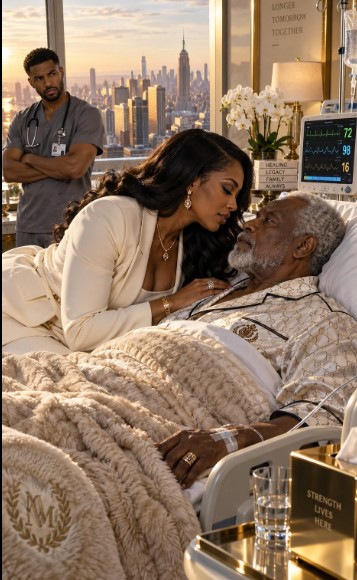
Seven days before the morning I was scheduled to die, my wife leaned over the chrome safety rail of my hospital bed, brushed her lips against the shell of my ear, and whispered the sentence that dismantled the entirety of my life.
“I’ve been poisoning you for weeks, Arthur.”
For several hollow seconds, my brain seized upon the irrational hope that the medication had finally curdled into hallucination. Outside the sixth-floor windows of St. Jude Medical Center, an unseasonable November gale was lashing downtown Chicago, driving sheets of gray water against the glass. A sudden fork of lightning illuminated the room, turning Vanessa’s reflection into an ethereal, predatory silhouette.
I had worshiped that face. At fifty-six, having spent thirty-one years grinding my bones into the foundation of Vance Heritage Furniture, I thought finding Vanessa at forty had been grace. I had believed her large green eyes and quiet grace were my reward for three decades of seventy-hour workweeks, cold factory floors, and solitary dinners in hotel suites.
Beside me, the telemetry monitor ticked off my failing pulse with agonizing neutrality. *Beep. Beep. Beep.* Each stroke sounded thinner than the last, like footsteps retreating into an empty hall.
Vanessa smoothed the stiff hospital blanket across my chest with agonizing poise, her touch as casual as if she were adjusting a throw pillow before heading down to the lobby for a latte. Then, she smiled. It was the same dazzling, curated smile she wore at museum galas and charity dinners.
“When you’re gone, your eighty-two million dollars belongs to me and Julian.”
Beneath the cotton sheet, my right hand attempted to form a fist. My tendons twitched, but my fingers remained nearly motionless. The digoxin had stripped the marrow from my limbs, leaving me pinned beneath the weight of my own dying flesh.
I had built Vance Heritage from an abandoned lumber shed in Milwaukee into one of the largest privately held furniture empires in the American Midwest. I owned the production plants outright. I held the deed to a seventy-acre estate in Naperville, two penthouses along the Gold Coast, commercial real estate portfolios, high-yield securities, and approximately $82.4 million in liquid capital. Yet as I lay beneath the hum of the fluorescent ballasts, every dollar I possessed could not buy me a single lungful of clean air.
That very morning, Dr. Shah had spoken to a resident just beyond my cracked door. *“The ventricular rhythm is destabilizing,”* she had muttered. *“Five days, perhaps seven, before complete heart block.”* I had spent the afternoon watching water droplets race down the pane, calculating what five days meant. Five breakfasts I could not stomach. Five sunsets I would view through double-paned glass. Then absolute, suffocating silence.
Now, the mystery of my inexplicable cardiac failure had resolved itself with chilling simplicity.
“You’re finally going to die, Arthur,” Vanessa murmured, pulling the visitor’s armchair closer and crossing her cashmere-clad legs. Her expensive cream coat, bought during our last autumn in Paris, hung over the back of the seat. The three-carat diamond tennis bracelet I had slipped onto her wrist for our third anniversary glittered under the white lights. “I cannot begin to tell you how exhausting it has been to pretend to love you.”
I opened my eyes fully, forcing myself to look into her face. Cruelty, it seemed, required an audience.
“The little capsules every night,” she continued, her voice taking on an intimate, conversational cadence. “Digoxin. Just enough at first to make you sluggish. A little dizzy on the stairs. A bit of morning nausea you blamed on your board meetings. Then, we increased the dosage. You were so pathetic, Arthur. You swallowed everything I put into your palm. *‘Take your vitamins, sweetheart.’* A glass of water, a kiss on the cheek, and you went to sleep thinking you were the luckiest man in Cook County.”
The memory struck harder than the poison. I saw her standing barefoot beneath the pendant lights of our Naperville kitchen, her dark auburn hair gathered in a loose knot, handing me a small ceramic dish with two blue capsules. I had taken them without a thought. Why wouldn’t I? She was my wife. I had added her name to deeds, given her unrestricted signatory power on accounts, paid off the private debts she claimed were left by her deceased mother. And every night, while I slept beside her, she had been calibrating the exact chemistry required to stop my heart.
“Julian says we probably overcomplicated the pharmacology,” she mused, inspecting her manicure.
Julian Mercer. The name hit like cold steel between my ribs. Julian was the boutique asset manager Vanessa had introduced as an old university acquaintance eighteen months ago. Tall, impeccably tailored, forty-three, with silvering temples and the polished confidence of a man who traded exclusively on other people’s wealth. He had sat at my dining table, drunk my 1982 Margaux, and shaken my hand with firm, deferential warmth.
“We’ve already put an offer on the property in Malibu,” Vanessa whispered, leaning closer. Her perfume—expensive, jasmine-heavy, suffocating—invaded my nostrils. “Seven bedrooms. Direct beach access. Julian wants a subterranean garage for six cars. Your sweat is going to buy us forty years of paradise, Arthur.”
“Why?”
The word barely made it past my parched lips. It was a dry, rasping syllable.
Vanessa’s smile dissolved into a look of profound, patronizing pity. She reached out and tapped my hollow cheek with two manicured fingers.
“Because you were lonely,” she said softly. “You wanted a beautiful wife so desperately that you never bothered to ask whether she loved you or just your balance sheet. Now, close your eyes and rest. I told the funeral home to keep the arrangements modest. I’d rather put the extra ten thousand toward the Porsche Julian wants.”
She picked up her handbag, touched up her crimson lipstick in the mirror above the sink, unlocked the door, and slipped into the corridor.
For a long time, the only reality was the rhythmic click of the telemetry unit. I stared at the ceiling panels, tears leaking silently from the corners of my eyes into my hair. I did not weep because my life was ending; I had faced mortality years ago during my first cardiac scare. I wept because four years of warmth, whispered dreams, entwined fingers beneath restaurant tables, and quiet mornings had been nothing more than an executioner’s pantomime.