“I want you to bathe her. In our tub. Don’t ring down for the housekeeper. You do it.”
I stared at my husband across the limestone expanse of our foyer, convinced his mind had finally snapped under the weight of his own self-righteousness.
My name is Delphine. I was thirty-six, and until that freezing Tuesday afternoon in November, I would have sworn under oath that I understood every corner of the man I had lived with for fifteen years.
**Bennett** was the managing director of **Cray Commercial Holdings**, controlling four industrial contracting firms across Halbrook City. He had inherited his father’s fortune, tripled it through ruthless logistical efficiency, and possessed one private trait that had tested my patience since our courtship in 2010: when Bennett decided an issue was a moral imperative, he pursued it like an evangelical zealot.
That week, his crusade had taken the form of the mobile soup kitchen behind **St. Ivo’s Church**. Three consecutive nights, he had stood behind the steam tables in his bespoke wool trousers with his oxford sleeves rolled to his forearms, ladling broth into polystyrene bowls.
“Some people fall on hard times,” I had remarked that morning over our breakfast coffee, watching our hired cook flip delicate crêpes at the Viking range while a private chauffeur warmed the sedan in the driveway. “But let’s be honest, Bennett. Plenty of them simply prefer living like that. It’s an absence of discipline.”
I said it with the effortless, dismissive cruelty of a woman whose underfloor heating was set to seventy-two degrees.
I have relived the utterance of that single sentence every waking morning since.
At five o’clock that afternoon, Bennett brought the street inside.
She stood on our Persian runner, dripping cold gray moisture onto the weave. Her coat was an assemblage of stained tweed and synthetic fleece, held together across the torso by a length of orange polypropylene baling twine. Her hair was a matted, dreadlocked mass of charcoal dust and dried grease, so dense it obscured the shape of her skull. The smell that billowed off her—stale urine, damp pavement, tobacco ash, and the sweet, rot-tinged stench of untreated skin infections—hit my throat so hard I took two involuntary steps backward, pressing my hand over my mouth.
“What is that doing in our house?” I demanded, my voice shrill and thin in the high-ceilinged hall.
“Her name is Lucy,” Bennett said, completely unruffled, handing his leather briefcase to no one.
“Is that her legal name, or did you bestow it upon her between the soup line and the car?”
“She doesn’t know her name,” he replied.
The woman did not look at the crystal chandelier above her head, nor did she look at the Italian sconces. She looked at her own split-leather boots. When she spoke, her voice was a dry, rasping scrape, yet beneath the ruin of vocal cords scarred by twenty winters of exhaust fumes, the vowels were unmistakably refined. Precise. Educated.
“Twenty years,” she whispered, her gaze anchored to the floor. “Between the rail terminals and the abandoned brickworks off Dunmore. I woke up once in a skip full of dry mortar. There was nothing in my head before that. No family. No town. No name. Just the mortar.”
“I am going to help her find out who she is,” Bennett said, his jaw tightening into that granite obstinacy I knew too well. “I am getting her medical clearance and permanent housing. Until then, she occupies the east guest suite.”
“In this house? With Hesper upstairs?”
“Yes. Mariana—Delphine—take her upstairs and help her wash.”
I didn’t hear it.
I have combed through the transcript of that afternoon four hundred times in my memory, and in that moment of white-hot domestic outrage, my ears simply rejected the slip. He had corrected himself instantly, his eyes flashing with an emotion I mistook for marital exhaustion.
“We employ three day-maids, Bennett,” I hissed. “Call Mrs. Gable.”
“No,” he said, stepping directly into my space, his eyes level and freezing. “If helping humanity matters to you beyond writing tax-deductible checks to the symphony, you start by treating her like a human being instead of a biohazard for the staff to scrub away. Take her upstairs, Delphine.”
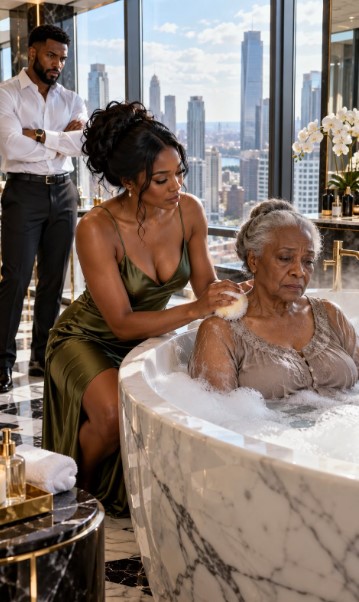
I took her up the rear staircase to avoid the parlor. I made her strip on the tiled floor of the master bath, dropping her clothes directly into an industrial biohazard bag. I snapped yellow latex gloves onto my hands.
“I can wash myself,” she said softly, clutching an oversized bath sheet against her collarbones. Her voice was remarkably polite.
“I’d rather ensure the Carrara marble survives the encounter,” I answered coldly.
She climbed into the clawfoot porcelain tub. The water was hot, scented with lavender oil. Within four seconds of her sitting down, the clear surface turned the color of dirty river water.
I knelt on the cold stone. Furious, resentful, and determined to do the job with enough aggressive roughness to prove to Bennett that his moral experiment was an insult, I seized a coarse natural sea sponge, coated it in eucalyptus soap, and dragged it down the crest of her left shoulder.
Twenty years of street grime, dead skin, and industrial soot rolled away under the suds in heavy gray ribbons.
And beneath the dirt, four inches below the top ridge of her left shoulder blade, the pale skin cleared.
There, stark and dark against the mottled flesh, sat a birthmark.
It was small, no larger than a five-cent coin. Light brown. Shaped like a slender crescent moon resting flat on its rounded back.
The sponge slipped from my fingers, hitting the dark water with a soft, hollow splash.
My vision flared white.
My twelve-year-old daughter, **Hesper**, had that exact mark.
Left shoulder blade. Four inches down. The identical crescent curve. We had taken a photograph of it on the dunes at Cape May three summers ago because Hesper had been crying, ashamed of the blemish, and I had kissed her neck and told her it was a celestial mark—that she was uniquely lucky.
And I knew where Hesper had inherited it.
Because thirty-six years ago, four days after I was born in a provincial hospital, my mother’s sister had leaned over the plastic bassinet, tapped my infant shoulder, and whispered:
*Oh, look at that… she’s got your mother’s moon.*
My mother.
Her name was **Mariana Vey**.
She had been thirty-eight years old. She had worked as a receptionist in an orthodontic practice on Carrow Street. She had possessed a rich, throaty laugh that could rattle windowpanes from the next room.
And on the fourteenth of November, 2005, she had put on a green wool coat, walked out our front door at twenty past four to buy a loaf of seeded rye bread for dinner, and vanished off the surface of the earth.