It began when my hospital supervisor held me past my shift.
“You’re held, Kayla. Two of my night nurses are stuck on Highway 10, and a county plow just went over on its side near Foley. I need you till somebody gets here.”
The emergency department overflowed with people injured on ice. A man in bed six complained of chest pain, while a teenager in bed nine needed care for a dislocated shoulder. With night staff stranded, I stayed. I couldn’t abandon my patients simply because my shift had ended.At 8:15, between checking vital signs and hanging IV fluids, I sent a message to our family chat.
“Held over at work. Night nurses are stuck in the storm. Roads are bad. I’ll be late. I’m sorry.”
Mom reacted with a little heart. A minute later, Dad replied:
TrackPregnancy
“Red.”
Marisol noticed me staring at the word.
“Your dad again?”
I nodded, and she rested against the nurses’ station counter.
“You know the night position is still open. 7 at night to 7:30 in the morning, $4.50 more an hour, and nobody’s waiting up for you.”
I gave my usual answer.“I can’t. House rules.”
At 10:01, I checked my phone between patients. Nothing. Night nurse Brooke arrived through the ambulance entrance at 10:15, snowy-haired and apologetic. I handed over my patients, collected my bag, and scraped my windshield at 10:25.
As I worked, I practiced what I’d say to Dad.
“I’m sorry, Dad. I couldn’t leave. They needed me.”
I said it aloud twice, as I once rehearsed school-play lines. With Highway 10 closed, I took County Road 75 toward Sock Rapids. I drove thirty miles an hour through blinding snow.
Fifteen minutes later, orange lights flickered inside a ditch. Hazard lights were nearly buried. A sedan lay nosefirst in the ditch, snow burying its rear window.
I pulled onto the shoulder, switched on my hazards, and called 911. Nursing school taught us not to create a second patient.Down the slope, an elderly man sat beside the driver’s door against a tire. He was in his seventies, white-mustached, with frozen blood on his forehead and a badly angled left wrist.
“Deer,” he managed through violently chattering teeth. “Went for the deer, then I went for the ditch.”
His name was Walt. He’d tried digging out the car, slipped, and couldn’t climb back with one good hand. His engine had died.
Bracing my boots, I supported him as we crawled uphill inch by inch. I got him into my heated passenger seat. His shoulders were soaked; I replaced his coat with mine and wrapped his legs in my trunk’s silver emergency blanket.
I didn’t rub his cold hands; I kept him talking. His wife was Joanie; he’d driven a county plow for thirty-one years.
“I used to clear this road,” he said, laughing until the laughter turned into coughing.I returned to the wind to clear snow from my tailpipe. The nearby drift could trap exhaust. Walt asked why.
“Making sure we don’t breathe the exhaust,” I said.
He studied me briefly, then nodded in tired approval.
“Good girl. Joanie would like you.”
State Trooper Hansen reached us at 11:20, followed by an ambulance at 11:38. Both had fought through unplowed snow. My report covered discovery time, exposure, wrist injury, head wound, and how cold his hands felt. Hansen recorded my contact information.
“If his family wants to reach me,” I told him, “that’s fine.”
The crew carried Walt away on a stretcher, still wrapped in my coat. I left it with him; he needed it more.
While helping Walt, I forgot curfew. Back in my car, the dashboard read 11:55. Throughout the last ten minutes home, I expected Dad to understand. Saving someone wasn’t a curfew violation.
I kept believing it as I drove through Larksburg Court, parked, and approached the porch. But when I pulled the front door, it moved only a few inches before catching on the chain.
I recognized the scene instantly. It had happened before, although I had prayed it never would again.
At 12:20, I called Dad from my running car. Five rings, then voicemail. Again. Mom didn’t answer either. Then, at 12:31, her text arrived.
TrackPregnancy
“I’m so sorry, honey. Please keep the engine running. Your father is firm on this. Doors open at 6.”
I read it three times before understanding. Mom was awake, knew where I sat, and chose sleep over opening the door.
My breath fogged the windshield while I tried to make sense of the numbers. Eighteen months before, I’d earned my nursing degree with $38,000 in student debt. Dad had proposed a deal.
“Live here, save your money, follow the rules.”
Every first of the month, I paid $600 in board. Another $150 covered the blue Corolla, still registered and insured to him. He’d laminated the rules and stuck them on the fridge with a school magnet.
Curfew: 10:00, or 11:00 Saturdays. Bedroom doors couldn’t be locked. Phone locations stayed shared. Guests needed forty-eight hours’ approval. The final underlined instruction said: Doors open at six.
Twenty-year-old Tyler lived there without those restrictions. He attended community college, worked at a tire shop, and came and went freely. Once I challenged that double standard. Dad barely looked away from the papers he was grading.
“Your brother isn’t the one who will be walking to a car alone at night.”
I’d learned not to raise the subject again.
Outside the locked house, I considered calling again. But begging had never worked in our family. I switched off the engine, curled up in damp scrubs, and listened to the wind.
The cold recalled an autumn night at seventeen, when I stage-managed the school play. Dress rehearsal ran long, and the director’s car stalled afterward. Fourteen-year-old Ava stood beneath the only working parking-lot light, forty minutes from her parents.
I refused to leave her alone; no one needed to tell me why. Her mother’s minivan finally arrived, and I drove home quickly.
TrackPregnancy
It was 10:40 when I reached our door. The door opened three inches, caught by the chain. I knocked once, lightly. Their bedroom light went out. That was my answer.
The temperature was thirty-eight degrees. I wrapped myself in Dad’s patio-furniture tarp and lay on the porch swing. The chains creaked if I moved, so I stayed still. I counted four passing cars through my visible breath.
Exactly at six, the chain slid free. Red-eyed Mom offered cocoa without meeting my eyes. Dad read his newspaper over coffee as on any Saturday.
“Consistency is love, Kayla,” he told me. “The world doesn’t make exceptions, so neither do I.”
He retold how nineteen-year-old Dany crashed into a tree driving from a party at 1:00 a.m. Dad was seventeen; their parents had set no rules.
“Rules are how I keep you alive,” he said, turning his newspaper page.
I caught bronchitis but kept rehearsing, coughing into my sleeve. At home, nobody mentioned that night again. Ava thanked me with a card on opening night. I concealed it in my desk as though it were incriminating. I vowed never to be late again, a promise I kept seven years.
At twenty-four, a nursing license trusted me to make decisions that could keep strangers alive. Yet at my parents’ door, I was still a child being punished behind a chain.
GetWriting Tools
I reviewed my actions like a medical chart, searching for errors. Perfection had ruled my life. Straight A’s, early returns, apologies before disappointment. Nursing was partly a career Dad couldn’t fault.
At my nursing pinning ceremony, he’d embraced me and said, “I’m proud of you.”
Then he added, “Now don’t get a big head.”
That warning lingered longer than his praise.
Four months earlier, I’d rejected Marisol’s higher-paying night role despite its trauma experience. Curfew prohibited those hours. Dad approved my choice with two words.
“Good choice.”
I secretly had $5,200 in another credit union. I planned to move in June, once I could afford a deposit and my own car.
In the Corolla, I reviewed my 8:15 text, Walt’s rescue, the report, and my journey. One thought overcame my self-blame: I’d done everything right.
My phone vibrated. The number was unfamiliar.
“Hi, I’m Walt’s daughter, Dana. The trooper gave me your number. Dad’s in the ICU. He’s stable. The doctor said if you hadn’t stopped, they’d have found him in the morning. I don’t even know your name.”
I held the screen for a while before replying in my usual professional manner. I identified myself as Kayla, expressed relief that he was stable, and asked whether they’d treated his wrist and whether his temperature was rising. Dana quickly answered, typos scattered through her message. They were warming him gradually; his wrist was fractured in two places, and he kept requesting news of the nurse in blue scrubs.
For a moment, despite everything, Walt’s concern gave me a reason to smile in the darkness.
Then, because making plans was how I coped, I devised a schedule for surviving the night. I’d warm the car for ten minutes every hour, leaving the driver’s window slightly open. Every fifty minutes, my phone would wake me so I could inspect and clear the tailpipe before restarting the engine. I understood carbon monoxide poisoning intimately: headache, dizziness, nausea. Whenever the heat ran, I checked myself as carefully as a patient.
Could I identify where I was? Yes, Larksburg Court, outside my own house. Did I know the date? Of course. What I struggled to accept was why I was there.
The knees of my scrubs were still damp from kneeling in the ditch. The wet fabric had begun to stiffen. I tucked my hands into my armpits, pulled my chin beneath my collar, and counted the small metallic clicks as the parked car cooled.
At one o’clock, Dana sent another question.
“Are you home safe? Are you warm?”
I gazed at the unlit front window of the house where I’d grown up, then typed a reassuring answer.
“Yes, home. Get some rest. Thank you for letting me know about your dad.”
I placed my phone screen-down against my leg. It was the first lie I’d told that night, and I’d told it to spare my father the judgment of someone who’d done nothing but thank me.
At 1:20, headlights swept across my rearview mirror. Tyler’s red pickup pulled into the space beside me without his looking in my direction. Before he even reached the garage remote on his sun visor, the door began rising.
I leaned toward the windshield. Through the kitchen window, I could see Dad in his robe, coffee mug in hand, standing at the garage control beside the mudroom. He hadn’t been asleep. He’d been in the kitchen, barely forty feet from my car, while I sat outside freezing.
After Tyler parked, the garage closed behind him. Three minutes later, the kitchen light went out, leaving me alone with the sound of the wind again.
I texted my brother.
“Can you open the front door? I’m in the driveway.”
His reply arrived at 1:24.
“Dad said not to. He’s sitting in the kitchen. I asked permission to wait out the roads at Jake’s before 10. Sorry, sis.”
I read his answer twice. For a moment, my thumb rested over Dad’s contact name. Now I knew he was awake, he might actually answer. I could almost hear the calm, rational voice he’d use.
“You know the rule, Kayla. You’ll come in at 6.”
I moved my thumb away without calling. Crying seemed impossible; my face was numb and I couldn’t afford to waste energy.
At 1:48, Dana messaged again.
“My dad keeps asking if the nurse got home okay. He won’t settle until I tell him. He says you gave him your coat.”
I imagined Walt, seventy-one and injured, refusing sleep until he knew I was safe. Then Dad beside the garage switch, choosing not to admit me.
By then, I lacked the energy to invent another comforting lie about my family.
“I’m in my car in my parents’ driveway,” I wrote. “My dad locked me out. Curfew. I’m okay. Engines on. Pipes clear.”
I sent it quickly. She responded within a minute.
“What’s the address? Don’t argue with me.”
Soon someone tapped my window. Outside stood a woman in a purple parka, pajama pants, and snow boots. She carried a thermos and bundle. I cracked the door.
SupportCauses
“Kayla, I’m Dana.”
She passed me the bundle: my folded coat, topped with an olive-green wool blanket smelling faintly of cedar and pipe tobacco.
“The ICU nurse gave me your coat. And that’s Dad’s old army blanket. He made me promise to bring it.”
She offered scalding, overly sweet coffee that tasted wonderful.
“Come home with me,” she urged. “I’ve got a couch and a furnace.”
I shook my head.
“If I leave, it turns into a bigger thing.”
Dana stared, unable to understand how I’d minimized my situation.
“Honey, it’s already a big thing. It’s 12 below.”
Without insisting, she sat where Walt had sat and stayed twenty minutes. She mentioned Walt complaining about hospital coffee and her Sartell bakery, then studied our dark house.
As she finally prepared to go, she said, “Somebody should know about this.”
She wasn’t asking my permission.
Beneath Walt’s blanket, I dozed between fifty-minute alarms to clear the tailpipe and heat the car. Shortly after three, the dashboard thermometer registered twelve degrees below zero.
At precisely six, I heard the front-door chain being released. Stiff, I climbed the steps. Dad waited, showered and shaved, in his robe with coffee. He moved aside.
“Good morning,” he said. “Now you know the rule holds.”
Warmth smelled of coffee and Mom’s vanilla candle. Inside, nothing suggested the night had happened.
TrackPregnancy
I reported four points: my overtime, County 75, the ditch, the ambulance. Dad listened and nodded.
“Then you should have called before 10 and asked.”
“I texted at 8:15,” I said. “You read it?”
He lowered his mug.
“You informed me, Kayla. That’s not the same thing.”
I held his gaze.
“Tyler came in at 1:20.”
He didn’t deny knowing.
“Your brother called before 10 and asked permission to wait out the roads at a friend’s house. He asked. You announced. There’s a difference between asking and announcing. That’s the whole lesson.”
As always, he finished with his favorite justification.
“Rules are how I keep you alive.”
Beyond him, snow again gathered around my Corolla’s exhaust. Perhaps the rules had once seemed protective after Dany. That blizzard, I survived through caution and an injured stranger’s blanket.
Dad protected obedience, not me. Tyler entered at 1:20 because he’d asked. I went upstairs without arguing and turned the shower to maximum heat. My fingers burned with rewarming; nursing had taught me why. My knees were purple from the ditch. I waited for the burning to ease.
Wrapped in a towel, I sat on my bed and checked my savings balance: $5,200. A secondhand car might cost $4,000 and a rental deposit around $800. I’d planned on June for a year, only because I wanted Dad’s approval.
Before dwelling on that thought, I texted Dana.
“How is he?”
She replied immediately.
“Temps almost normal. He ate half a pudding and called the night nurse sweetheart.”
Another message followed.
“He says the nurse who saved him had better be sleeping in a real bed right now.”
I looked at Grandma’s quilt and my crookedly hung nursing diploma. Dad had hung it there himself. That bed had waited thirty feet from my freezing car.
“I am now. Tell him thank you for the blanket. I’ll bring it back.”
Dana’s answer brightened my mood.
“He says keep it. He says it’s been to worse places than your driveway.”
Marisol’s night job remained posted internally until Monday. I emailed before fear took over.
“Is the night position still open? If it is, I’d like it.”
I sent it at 6:38. Later, I saw Dad had thrown the storm-door note into the cabinet trash. Its folded corner revealed his assistant-principal handwriting. I left it; I already remembered its words.
I collapsed beneath my quilt and slept deeply.
The bell woke me at 8:45, then rang again. Mom’s slippers shuffled; the deadbolt clicked and cold reached the stairs. In a sweatshirt, I watched from the landing.
TrackPregnancy
Mom clutched her pale-blue robe, hair still clipped up. A reporter in a red parka and a cameraman waited outside. A white Channel 7 van lined the curb.
The reporter smiled courteously.
“Good morning, ma’am. I’m Nina Alrech with Channel 7. Is this where the nurse who slept in her car lives?”
Mom gripped her collar and looked up at me. She looked as though I’d broken something precious.
Nina continued explaining why they were there.
“There’s a post on the Facebook page for Brandt’s Bakery in Sartell. It’s been shared more than 3,000 times since early this morning. Walt Brandt’s family wants to thank the nurse who saved him on County 75 last night. They’d love for her to say a few words.”
Neighbor Gloria Hogan stood across the street with an idle snow shovel.
Dad emerged in pressed slacks and his school fleece. He used his reassuring school voice.
“Good morning,” he said. “There’s been some kind of misunderstanding. My daughter isn’t available right now.”
Nina saw me upstairs and nodded without telling him.
“We’ll be right out here,” she told him.
He held the door partly open.
“Give us a few minutes.”
He bolted the door and ordered me downstairs without looking.
“Kitchen.”
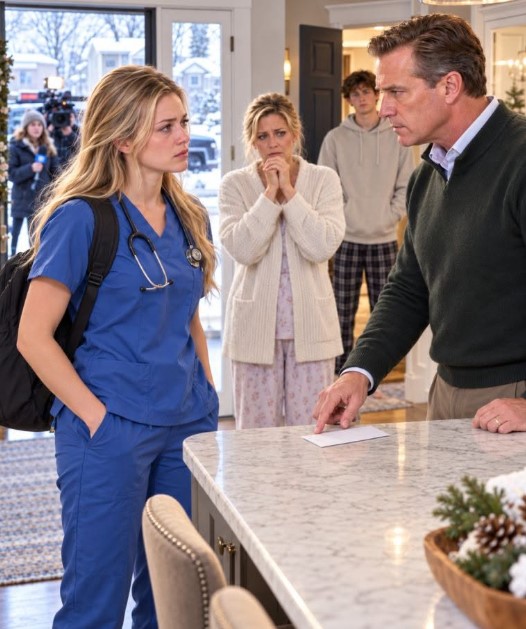
Around the island, Mom adjusted her robe while Tyler hovered in the doorway, hands pocketed. Dad dictated his version.
TrackPregnancy
“Here’s what happened. The lock froze in the storm. You didn’t want to wake the whole house, so you chose to wait in the car until morning. You’re going to go out there, thank them for the attention, and talk about the man. That’s it. Nothing else.”
Mom touched my wrist across the counter.
“Please, honey. Your father has parents at that school. You know how people are. They’ll twist it into something it wasn’t.”
Dad slid an index card across the counter. His three numbered lines used the same blue handwriting as the storm-door note. I should thank the Brandts and Channel 7, blame a frozen lock and my reluctance to wake anyone, and express relief about Walt.
I recognized his blue detention-slip pen. He’d written my script while I slept, before the crew arrived.
“The lock didn’t freeze,” I said. “The chain was on.”
His voice fell to the quiet warning tone I remembered from childhood.
“Let me be very clear. The car you slept in last night is in my name. The roof you’re standing under is mine. Think hard about what you want to keep.”
He reached once more for his brother’s death as justification.
“I have stood at the grave of a 19-year-old who had no rules. You don’t get to make me the villain for keeping you safe.”
GetWriting Tools
I looked toward Mom, who wouldn’t lift her eyes from the countertop. Outside, the television tripod stood in the snow.
“I need 5 minutes,” I said, and headed upstairs with my phone.
I called Dana. She picked up immediately and apologized before I said anything. Still furious in the ICU waiting room, she’d posted about the rescue at ten to seven that morning. After expressing gratitude, she’d described the curfew, the chain, and the twelve-below temperature. When the television station contacted her, she provided our street.
“I should have asked you first,” she said. “I know that. I’m sorry.”
I closed my eyes.
“You didn’t say anything that wasn’t true,” I told her. “But from here on, I decide what I say about my own life.”
She paused to consider that.
Discover more
Find Divorce Help
Get Marriage Tips
Track Pregnancy
“Yes, ma’am. That’s fair.”
Her voice softened as she shared another update.
“Dad’s awake for real. They’re moving him downstairs this afternoon. He wants to see you.”
After our call, I sat on my bed looking at the coat she’d returned overnight. A woman I’d barely met had left intensive care and driven across town at two in the morning to protect me from the cold. Mom, only thirty feet away, had merely advised me to run the engine.
TrackPregnancy
Dad’s prepared lie would have relieved everyone in the household by lunchtime: the lock froze, and I decided to wait. I’d told similar convenient stories for him throughout my life. But the lie I’d sent Dana overnight still felt heavy inside me.
I put on the coat and walked downstairs. Dad waited at the bottom.
“Well?”
I pulled the zipper to my chin.
“I’m going to talk about Walt,” I said, and passed him toward the entrance.
I could sense him behind me, but with a camera crew only thirty feet away, he didn’t try to stop me.
The freezing air struck my cheeks. Somehow it felt refreshingly clean.
Nina approached me halfway along the driveway, removed her glove, and shook my hand. Close up, she looked about thirty, with exhausted eyes and snow caught in her eyelashes.
“Thank you for coming out,” she said. “We’ll keep it short. Just tell me what happened on County 75.”
I described the buried hazard lights and why I’d called 911 before climbing down: a rescuer who gets injured simply creates a second emergency. I explained Walt’s damaged wrist and his laughter when he recalled plowing that very road. I also offered advice for anyone stranded in a snowstorm: remain with the vehicle and keep its tailpipe clear, because exhaust fumes can kill even before the cold does.
Then I mentioned what mattered most to me.
“Three of our night nurses drove through that storm last night to get to work. Nobody’s putting them on the news. They should be.”
The cameraman smiled for the first time.
Nina lowered her microphone slightly and looked directly at me.
“Dana Brandt says you were locked out of the house last night over a 10:00 curfew and that you slept in your car. Is that true?”
The storm door creaked behind me. Dad stood on the porch with crossed arms, his school fleece zipped up. Mom watched through the glass. Gloria still held her shovel across the driveway.
TrackPregnancy
For two seconds, I looked at Dad. He gave a barely perceptible nod like the one he used to give me from the basketball bleachers before a free throw. I knew what it meant: repeat the prepared lines.
I turned to Nina.
“Yes,” I said. “I got home at 10 after 12, and the chain was on. I’m not going to talk about my family on television. I’d rather talk about Walt.”
My voice remained even, like the voice I used when handing over a patient. I didn’t elaborate. There was no need. Nina accepted my answer without pressing further, and I remained grateful for that restraint.