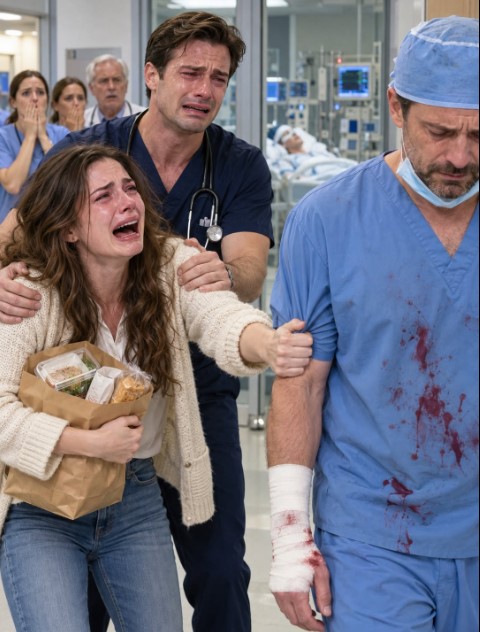
I went to Saint Ambrose Memorial Hospital in Indianapolis to surprise my husband with lunch after another week of missed dinners and unanswered texts. Instead of finding him resting between rounds, his closest colleague looked at me with tears gathering in his eyes and whispered a question that made my world stop spinning.
“He hasn’t told you anything, has he?” Luke murmured, his voice breaking under the weight of a secret he had carried for far too long. In that singular moment, every late shift, every cold plate on our stove, and every exhausted silence from the past eleven months suddenly took on a terrifying new meaning.Wyatt and I had been married for eleven years. For more than a decade, I had quietly shared my husband with the demands of that busy Midwestern hospital. He was one of the finest pediatric thoracic surgeons in Indiana, and I had always been endlessly proud of his calling. I knew his work mattered deeply to families in their darkest hours, and I knew children were alive because of the precision of his hands.
Over the past year, though, our life together had slowly fractured into lonely routines. I had started wrapping his dinner in foil before I even sat down to eat with our daughter. He missed Thanksgiving dinner with my family, leaving an empty chair at the head of the table. He missed our eleventh anniversary dinner, stranding me in an Italian booth with a melting candle.He even missed our daughter Maisie’s eighth birthday party, which shattered my heart more than any missed anniversary ever could. Sometimes he did not come home at all, leaving me staring at an untouched pillow while the radiator hissed against the chill.
“We are hopelessly short-staffed today, Nora,” he would always say through the static of a hurried phone call. “Please do not stay awake waiting for me tonight.”I believed him every single time because trusting him had always been my second nature. Whenever he finally crawled into our bed in the dark hours before sunrise, he looked so utterly drained that I swallowed every complaint before it reached my lips.
One night, I woke around three in the morning to find him sitting on the edge of the mattress with his head in his hands. His shoulders were trembling violently in the dim moonlight that filtered through our bedroom blinds.
“Wyatt, what is wrong?” I asked softly as I reached out to touch his back.
He flinched, quickly wiped his wet face with his forearm, and forced a weary smile that never touched his eyes. “Just a rough case in the operating room, Nora. Go back to sleep, sweetheart.”I should have pressed him right then, but I simply reached for his hand to comfort him. He pulled his fingers away with unusual gentleness and stood up to pace by the window.
On that bright Tuesday morning, after watching him head down our driveway with his hospital badge clipped to his breast pocket, I decided I would no longer let him drift away into his work. I spent an hour preparing his favorite meal to remind him that someone was waiting for him at home.
I packed a roast beef sandwich on fresh sourdough bread, a bag of sea salt kettle chips, and a thick slice of warm peach pie from the bakery down our street. Before sealing the brown paper bag, I tucked a handwritten note underneath the plastic fork.
“You do not have to carry everyone alone anymore. Let me have a turn taking care of you.”I drove across Indianapolis with the windows down, feeling hopeful for the first time in months as I imagined the surprise on his face when I walked into the surgical breakroom. Yet the moment I stepped through the sliding glass doors of Saint Ambrose, an unnatural chill settled deep in my chest.
At the main nursing station, an administrator named Beth, whom I had known for nearly a decade, looked up from her computer monitors. Her warm greeting died instantly on her lips, and her eyes widened in obvious alarm.
“Good morning, Beth,” I said cheerfully as I lifted the paper bag. “Is Wyatt around somewhere? Please do not warn him over the intercom, or he will lecture me about wasting my lunch break on him.”
Beth looked immediately at the charge nurse beside her, but neither woman offered a word in response. The heavy silence that hung over the desk made my cheerful smile wither away into confusion.
“Did something happen during his morning schedule?” I asked, taking a nervous step closer to the high counter. “Can someone please tell me where my husband is?”
That was when Luke Palmer appeared from the double doors leading to the elevators. Luke was Wyatt’s closest colleague and the godfather to our daughter, a man who had stood beside us at our wedding and shared countless weekend cookouts in our backyard.
He walked toward me with dragging, hesitant footsteps that felt completely wrong for a surgeon known for his confident stride. His face was entirely devoid of color, and the skin beneath his eyes looked bruised with fatigue.
“Luke, I am so relieved to see you,” I said, trying to steady my racing pulse as I raised the paper lunch bag. “Could you tell me where Wyatt is hiding today?”
Luke stopped right in front of me, staring down at the humble brown bag before lifting his gaze to meet mine. Without any warning, his eyes welled with tears, and his jaw worked silently as he struggled to find his voice.
“Luke, what is going on here?” I asked in a rising panic.
He glanced around the wide corridor, seemingly searching for any other person who could spare him the task of speaking. When he looked back at me, his eyes were full of a sorrow that made my knees begin to tremble.
“He hasn’t told you anything, has he?” Luke whispered.
The paper bag slipped an inch in my numb fingers as the blood rushed loudly through my ears. “Told me what, Luke?”
Luke pressed his lips together into a tight, miserable line. Behind him, Beth lowered her gaze to her desk, unable to watch the scene unfolding between us.
In that quiet corridor, I realized with absolute certainty that every medical professional standing around me possessed a devastating truth about my husband. Whatever Luke was about to say was going to carve my life cleanly into two halves: the naive world I lived in five minutes ago, and whatever terrifying reality waited on the other side.
“Luke,” I said, my voice hardening to keep from collapsing on the floor, “take me to my husband right now.”
He drew in a slow, ragged breath and reached out to grasp my forearm with a trembling hand.Luke’s fingers were warm against my sleeve, but the fierce tremor running through them frightened me more than any words could have. Over the past decade, I had known Luke as an unshakeable rock who remained calm through the most horrific pediatric traumas.
Now, this seasoned doctor could barely steady his own hands while holding onto my coat. “Please do not make a scene out of this out here in the open hallway, Nora. Come with me right now.”
“Just tell me what is happening right this second, Luke,” I demanded, digging my heels into the polished floor.
“I will explain every single detail, Nora, but we cannot do it standing in front of the entire floor,” he pleaded softly.
He guided me past the main desk, where Beth pressed her trembling fingertips against her mouth while tears spilled freely down her cheeks. We turned down a quiet, carpeted corridor on the surgical administrative wing that I had never walked before.
At the very end of the hall, there was a heavy walnut door bearing a small brass sign that read PRIVATE CONSULTATION ROOM. I froze in my tracks the instant I recognized the purpose of that quiet space.
Every hospital maintains one of those rooms, tucked away from the bustling wards so doctors can deliver catastrophic news behind closed doors. Wyatt had described those exact rooms to me during our early years of marriage, calling that short hallway the most agonizing walk any human being could ever take.
“No, I am not going in there,” I said, yanking my arm backward with all the strength I had left.
Luke stopped and turned to face me with a pleading expression. “Nora, please sit down inside with me.”
“Do not you dare push me into that room, Luke Palmer,” I shouted, my voice bouncing sharply off the quiet walls. “Is Wyatt dead? Tell me the truth right now, is he dead?”
“No, Nora, absolutely not,” Luke replied instantly, seizing both of my shoulders to hold me steady. “Listen to the words coming out of my mouth right now. Wyatt is alive.”
The sudden rush of relief made my limbs turn to water, and Luke had to catch my weight as he guided me through the doorway. He eased me down into a soft armchair while the paper lunch bag remained clutched tightly in my cold fingers.
Luke pulled another chair directly across from me and rubbed his face with both hands, looking more haggard than I had ever seen him. “He is alive, but right now, at this exact moment, he is on the fourth floor inside an operating theater.”
“Well, of course he is in an operating theater,” I said, letting out a wild, breathless laugh. “He is a surgeon, Luke, so that is precisely where he spends twelve hours of every single day.”
Luke slowly shook his head, his eyes darkening with unspeakable sorrow. “He is not holding the instruments today, Nora. He is the patient lying on the table.”
A deafening silence fell over the small room, accompanied by a high-pitched ringing that seemed to drown out all surrounding air. “I do not understand what you are trying to say to me.”
“I know this makes no sense to you yet, but I need you to listen very carefully to me,” Luke whispered.
“He kissed our daughter Maisie goodbye on the porch at seven this morning,” I insisted, pointing an accusing finger at him. “He told me he had an exhausting day scheduled and begged me not to wait up for dinner.”
“I know what he said to you, Nora, because he spent all of yesterday rehearsing those exact lies,” Luke murmured.
“He said it was just a long day,” I repeated, my voice splintering into high, jagged pieces.
Luke leaned forward until his elbows rested on his knees, leaning into my space to keep me focused on his voice. “Almost a year ago, back in late November, Wyatt began noticing an intermittent tremor in his right hand whenever he worked long hours.”
“He told me he was drinking too much espresso and needed more sleep,” I whispered, remembering the empty mugs piled in the sink.
“That was what he told himself at first, too,” Luke explained with a heavy sigh. “Then, during a routine valve reconstruction, his right hand locked up completely for five long seconds while we were in the middle of the field.”
I stared at him in horror as the room seemed to tilt beneath my chair. “What happened to the patient?”
“I was standing right across the table from him, so he calmly passed the forceps to me and told me to finish the closure,” Luke said quietly. “Nobody else in the room realized anything had gone wrong, but after he scrubbed out, I found him sitting alone in the dark basement stairwell for two hours.”
I closed my eyes, trying to picture my proud, brilliant husband hiding in a concrete stairwell like a frightened child. This was the man who had practiced tying surgical knots with waxed dental floss at our kitchen table while I boiled pasta when we were newlyweds.
“I practically dragged him down to the radiology department myself the next morning,” Luke continued. “The imaging revealed a large meningioma pressing against the motor cortex that controls the right side of his body.”
“A brain tumor,” I breathed, the word tasting like ash on my tongue.
“It is a meningioma, which means it is almost certainly benign, and that is the hope you need to cling to right now,” Luke said, reaching to touch my knee. “The problem was never cancer, Nora. The problem is its precise location next to critical motor pathways, and we knew it would eventually trigger major seizures.”
“Eventually?” I asked, looking straight into his eyes.
Luke dropped his head, unable to maintain eye contact for a long, agonizing beat. “It has already been triggering them for months.”
I shot up from the chair so violently that the lunch bag tumbled to the carpet, sending the plastic fork skittering across the floor. “He hid a brain tumor from me for eleven months?”
“Nora, please understand the impossible corner he thought he was backed into,” Luke pleaded, rising with his hands raised.
“Do not you dare defend him to me right now,” I screamed, pacing the narrow confines of the room like a trapped animal. “He slept in our bed, ate the meals I cooked, and let me believe he was just growing distant from his family!”
Luke stood frozen against the wall as my rage poured out of me. “I spent months wondering if he had fallen out of love with me, Luke! I sat alone at night wondering if he regretted marrying me, and I even checked his phone once because I thought he was seeing someone else!”
“He loved you more than his own life, Nora, and that was the tragic root of the entire problem,” Luke said, his voice cracking with emotion.
“You knew about this,” I said, wheeling around to glare at him with absolute fury. “The nurses at the front desk knew, his entire department knew, and I was left living in a complete fantasy.”
“Only four of us on the executive committee were informed because hospital protocol required his immediate removal from active surgical duty,” Luke said. “He begged us on his knees not to contact you, Nora. Janet argued with him until she wept, and his own neurosurgeon threatened to call you herself, but he refused to yield.”
“Why would he do something so cruel to the woman he swore to cherish?” I sobbed, collapsing back into the chair as the tears finally overtook my anger.
Luke knelt down in front of me so we were at eye level. “Wyatt told me that you had spent eleven years carrying the emotional burden of this household all by yourself while he worked eighty-hour weeks. He looked me dead in the eye and said, ‘Nora has shouldered everything for our family for a decade, and I will not drop this nightmare onto her shoulders until the day they open my skull.’”
“That was not his choice to make for our marriage,” I wept, pressing the heels of my hands against my burning eyes.
“I told him that exact same thing every single week, Nora,” Luke replied with a gentle sigh. “I told him he was being reckless, stubborn, and deeply unfair to the woman who loved him.”
He paused to let me catch my breath before continuing with the agonizing timeline of the past year. “After we pulled him from the operating schedule, he refused to take medical leave because he could not stomach the idea of sitting at home pretending everything was normal.”
“So where was he going every day?” I asked, wiping my wet cheeks.
“He took on every miserable administrative task in the building,” Luke explained. “He reviewed charts, mentored junior residents, handled difficult family consultations, and covered overnight call lines so younger surgeons could go home to their children.”
“What happened on Thanksgiving?” I whispered, remembering the untouched plate of turkey sitting on our dining table while my mother shook her head in disapproval.
“He suffered a focal seizure right in the middle of the doctors’ lounge that afternoon,” Luke confessed softly. “We admitted him under an assumed name on the fourth floor for twenty-four hours of observation.”
“And our anniversary dinner at the bistro?” I asked, feeling a fresh wave of grief wash over me.
Luke hesitated, running a hand through his hair. “That morning, Dr. Helen Vance told him the mass was growing more rapidly than expected and was beginning to compromise major blood vessels. She scheduled the craniotomy for today, and warned him that the surgery carried immense risks to his motor function.”
“What kind of risks are we talking about, Luke?” I demanded, grasping his wrist tightly.
“There was a significant chance he might lose the use of his right arm permanently, or suffer severe speech deficits,” Luke admitted, his voice dropping to a whisper. “And with any complex cranial procedure, there is always the rare risk that a patient never wakes up from the anesthesia.”
I covered my mouth with both hands, remembering how Wyatt’s voice had trembled when he called me from the hospital parking lot on our anniversary to claim an emergency bypass had come in. I had spent that evening weeping in a restaurant booth, assuming he was feeling guilty about neglecting our marriage, completely unaware that he had just received his own medical sentence.
“And Maisie’s eighth birthday?” I asked, dreading the answer I already knew was coming.
Luke looked down at the carpet, his chest heaving with a deep, sorrowful breath. “That was the worst episode he experienced. He was walking to his car in the south garage with a brass telescope he had bought for her, and a generalized seizure hit him before he could unlock the door.”
“Oh God, Wyatt,” I gasped, clutching my stomach as nausea swept through me.
“Security found him slumped against his steering wheel with a severe concussion,” Luke said. “Dr. Vance suspended his driving privileges on the spot and forbade him from spending nights alone.”
“But he left our house in his car every single morning, Luke,” I said, shaking my head in sheer disbelief.
“He would drive two blocks away, park on a side street, and take a rideshare the rest of the way to the hospital,” Luke revealed. “And on the nights he told you he was working continuous trauma shifts, he was sleeping right here in the third-floor call room so nurses could monitor him every hour.”
“He slept in a call room because he did not want to frighten our daughter,” I whispered, the realization hitting me like a physical blow.
“He told me he would rather die alone in an on-call bunk than have Maisie walk into your master bedroom and see her father convulsing on the carpet,” Luke said, wiping a stray tear from his cheek.
Before I could answer, the door swung open, and Beth entered carrying two steaming paper cups of black coffee. She set one down on the small table next to me and pulled a rolling stool close to my chair.
“How are you holding up, Nora?” Beth asked gently, before quickly waving her hand to dismiss her own words. “I am sorry, that is the most foolish question I could possibly ask you right now.”
“How much longer will they be inside his skull, Beth?” I asked, ignoring the hot coffee entirely.
“Dr. Helen Vance started the initial incision just after eight this morning,” Beth answered, squeezing my cold fingers between her warm hands. “She is the finest neurosurgeon in the entire state of Indiana, Nora, and Wyatt personally trusted her with this procedure. These intricate tumor resections routinely take six to eight hours, so the long duration is completely expected.”
I glanced up at the plain wall clock ticking mercilessly above the door. It was already twelve-thirty in the afternoon, meaning my husband had been lying under surgical lights for over four hours while I had been singing along to the car radio with a lunch bag on my passenger seat.
“I need to call my mother immediately,” I said, fumbling through my handbag for my phone. “Maisie gets dismissed from elementary school at three, and someone has to shield her from this.”
“Would you prefer that we step outside to give you privacy?” Luke offered, already starting to stand up.
“No, please stay right where you are,” I pleaded, my fingers shaking so violently that I dialed the wrong number twice before reaching my parents’ home.
My mother answered on the second ring, her voice crisp and hurried. “Hello, Nora, I was just heading out to run some errands before picking up Maisie.”
“Mom,” I choked out, and the single syllable was enough to convey the complete ruin of my composure.
There was a sudden, sharp silence on the line before my mother spoke with sudden urgency. “Nora, where are you right now?”
“I am at Saint Ambrose, Mom,” I wept, gripping the phone against my ear. “It is Wyatt. He has been hiding a brain tumor from us for almost a year, and he is undergoing major surgery on the fourth floor right this second.”
I heard my mother gasp sharply, followed by the clatter of her car keys dropping onto her kitchen counter. “Dear Lord in heaven. What can I do for you right now, darling?”