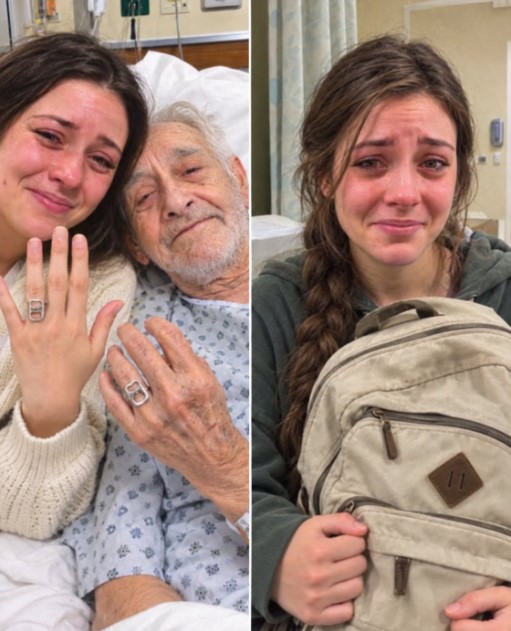
I married a dying stranger so he would not have to leave this world by himself. For seven days, I answered to the title of his wife while sitting beside his bed. Then his probate attorney handed me an old olive green rucksack and whispered that my late husband wanted me to uncover the full truth. I prepared myself for buried fortunes, hidden relatives, or ugly family secrets. Instead, the pack carried only quiet places written on scraps of paper.
The first envelope bore the words Bus Stop in neat blue ink. There was no date marked anywhere on the front, nor was there any long explanation to ease my confusion. Those two simple words sat quietly across the thick cream envelope inside the worn bag. The lawyer placed the parcel directly onto my lap less than an hour after the monitors in the room went silent.“Hannah, you should know that Walter was not simply the man you saw in these corridors,” the attorney said quietly as he stepped toward the door.
I glanced back toward the metal frame where the clean sheets were already being stripped away. The pillow still retained the shallow hollow where his tired head had rested only minutes earlier. His lukewarm chamomile tea sat untouched on the mobile plastic tray beside the window. Around my fourth finger, the silver pull tab from an ordinary soda can felt featherlight yet bound me like forged iron“What kind of truth could he possibly hide from me?” I asked while turning the metal tab with my thumb.
“Walter insisted you would grasp everything much better if you examined his belongings without an audience,” the lawyer replied as he bowed his head politely. Then he slipped into the busy hallway without another word, moving as quietly as my late husband always used to move. Walter never forced open any heavy doorway when he could leave the lock turned and invite you to step through on your own schedule.I pulled open the brass zipper with fingers that would not stop trembling against the canvas. There were no stacks of hundred dollar bills or velvet jewelry boxes waiting inside. No legal contracts appeared that would turn me into an heiress or burden me with debts. Only thick paper packets filled the interior, and each one displayed the name of an ordinary public space.
Bus Stop rested against Corner Diner, which leaned right into Regional Airport. Beneath them lay Coin Laundromat, Shaded Park, Emergency Waiting Room, and Little Memorial Chapel. At the very bottom of the bag sat a battered spiral notebook with frayed black corners, but I could not bring myself to open that cover yet. The labeled packets disturbed me far more because they felt like whispers from a life I had never shared.
I lifted Bus Stop first and broke the wax seal with my thumbnail. A faded commuter train stub fell into my palm, soft from decades of handling. On the reverse side, Walter had penned a single sentence stating that she finally decided to go. I stared at the faint letters until the ink began to swim before my tired eyes.
“Who went away, Walter?” I whispered to the empty room as the linoleum floor hummed beneath my shoes.I reached back into the pack and pulled out Corner Diner without pausing to catch my breath. Inside rested a faded cashier receipt recording two bowls of chicken noodle soup and a loaf of fresh sourdough bread. Across the printed total, he had written that she accepted the warm soup at last.
I opened Shaded Park next, letting the paper flap drop onto my knee. A square snapshot showed Walter sitting beside a silver-haired man in a heavy winter coat, both looking past the camera toward the lake. Walter had noted on the glossy back that the man smiled warmly before he had to catch his bus.
Three more envelopes yielded a child’s green crayon sketch of a dog, a crumpled bakery slip, and a torn paper napkin with a canceled telephone number. None of these scraps formed a clear picture, yet each fragment seemed to carry an invisible weight. Every tiny packet offered a single piece of a puzzle without giving me the border edges to frame it.
By the time my fingers reached Emergency Waiting Room, my hands had grown steady while my chest tightened painfully. Inside was an adhesive visitor badge stamped with a date from almost eleven months earlier. On the adhesive backing, Walter had jotted down that the young woman told him her mother used to laugh as though she was trying hard not to make a sound.
A chill rushed through my blood because those exact words belonged to my own memory. Walter had asked me that very question on the rainy afternoon we first spoke in the lobby. He did not ask how cancer had taken my mother, nor did he inquire how many months I had spent crying in dark rooms. He simply asked what her laughter sounded like when she was truly happy.
“I almost walked away from you that day,” I murmured while smoothing the corner of the badge against my knee.
“That laugh sounds like the sweetest music in the world,” Walter had answered back then after I told him she always tried to hold it in.
I was twenty-nine when our paths crossed, though my soul felt twice that age after losing my home and my mother in the same difficult year. My world had not shattered in an instant of loud fury, but rather it ground to an absolute halt while everyone else kept rushing forward. I went to my desk job each morning, paid my electric bills on time, and typed cheerful emojis to friends who did not know what else to say.
Then I signed up to volunteer on the evening shift at Clearwater General Hospital because watching someone drift away alone felt like an unbearable tragedy. I spent hours sitting beside elderly patients whose children resided across the country or could no longer bear the sight of medicine tubes. I learned which corner rooms gathered drafts from the courtyard and which registered nurses hummed vintage tunes while taking vitals.
“People keep calling you an angel for doing this,” Walter remarked to me one evening while leaning against the nurses’ counter.
“They do not realize I am only hiding where grief is ordinary,” I confessed as I offered him a cup of hot water.
Walter understood that truth long before I could admit it to myself in the mirror. He was seventy-two years old, with hollow cheeks that showed his illness, warm blue eyes, and that olive rucksack always tucked beside his work boots. He spent his days wandering near the cardiac clinic, chatting near the vending machines, or resting in the quiet pews of the chapel.
He never spoke with the grim tone of someone counting down his final hours on earth. Instead, he watched the people around him with the quiet intensity of an archivist recording precious history.
“Did the cafeteria cashier ever tell you if her nephew passed his plumbing exam?” Walter asked me during my third week on the floor.
“I never thought to ask her,” I admitted while setting down a fresh stack of magazines.
“He took the test on Tuesday morning,” Walter replied with a gentle nod.
“How do you manage to catch every tiny detail in this massive building?” I asked him with a soft laugh.
“People talk when they realize somebody is actually listening to the answer,” Walter said as he adjusted his wool collar.
A young housekeeper named Brenda entered the room a moment later while humming a lively spiritual tune under her breath.
“Good morning, Brenda, are you singing that sweet gospel again?” Walter called out from his chair.
“My grandmother taught me that hymn before she passed, Mr. Walter,” Brenda replied with a bright grin as she tied off the trash liner.
“Her memory is safe with you,” Walter said softly, and the young woman touched his shoulder with deep affection before heading back into the hall.
PART 2
That was the gentle man I thought I knew during those quiet summer evenings. He seemed to be nothing more than an observant, lonely gentleman preparing for the end of his journey. Then came a stormy Thursday afternoon when the rain battered the glass of his private hospice room.
“Hannah, I want you to marry me before my time runs out,” Walter whispered from beneath his woolen quilt.
I froze where I stood near the sink, the plastic cup of fresh ice chips shaking in my grasp.
“Walter, you cannot be serious about this,” I stammered as I set the cup onto his nightstand.
“I have never spoken a more serious sentence in my seventy-two years,” he answered while looking directly into my eyes.
“You are gravely sick, and we have only shared casual conversations in hospital corridors,” I argued gently.
“I know all that I need to know about your spirit,” he replied without wavering.
“A few conversations are hardly enough foundation for holy matrimony,” I countered while trying to keep my voice steady.
“It is more than enough to see that you are someone who stays when others turn away,” Walter said softly. “My final prayer is to leave this world as a loving husband rather than an anonymous medical chart in an archive.”
Two mornings later, an ordained minister joined our hands right there between the monitors and the oxygen tanks. I wore an oversized amber cardigan because Walter insisted bright colors chased away the sterile sadness of the room. He wore his favorite brown buttoned sweater, even though the bottom horn button had been missing for years.
“Are you entirely certain about taking this step, young lady?” the floor nurse asked me in the corridor while holding the legal registry.
“My mind cannot explain it, but my heart knows this is the right place for me,” I answered without hesitation.