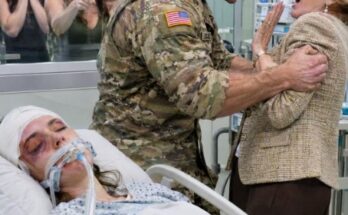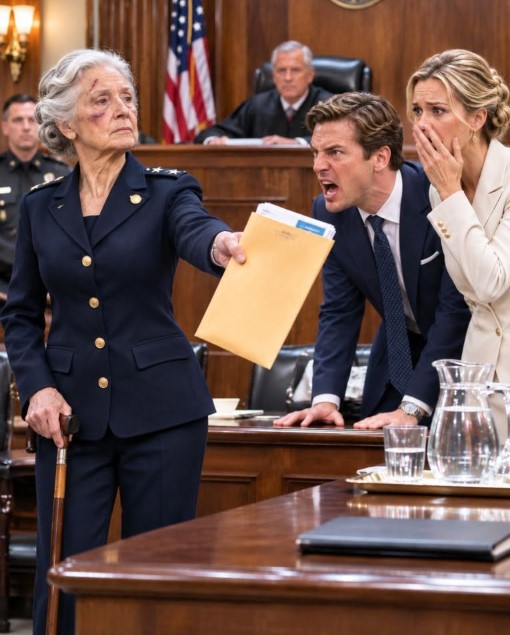
My grasping son laughed as I entered court with a cane, bruised and swollen from his and his wife’s attacks. “She looks even worse than I thought,” Daniel whispered, certain I looked incapable of managing my own affairs. He had overlooked one critical fact. Before widowhood at seventy-one, I spent thirty-six years in the U.S. Army, retiring a two-star general.
My name is Eleanor Vance.
That morning I wore a plain navy coat, carrying no purse or briefcase and accompanied by no attorney. My wrist remained swollen, my eyebrow cut was healing, and bruises darkened my shoulder.
That was Daniel’s intended image.
Weak.
Confused.
Defenseless.
In his petition for emergency guardianship, Daniel claimed I had experienced serious cognitive decline after my husband Robert died. He accused me of wandering disoriented through my house, forgetting conversations, mishandling money, and falling repeatedly.He supplied photographs as well.
One fact undermined it all.
I knew exactly where each injury came from.
Vanessa had twisted my wrist while trying to press my hand against documents granting Daniel access to an investment account. Daniel had pushed me into a hallway wall after I refused to surrender my finances.
I cut my eyebrow trying to stop them removing paperwork from Robert’s study.
Each time, they offered our neighbors the same excuse.
“Mom had another fall.”
Vanessa then began manufacturing a written record—dates, photographs, invented episodes of disorientation, and notes listing things I allegedly forgot.
She had no intention of caring for me.She was building my confinement.
Three weeks ahead of the hearing, they changed the locks on the home Robert and I built forty years earlier.
I stood in the freezing rain as my son observed from inside.
At 12:17 that night, Daniel sent me a text.
Quit making this so difficult.
I saved that message.
Daniel mistook my quietness for surrender.
He was wrong.
Before I became his elderly mother, I had been Major General Eleanor Vance.
TrackPregnancy
Thirty-six years in uniform had taught me one truth: angry people make noise.
People who are prepared gather evidence.So I did precisely that.
Text messages. Banking records. Medical reports. Photographs. Copies of the paperwork they had tried to force me to sign. Proof that the locks were changed.
Efalsehood.
Einconsistency.
And then I waited.
In the courtroom, Daniel’s attorney rose and declared, “Mrs. Vance’s condition makes immediate intervention necessary.”
FindLegal Help
Daniel bowed his head.
I saw his shoulders shake with suppressed laughter.
Judge Adrian Mercer then opened the file.
His expression altered.
“Eleanor Vance?”
“Yes, Your Honor.”
He studied me.
“Major General Eleanor Vance?”
Silence overtook the courtroom.
FindLegal Help
Daniel stopped smiling.
“United States Army?”
“Yes, Your Honor.”
The judge eased back in his chair.
“I recognize your name.”
He turned next to the photographs of my injuries.
“Your son says these injuries came from repeated falls. Is that correct?”
I turned my eyes toward Daniel.
“No, Your Honor.”
His attorney immediately rose, but the judge lifted one hand.
FindLegal Help
“Sit down.”
I reached inside my coat.
Daniel stared wide-eyed.
I produced a thick sealed envelope.
“Inside are medical records, messages, financial documents, photographs, and copies of paperwork my son and daughter-in-law attempted to make me sign.”
Vanessa went pale.
“My injuries are genuine, Your Honor,” I told him. “My supposed confusion is not.”
The judge examined me.
FindLegal Help
“And these bruises?”
I turned toward Daniel.
“The very people asking this court to protect me from myself are the people I allege inflicted them.”
Daniel shot to his feet.
“She’s lying!”
“Sit down, Mr. Vance.”
The judge unsealed the envelope.
FindLegal Help
The room quieted.
For the first time, my son no longer saw a defenseless widow with a cane.
He was remembering Major General Eleanor Vance.
Two stars.
Thirty-six years in uniform.
A lifetime learning that appearing vulnerable and lacking power weren’t the same.
Daniel came to court convinced he would gain control over my life.
Instead, he handed me what I needed.
A courtroom.
FindLegal Help
An official record.
And a judge prepared to hear the truth.
PART 2
Judge Mercer remained silent for nearly four minutes.
I counted the seconds. An old habit. In a briefing, silence often reveals more than speech. It exposes the anxious, the calculating, and those who know the answer but await permission to speak.
Daniel’s attorney, a polished attorney named Grant Holloway, clicked his pen repeatedly. Vanessa remained motionless, trying to appear composed. Daniel stared at the table.
The judge reviewed each page deliberately.
FindLegal Help
First came St. Luke’s urgent-care report, dated the night of my wrist injury. I had taken a taxi there alone at two a.m. A young nurse, Teresa, wrote down my account: Patient states injury was caused by a family member. She offered to contact police. I refused because I wasn’t ready, not because I was afraid. Premature reports can disappear. A complete case gets heard.
The texts followed. Quit making this so difficult. A bank letter confirming a transfer request from my investment account was denied over a mismatched signature. The locksmith’s receipt with Daniel’s name on it.
At last, Judge Mercer extracted one page from the petition.
FindLegal Help
“Mr. Holloway, your petition includes a letter from a Dr. Philip Ashford. He states that he personally evaluated Mrs. Vance on September fourteenth and found ‘significant cognitive impairment consistent with early-stage dementia.’” He looked at me. “Mrs. Vance, did you see Dr. Ashford on September fourteenth?”
“I have never met Dr. Ashford in my life, Your Honor.”
“Do you recall where you were that day?”
“Annapolis. I gave a ninety-minute lecture on leadership under pressure to two hundred midshipmen at the Naval Academy. It was recorded. The Academy will provide a copy if the court requests it.”
FindLegal Help
Holloway stopped clicking his pen.
Vanessa turned her head, slightly, toward Daniel. It was her first visible sign of unease then.
Judge Mercer laid the letter aside as if touching it might leave a stain.
“Mr. Holloway, I’m going to give you one opportunity. Do you wish to proceed with this petition?”
Holloway bent to confer quietly with his clients. Daniel shook his head. Vanessa’s lips moved fast and sharp. Eventually Holloway rose upright.
“Your Honor, my clients request to withdraw the petition without prejudice.”
“Request denied,” the judge said. “This court is not going to let you walk away and refile when it’s convenient. The petition for emergency guardianship is dismissed. The court finds no credible evidence of incapacity. Mrs. Vance is to have full and immediate access to her residence. Mr. and Mrs. Vance will surrender all keys within twenty-four hours. I’m issuing a temporary protective order, and this file is being referred to the State’s Attorney and to Adult Protective Services. The letter from Dr. Ashford will be forwarded to the Board of Physicians.”
FindLegal Help
He paused.
“Mr. Holloway, I’d suggest your clients find a criminal defense attorney. Today.”
Daniel released a sound I remembered from his boyhood, a small, broken exhale, like the air going out of something.
While the courtroom emptied, Judge Mercer looked down at me once more.
“General, I heard you speak at the Army War College in 2009. I was a reservist then. You said the hardest battles are the ones we fight against people we love.” He paused. “I didn’t understand it at the time.”
“Neither did I, Your Honor,” I said. “Not really. Not until now.”
Outside, the hall smelled of floor polish and scorched coffee.
“Mom. Mom, wait.”
TrackPregnancy
Daniel caught me at the fountain, looking older than forty-four. I noticed unfamiliar gray at his temples, and familiar shadows beneath his eyes. As a teen, sleepless worries he refused to discuss had left the same shadows.
“It’s not what you think,” he said. “It got out of hand. I never meant—”
“Daniel.” Vanessa’s voice sliced across the hallway. She took his arm, her nails pressing into his sleeve. Then she eyed me, and her performance as a caring daughter-in-law vanished.
“This isn’t over, Eleanor,” she said quietly. “Judges change. Juries listen to tears. And you’re a seventy-one-year-old woman who lives alone.”
She walked away, pulling my son with her.
I refused to watch them leave. I walked to the elevator, where a tall woman in a charcoal suit was waiting with a leather folder tucked under her arm.
Colonel Lydia Okafor, U.S. Army JAG Corps, retired. She served as my legal adviser in Kandahar. She had also been seated in the courtroom’s back row throughout.
ConsultLawyers
“You could have let me speak for you,” she said.
“I needed them to see me stand alone,” I said. “You’re for what comes next.”
Lydia didn’t smile. That unsettled me. Lydia always smiled when we won.
“Then you need to see this,” she said, opening the folder. “The bank compliance office called me an hour ago. There’s a second account, Eleanor. A money market account opened in your name, with Robert listed as joint holder.”
“Robert and I never had a money market account.”
“I know.” She pointed to the date. “It was opened the same week Robert entered hospice. His signature is on the application.”
My throat constricted. In his final weeks, Robert could barely grip a spoon, much less a pen.
Lydia closed the folder.
“Someone has been pretending to be both of you,” she said, “for a very long time.”
PART 3
Sheriff’s deputy Carl Briggs followed my car home. A locksmith was waiting in the driveway, the third one I had spoken to that month, the only one not to demand my son’s permission.
Restoring the locks took eleven minutes.
Robert and I lived there for forty years. I reclaimed it in eleven minutes.
“You want me to walk through with you, ma’am?” Deputy Briggs asked.
“Yes,” I said. “I would.”
I had entered villages following firefights. I had entered field hospitals where young men were asking for their mothers. Yet entering my own living room overwhelmed me.
TrackPregnancy
The furniture was rearranged; my reading chair had been replaced by an unwanted gray sectional. Our mantel held a framed Live, Laugh, Love print instead of family photos.
I nearly laughed, but not quite.
Robert’s study was worse.
Drawers gaped, files covered the floor, and books stood in crooked stacks with broken spines, as if shaken for hidden contents. The open closet safe was empty; I had removed its contents two months earlier after sensing danger.
“Looks like somebody was searching for something,” Briggs said.
“Yes,” I said. “And they didn’t find it.”
I couldn’t be certain yet. But then I saw the flag case.
The triangular oak case containing Robert’s burial flag still stood untouched on the top shelf. Before teaching history in high school, Robert spent six years in the Navy. He dismissed his six years against my thirty-six; I always disagreed.
Vanessa had torn the room apart, but she hadn’t touched the flag.
Some people fear the dead. Others never imagine the dead can still help.
After Deputy Briggs departed, I removed the case and flipped it over. The felt backing was held by four small brass clips. Three were tight. One was bent, as if a fingernail had repeatedly pried it loose.
Behind the felt, taped to the wood, was a small brass key and an index card in Robert’s neat, slanting script.
Ellie — Box 114, Chesapeake Federal. I should have told you sooner. Forgive me for that, if you can. — R.
I sat down on the floor of my husband’s study and held that card for a long while.
At six o’clock, the doorbell rang. My hand went to the phone in my pocket before I peered through the glass.
It was Ruth Callahan from next door, eighty-three years old, carrying a foil-covered casserole.
“Chicken and rice,” she said. “You’ve lost weight. Don’t argue with me.”
I obeyed.
We sat at the kitchen table, the only furniture Vanessa left unchanged, and Ruth watched me eat three bites before speaking.
“I should have called someone,” she said. “I heard things. That night in October, I heard you shout. Then a bang, like something hitting a wall. And the next morning, Vanessa came over with muffins and told me you’d tripped on the hallway runner.” Ruth’s voice wavered. “I knew she was lying. I could see it. And I said, ‘Oh, poor Eleanor,’ and I took the muffins.”
“Ruth, you’re not the one who should apologize.”
“There’s something else.” She folded her hands. “That same night, maybe an hour later, I saw someone sitting on your back porch steps. In the cold. Just sitting there with his phone in his hand, crying like his heart was broken.”
“Who?”
“Your grandson. Tyler.”
I put down my fork.
I hadn’t seen Tyler for nearly five months. After Robert’s funeral, Daniel and Vanessa moved into my home “just to help for a little while,” with Tyler. He once made midnight grilled-cheese sandwiches and asked about Desert Storm, but gradually stopped coming downstairs. When I asked Vanessa about it, she claimed school kept him occupied. I later discovered she had told him that Grandma was “getting confused” and that it upset me to have him around.
Then they put him in his room and locked me out of the house.
Once Ruth had gone, I washed her dish and sat in the dark kitchen hearing the refrigerator buzz.
At 11:48 p.m. my phone vibrated.
Unknown number.
Grandma, it’s Tyler. I have something you need to hear. Please don’t tell Mom I texted you. She checks everything.
TrackPregnancy
PART 4
I selected Bayside Diner because it opened at six, it had a back booth with a clear view of the parking lot, and Vanessa’s acquaintances would never visit a place serving hash browns.
At 6:52, Tyler cycled up wearing an oversized hoodie. At sixteen he was taller than Daniel had been, with Robert’s hands and my chin. He sat opposite me, avoiding eye contact.
“Hi, Grandma.”
“Hello, sweetheart.”
His eyes went to my wrist, then to the cut above my eyebrow. His expression crumpled.
“I’m so sorry,” he whispered.
“You didn’t do this.”
“I didn’t stop it either.”
The waitress came, and I ordered him pancakes and bacon, because I know teenage boys and I know guilt, and syrup makes guilt easier to swallow.
After she went, Tyler took out his phone and set it between us as if it were dangerous.
“The night Dad pushed you,” he said, “I was upstairs. In the guest room. You were all yelling, and Mom kept saying, ‘Just sign it, Eleanor, just sign it.’ And I didn’t know what to do, so I hit record.” He swallowed. “It’s six minutes long.”
TrackPregnancy
He handed me one of his earbuds.
I have listened to recordings of enemy radio traffic. I have listened to the final transmission of a helicopter crew I sent into a mountain pass. I thought I knew the pain of hearing something unforgettable.
I heard my son’s voice saying, “You’re going to sign it, Mom. You’re going to sign it right now.” I heard my own voice say, “No.” Then I heard a sound like a door slamming, which was my body hitting the wall. And after that, clearly, I heard Vanessa say, “Okay. Okay. Get the camera. We say she fell. Make it look like a fall.”
TrackPregnancy
I removed the earbud and placed it down. My hand trembled slightly.
“I should have come downstairs,” Tyler said. His voice cracked. “I was scared. I just sat there.”
I reached over and held his hand.
“Listen to me. You were a child in a house where the adults had stopped acting like adults. Children are not soldiers, Tyler. It was never your job to fight that battle.” I squeezed. “But you did something braver than you know. You kept the truth.”
He dried his face on his sleeve.
“There’s more,” he said. “Mom has been on the phone a lot at night, out on the back deck, when she thinks I’m asleep. Somebody named Phil. Last week, I heard her say, ‘Once she’s in Briarwood, it’s done. Nobody visits those places.’”
Briarwood. I knew the name. A memory care facility three hours west, near the Pennsylvania line. The kind of place with locked doors and beautiful brochures.
Phil.
Dr. Philip Ashford.
“Tyler,” I said carefully, “if I give this recording to the police, they will want to talk to you. You might have to tell a judge what you heard. About your mother. About your father.”
FindLegal Help
He studied his pancakes.
“Dad cried,” he said. “After. He went out to the garage and cried for like an hour. I could hear him through the vent.” He looked up at me with Daniel’s eyes. “He’s not all bad, Grandma. He’s just… he does whatever she says.”
“I know,” I said. “I raised him. I know exactly who he is. And I know who he could be.”
“If I give it to the police, does Dad go to jail?”
I could easily have lied, and he would have believed me.
“Maybe,” I said. “I don’t know. What I do know is this: I am not going to make you choose. This is your recording. You decide.”
He was quiet for a long time. Outside, sunrise reached across the parking lot, turning the windshields gold.
“I want to give it to them,” he said finally. “Because if I don’t, she’ll do it again. To you. Or to somebody else.”
I phoned Elder Abuse Unit detective Sarah Kowalski from our booth. She said she could meet us then.