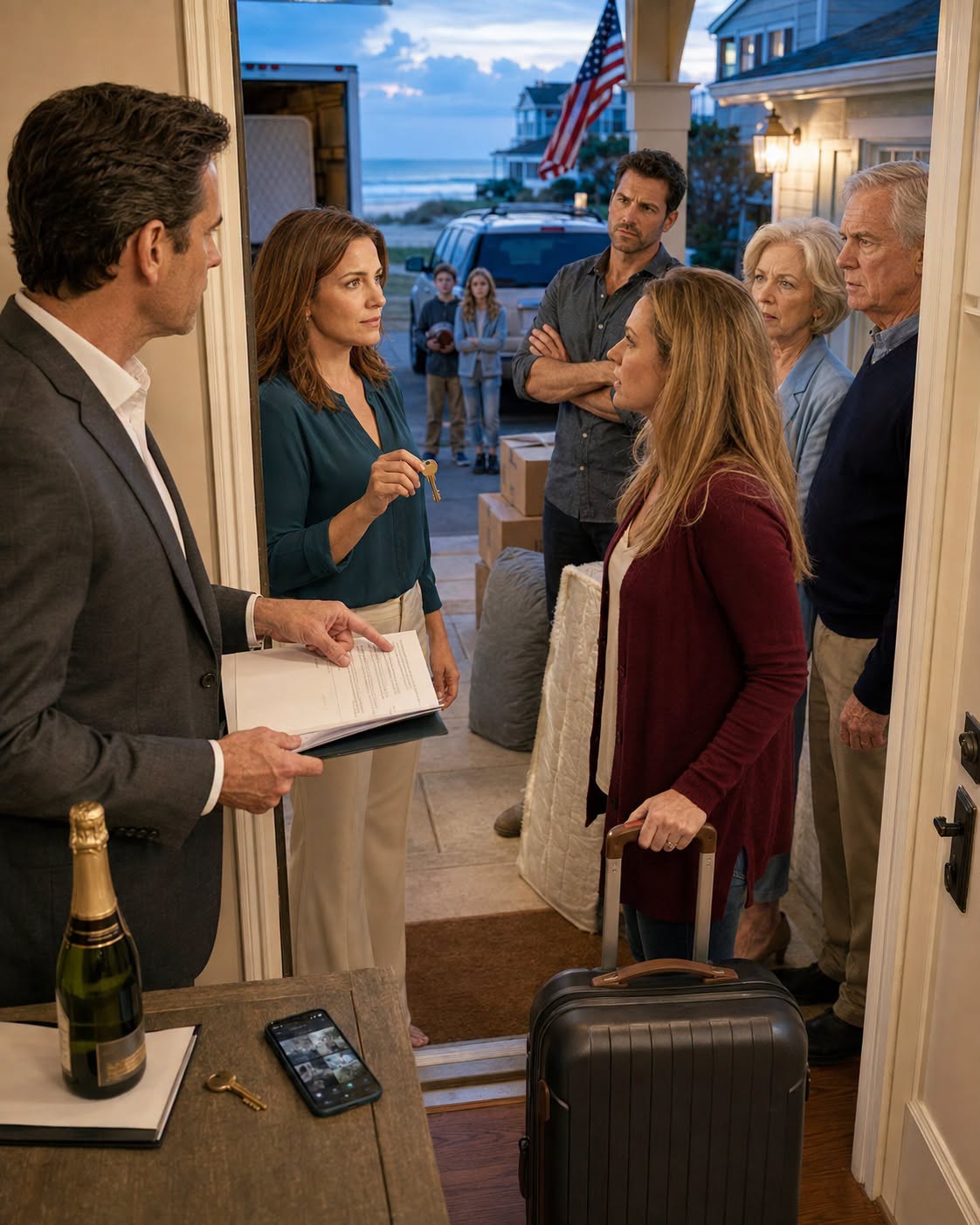
The Beach House They Thought I Had to Give Away
“Pack the master bedroom. Your sister wants it.”
I was standing barefoot on the second-floor balcony of the beach house I had owned for less than twelve hours when my mother said those words.
For a moment, I thought I had misunderstood her.
The ocean was black beyond the dunes, visible only where moonlight touched the waves. Salt air moved through the open balcony doors behind me. Downstairs, half-unpacked boxes were stacked beside a new cream-colored sofa, and the little brass key I had been carrying around all day sat on the kitchen counter beside a bottle of grocery-store champagne.
It was my first night in the house.
My first night in a place I had spent fourteen years working toward.
“Mom,” I said, “what did you just say?”She sounded impatient.
“Your sister needs the master bedroom. Pack your things into one of the smaller rooms before they get there.”
“Before who gets here?”
There was a pause long enough for my stomach to tighten.
“Your sister. Mark. The kids. The movers.”
I looked at the clock on my phone.
9:55 p.m.
“What movers?”
My mother exhaled as if I were intentionally slowing down a very simple process.
“Rachel told you her apartment isn’t working anymore. Three children in that space is ridiculous. You have four bedrooms and no children. This solves everybody’s problem.”
I leaned against the balcony railing.
“No. It doesn’t.”
“Don’t start.”
“I’m not starting anything. I’m trying to understand why you think Rachel is moving into my house.”
“Because family shares.”
“You asked me last week if she could stay for a few months. I said she could visit. I did not say she could move in.”
“Well, she took that as you being difficult.”
“That sounds like Rachel’s problem.”
My mother’s voice changed.
It became quieter.
Colder.
“You really need to think about how selfish this looks.”
I stared out at the water.
For fourteen years, I had learned that word could be made to mean almost anything in my family.
Selfish meant keeping the birthday money Grandma gave me when Rachel wanted a new coat.
Selfish meant not switching Thanksgiving shifts with a coworker after Mom had already promised I would.
Selfish meant buying a newer car instead of giving my old one to Rachel’s oldest son before I was ready to replace it.
Now apparently selfish meant sleeping in the master bedroom of a house I had bought by myself.
“I’m not giving Rachel my bedroom.”
“You don’t need it.”
“I bought it.”
“You bought a four-bedroom house.”
“Yes.”
“For one person.”
“Yes.”
There was silence.
Then Mom said the sentence I already knew was coming.
“Rachel has children.”
I closed my eyes.
“There it is.”
“What?”
“The reason her needs are automatically more important than mine.”
“That is not what I said.”
“You didn’t have to.”
“Emily, she has three growing kids sharing space. You have four bedrooms sitting empty.”
“They aren’t sitting empty. I moved in today.”
“You know what I mean.”
“I do. That’s the problem.”
She began speaking faster.
“We are not asking you to live on the street. You can take one of the guest rooms. Rachel and Mark will use the master. The boys can share one room, Lily can have another, and you’ll still have a room.”
I almost laughed.
“You’ve assigned bedrooms?”
“Rachel worked it out.”
“In my house.”
“Stop saying it like that.”
“How should I say it?”
She did not answer.
Then another sound reached me.
Low at first.
An engine.
I stepped away from the railing and looked toward the street beyond the dunes.
Headlights turned at the corner.
Behind a dark SUV was a large moving truck.
My heartbeat changed.
“Mom.”
“What?”
“They’re already here.”
She went quiet.
I looked at the clock.
9:58.
“You knew they were already on the way when you called me.”
“Rachel didn’t want another argument.”
“So instead of asking permission, you decided to arrive with furniture.”
“Please don’t make a scene in front of the children.”
The absurdity of that sentence almost took my breath away.
I had spent fourteen years building toward this house.
Fourteen years of early shifts, late shifts, skipped vacations, careful investments, automatic transfers into savings, and living below what people assumed I could afford.
And on my first night here, my mother was warning me not to make a scene because people were arriving to take over my bedrooms without permission.
I walked inside.
The bedroom still smelled faintly of fresh paint.
My mattress had been delivered that morning. The bed frame was assembled, but the nightstands were still in boxes. A single lamp sat on the floor with its cord stretched awkwardly toward the outlet.
On the dresser was the framed photograph I had carried in my own car instead of trusting to the movers.
Dad and me when I was twelve, standing ankle-deep in the Atlantic.
He had died seven years earlier.
Sometimes I wondered whether my family became more complicated after he was gone or whether he had simply been the person who kept some of the complications from reaching me.
I picked up my phone.
My mother was still on the line.
“Emily?”
“I’m here.”
“You understand why Rachel needs this.”
“No.”
“She has a family.”
“So do I.”
“You know what I mean.”
Again.
That sentence.
You know what I mean.
The phrase people use when the actual meaning would sound too ugly if spoken plainly.
I ended the call.
Then I made one of my own.
His name was Daniel Price.
He was the attorney who handled the closing when I bought the house.
I had met him only three times, but he had given me his direct number because the property included a private dune-access agreement and a shared-maintenance easement with two neighboring homes.
He answered on the fourth ring.
“Emily?”
“I’m sorry to call this late.”
“Everything okay with the house?”
I looked through the front windows.
The moving truck had stopped.
Rachel’s SUV pulled into my driveway.
“Not exactly.”
I explained.
Not emotionally.
Facts.
My mother had told my sister she could move in.
I had never agreed.
They were arriving with furniture.
Daniel was quiet for several seconds.
“Is your sister on the deed?”
“No.”
“Lease?”
“No.”
“Written occupancy agreement?”
“No.”
“Did you ever tell her she could move in?”
“No.”
“Did you give your mother authority to make decisions concerning the property?”
“No.”
“Then this is much simpler than your family is making it.”
I let out a breath.
“What do I do?”
“You tell them clearly that they do not have permission to move into the house. Keep your exterior cameras recording. Do not let movers begin unloading inside.”
“What if they refuse?”
“Then we deal with that properly tomorrow. Tonight, do not create a physical confrontation. You own the home. You do not need to win an argument on the porch to prove it.”
That sentence steadied me.
I own the home.
I did not need to perform ownership.
I only needed to exercise it.
Daniel continued.
“Do you have the text messages?”
“Yes.”
“Save them.”
“I already did.”
“Good.”
“Anything else?”
“Put the refusal in writing.”
I opened a text thread with Rachel.
You do not have permission to move into my home. Do not unload anything onto the property. We can discuss your housing situation tomorrow, but you are not moving in tonight.
I sent it.
Three dots appeared immediately.
Then disappeared.
Then reappeared.
No reply came.
Daniel said, “Good?”
“Sent.”
“Lock your doors. Keep the gate closed if you have one.”
“I do.”
The property had a low cedar driveway gate with a keypad, more decorative than defensive, but functional.
I pulled up the home-security app.
The gate was currently open because I had been carrying boxes in all afternoon.
I pressed CLOSE.
Outside, the cedar gate began sliding across the drive.
The moving truck stopped before reaching it.
Daniel said, “Call me in the morning.”
“I will.”
“And Emily?”
“Yes?”
“Congratulations on your new house.”
My throat tightened.
“Thank you.”
It was the first time anyone in my family’s orbit had said it that day.
At exactly ten, Rachel walked up the driveway.
Her husband Mark followed.
Behind them were their children, eleven-year-old Jonah, eight-year-old Ben, and six-year-old Lily.
The moving truck remained idling beyond the gate.
Rachel reached the front porch carrying a tote bag and wearing the expression she usually wore when a restaurant had lost her reservation.
I opened the door but remained inside.
“Hi,” she said brightly.
“What are you doing?”
“We brought everything ourselves, so you don’t have to lift anything.”
She said it as if she were doing me a favor.
“Rachel.”
She smiled.
“Mom said you’d be emotional at first.”
Mark looked uncomfortable.
That registered.
He knew something was wrong.
The children mostly looked tired.
Lily held a stuffed rabbit under one arm.
I lowered my voice.
“We are not doing this in front of the kids.”
Rachel’s smile flattened.
“Then let us in.”
“No.”
“What?”
“You’re not moving in.”
Her eyes narrowed.
“We drove almost forty minutes with a truck full of furniture.”
“I know.”
“Then open the gate.”
“No.”
Mom’s car pulled up behind the moving truck.
Of course.
She got out before the engine fully stopped and marched toward the house.
“Emily.”
I remained in the doorway.
“Mom.”
“This is ridiculous.”
“I agree.”
“Then unlock the gate.”
“No.”
Rachel crossed her arms.
“You have four bedrooms.”
“Yes.”
“You sleep in one.”
“Yes.”
“The other three are empty.”
“At the moment.”
She stared at me.
“You are really going to stand there in a four-bedroom beach house while my children are sharing rooms in an apartment?”
“Your apartment has three bedrooms.”
“The boys share.”
“They are brothers.”
“That isn’t the point.”
“No, apparently the point is that anything I have beyond your definition of what I need becomes available to you.”
Mom stepped closer.
“You are childless, Emily.”
I felt the word land.
Not because I had never heard it.
Because of the way she used it.
Like a category of reduced citizenship.
“I know.”
“You don’t understand what it means to raise three children.”
“Correct.”
“Rachel does.”
“Also correct.”
“She needs space.”
“Then she and Mark should find a larger place.”
Mark finally spoke.
“We’ve been looking.”
I turned toward him.
“And?”
“Prices are high.”
“I know.”
Rachel snapped, “Why should we pay three thousand dollars a month when this place has empty rooms?”
That was the first completely honest sentence of the night.
Not emergency.
Not homelessness.
Not desperation.
Convenience.
My house was better than what they could afford.
Therefore they had decided proximity and blood created a claim.
I looked at Rachel.
“Because this place belongs to me.”
Mom threw up both hands.
“There you go again.”
“There I go what?”
“Acting like a stranger.”
I almost smiled.
“Strangers usually ask before moving into somebody’s home.”
Rachel glanced toward the truck.
“The movers charge by the hour.”
“Then you should send them home.”
She gave a sharp laugh.
“Mom was right.”
“About what?”
“You’re selfish.”
The children heard that.
Jonah stared at the driveway.
Mark looked down.
Something in me went cold and calm.
“Mark, can you take the kids back to the car for a minute?”
He looked at Rachel.
“Why?”
“Because none of this belongs on them.”
To his credit, he nodded.
“Come on, guys.”
Rachel protested.
“They’re tired.”
“Exactly.”
He took them toward the SUV.
Lily looked back at me over his shoulder.
I hated that part.
I had always loved my nieces and nephews.
I still did.
Boundaries do not erase love simply because other adults pretend they do.
Once the children were out of earshot, I looked at my sister.
“You have five minutes to tell the movers to leave.”
She stared at me.
“You can’t be serious.”
“I am.”
“Mom said we could stay.”
“Mom does not own the house.”
Mom’s face tightened.
“Don’t speak to me like I’m some outsider.”
“I am speaking to you like someone who does not own this property.”
Rachel pointed toward the house.
“You bought this because you don’t have a family to spend money on.”
The sentence surprised even her.
I saw it immediately.
Her face changed by half an inch.
But she did not take it back.
I looked at her.
“What did you just say?”
She swallowed.
“You know what I mean.”
There it was again.
No.
This time I did not let it pass.
“Say what you mean.”
“Emily.”
“No. Say it.”
Mom stepped between us emotionally if not physically.
“She’s upset.”
“So am I.”
Rachel looked at the porch boards.
Then said:
“You’ve always had more freedom because you don’t have kids. You’ve been able to save. Travel. Work overtime. Take promotions. You bought this place because you didn’t have the same responsibilities.”
The words hurt because parts of them were true.
I had worked overtime.
I had taken weekend assignments.
I had skipped trips.
I had made career choices that were easier without children.
But “easier” and “without cost” were not the same thing.
My life did not become surplus simply because it looked different from hers.
“Rachel, I have never asked you to justify what you spent raising your children.”
“That’s different.”
“Why?”
“Because they’re children.”
“And?”
She had no answer that did not return us to the same ugly conclusion.
My money counted less because it had not been spent on motherhood.
My home counted less because no children slept in it.
My sacrifices counted less because nobody had called me Mom while I made them.
I looked toward the ocean beyond the dunes.
Then back at her.
“I worked fourteen years for this house.”
“So what?”
That was the moment.
Not the truck.
Not Mom’s call.
Not even the word childless.
So what?
Fourteen years compressed into two words.
I thought about my first job after college.
An insurance claims office in Raleigh where I worked ten-hour days under fluorescent lights and ate lunch at my desk because overtime was paid.
I thought about the promotion I accepted when everyone else complained the travel schedule was terrible.
I thought about Christmas Eve shifts.
The tiny apartment where I lived for six years because the rent was cheap and the plumbing only failed twice a winter.
Every automatic transfer into the account labeled BEACH.
The first time that account reached ten thousand.
Then twenty-five.
Then fifty.
The years I watched beach houses rise in price faster than my savings and wondered if the dream was becoming impossible anyway.
The vacation I canceled because I was offered a temporary management assignment with a bonus.
The used Honda I kept for twelve years.
The furniture I bought secondhand.
The index funds.
The high-yield savings account.
The envelope of brochures I carried through three moves.
Then the day my realtor called.
Four bedrooms.
Two blocks from the beach.
Not new.
Not luxurious.
Good bones.
Price reduced after a previous contract fell through.
I drove down that afternoon.
The house had pale blue siding, weathered decks, oak floors, and an upstairs balcony where the ocean could be seen between rooftops.
I stood in the empty master bedroom and knew.
Not because it was large.
Because it was quiet.
My quiet.
I made an offer.
Negotiated inspection repairs.
Paid the down payment.
Signed forty-two times at closing.
Took the brass key from the title agent.
Drove here alone.
Opened the door alone.
Cried in the empty kitchen alone.
And now my sister looked at those fourteen years and said:
So what?
I turned toward the security camera above the porch.
“Do you see that?”
Rachel looked up.
“Yes.”
“It has recorded this entire conversation.”
Her confidence shifted.
“What are you doing?”
“Nothing. The cameras were already on.”
Mom frowned.
“Why would you record family?”
“I’m recording my property. You brought the family argument to it.”
I pulled out my phone.
Opened the security app.
Showed Rachel the moving truck arriving.
Mom’s SUV.
Rachel walking up the drive.
Then I opened the text messages.
My mother’s message from earlier that week.
Rachel needs a few months. You have room.
My response:
She is welcome to visit. I am not agreeing to anyone moving in.
Then tonight’s message.
Pack the master bedroom.
Rachel read it.
Her mouth tightened.
“Why are you collecting evidence?”
“Because you arrived with a moving truck after I had already said no.”
“You think we’re criminals?”
“No.”
I kept my voice level.
“I think all of you have convinced yourselves that my consent is optional. I’m making sure nobody gets to rewrite tonight tomorrow.”
Mom’s face went pale.
“I would never lie about you.”
“You already told Rachel she could move in after I said she couldn’t.”
“That isn’t lying.”
“It’s close enough for me to save the messages.”
Rachel turned away.
The truck driver stepped through the gate area and called:
“Ma’am? We need to know if we’re unloading.”
I looked at Rachel.
She looked at Mom.
Mom looked at me.
Nobody had prepared for the possibility that the person who owned the house would simply continue saying no.
I called toward the driver.
“No unloading. I’m sorry you came out here.”
He nodded.
“Understood.”
Rachel spun toward me.
“You are paying the truck.”
“No.”
“You caused this.”
“I did not hire them.”
“You knew we were coming.”
“Five minutes before you arrived.”
Mom started crying.
That was not unusual.
My mother cried when angry as easily as when sad.
“This family used to care about each other.”
I looked at her.
“I do care.”
“No, you care about a house.”
“I care about what happened before the house.”
“What is that supposed to mean?”
“It means you decided the life I built was available for redistribution because Rachel has children and I don’t.”
“That’s not what we’re saying.”
“It is exactly what you’re saying.”
Rachel picked up her tote.
“Forget it.”
I nodded.
“Okay.”
That seemed to upset her more than an argument would have.
“Just forget the whole thing.”
“I said okay.”
“You’re unbelievable.”
“Rachel.”
“What?”
“Tell the movers to leave.”
Her mouth tightened.
Then she walked down the driveway.
At 10:27, the truck backed away.
Its red lights disappeared at the corner.
Mom sat in her car for another five minutes.
Then she drove away without saying goodbye.
Mark came to the porch before leaving.
The children were already buckled inside the SUV.
“I’m sorry.”
I looked at him.
“Did you know I said no?”
He hesitated.
“Rachel said you were unsure.”
“That is not the same as no.”
“I know.”
“Did she tell you Mom called me tonight?”
“No.”
He looked genuinely embarrassed.
“I thought you had agreed to let us stay temporarily and changed your mind when we arrived.”
“That’s not what happened.”
He nodded.
“I believe you.”
“I’m not asking you to choose sides.”
“I know.”
He looked toward the truck turning at the end of the street.
“We should have called you ourselves.”
“Yes.”
He nodded again.
“I’m sorry.”
Then he left.
I closed the door.
Locked it.
Walked upstairs.
The master bedroom was almost empty.
My lamp was still on the floor.
The mattress had no sheets because the linen box was somewhere downstairs.
I walked onto the balcony.
The ocean continued doing what it had been doing before my family arrived.
Waves.
Wind.
Dark water.
I thought I would feel victorious.
I didn’t.
I felt tired.
Then I looked around the room and realized something simple.
Nothing had moved.
My dresser remained where the delivery team put it.
My boxes were untouched.
No children’s mattresses leaned against the wall.
No one had taken the closet.
My first night in the house still belonged to me.
I made the bed.
Opened the champagne.
Drank half a glass on the balcony.
Then slept for almost nine hours.
The next morning, my phone contained thirty-one messages.
Three from Mom.
Seven from Rachel.
Two from Mark.
The rest from extended family members who somehow already knew enough to have opinions.
Aunt Linda wrote:
You have the right to your home, but maybe there was a kinder solution.
My cousin Daniel wrote:
Did Rachel seriously show up with movers without permission?
I answered Daniel first.
Yes.
He sent back:
That is insane.
I did not answer Aunt Linda.
Kindness is one of those words families sometimes use when they mean compliance.
There might have been kinder ways for everyone to handle the situation.
But kindness had not been requested from Rachel when she hired the truck.
Only from me when I refused to unload it.
I made coffee.
Sat at the kitchen island.
Sunlight poured across the oak floor.
Then Daniel Price called.
“Still own your house?”
I laughed.
“Apparently.”
“Anyone inside who shouldn’t be?”
“No.”
“Good.”
He advised me to send one clean written message to Mom and Rachel.
No accusations.
No emotional history.
Just clarity.
I wrote:
Last night was not acceptable. No one has permission to move into my home without my express agreement. The house is solely mine, and no family member has authority to assign bedrooms, grant occupancy, arrange movers, or give others access. I love Rachel, Mark, and the children, but they are not moving into this property. Please do not arrive with belongings or enter without invitation again.
I sent it.
Rachel replied six minutes later.
You’ve made your position clear.
Mom took almost an hour.
One day you will regret choosing property over family.
I stared at the message.
Then placed my phone facedown.
The strange thing was that I had spent most of my life hearing that accusation in different forms.
When I was twenty-two, I skipped a family beach trip because I had just started a new job and did not have vacation time.
Mom said:
“You’ll regret choosing work over family.”
When I was twenty-seven, I declined to loan Rachel money for a new SUV because I was saving my emergency fund.
“You care too much about money.”
At thirty-one, I spent Thanksgiving morning working because the holiday rate was double and the extra money went straight into my house fund.
“You’ll look back and realize you missed what mattered.”
Nobody ever asked what mattered to me.
They assumed the answer should match theirs.
The next several weeks were quiet.
Painfully quiet.
Mom stopped calling.
Rachel removed me from the family group chat.
Dad had been gone seven years, but somehow I missed him more during those weeks than I had in a long time.
He would not have handled everything perfectly.
He adored Rachel’s children.
He might have asked me to help.
But Dad also believed in doors.
“When someone pays for the roof,” he once told us after Rachel and I argued over borrowing his car, “they decide who gets a key.”
Mom had laughed at him.
He was serious.
The beach house had exactly one key that mattered.
Mine.
I threw myself into unpacking.
The downstairs guest room became an office.
Not because I needed one.
Because I wanted one.
I put a desk near the window and hung a framed map of the North Carolina coast above it.
The second guest room got a queen bed.
The third remained almost empty except for a reading chair, two bookshelves, and a folded exercise mat.
For the first time in my life, unused space did not feel wasteful.
It felt available.
There is a difference.
A room does not have to justify itself every day.
Neither does a person.
I planted sea oats along the side yard where the previous owner had left bare sand.
Repainted the kitchen cabinets.
Found a used dining table from a woman in Wilmington who was downsizing.
The table seated eight.
When Mom eventually saw a picture of it online, she texted:
Eight chairs for one person?
I looked at the message for a long time.
Then answered:
Yes.
Nothing else.
That was new.
The old me would have explained.
Friends visit.
Coworkers come down.
I might host Thanksgiving.
Maybe one day there will be more people.
I would have built an entire legal defense for owning eight chairs.
Instead:
Yes.
A month after the moving-truck incident, Mark called.
Not Rachel.
“Can we talk?”
“Yes.”
“I want to apologize again.”
“You already did.”
“I didn’t know enough the first time.”
I waited.
He continued.
“Rachel told me the whole story.”
“Which whole story?”
“The week before. Your call with your mom. You saying we could visit but not move in.”
I said nothing.
“She knew you had said no.”
“Yes.”
Mark exhaled.
“I didn’t.”
“I believe you.”
“I should have asked you myself.”
“Yes.”
He paused.
“We’re moving.”
My stomach tightened.
“Where?”
“A townhouse near Cary.”
“That’s farther from Mom.”
“Thirty minutes.”
“How?”
“We signed a lease.”
I smiled despite myself.
“You found a place.”
“Turns out when you stop assuming somebody else’s house is Plan A, you look harder for Plan B.”
That sounded like something he had rehearsed.
It was still true.
“What about the kids?”
“They’re excited.”
“Good.”
Then Mark said:
“Rachel’s angry.”
“I know.”
“Not only about the house.”
“What else?”
“She thinks you’ve always had it easier.”
I leaned against the kitchen counter.
“Because I don’t have children.”
“Yes.”
“That isn’t new.”
“No.”
He hesitated.
“I think the house made it visible.”
“Visible to who?”
“To her.”
That interested me.
Mark continued.
“She sees the place and thinks of what she could have done with fourteen years if she hadn’t had kids young.”
I looked toward the ocean.
That was different from entitlement.
Still unfair.
But human.
“I never asked her not to have children.”
“I know.”
“She loves them.”
“She does.”
“Then what is she angry about?”
“I think sometimes people can love the life they chose and still grieve the lives they didn’t.”
I sat down.
That was the first sentence anyone had spoken that made my sister’s behavior understandable without making it acceptable.
“I understand that.”
“I told her understanding doesn’t mean you owe her your house.”
I laughed softly.
“Thank you.”
“She did not appreciate my insight.”
“I imagine not.”
We ended the call better than we started.
Rachel contacted me another month later.
A text.
Can I come down Saturday? Alone.
I stared at it.
Then answered:
Yes. Noon.
She arrived at 11:52.
No truck.
No children.
No Mark.
Just Rachel in jeans and a gray sweatshirt, holding two coffees.
I opened the door.
She handed me one.
“Oat milk. One sugar.”
“You remembered.”
“You’ve ordered the same thing for twelve years.”
For a second, we were sisters again.
Not competing categories.
Not mother and childless woman.
Just girls who once shared a bathroom and stole each other’s sweaters.
I let her in.
She looked around.
The house had changed since the night she tried to move into it.
Curtains.
Rugs.
Books.
Family photographs.
She stopped at one picture of Dad.
“He would’ve loved this place.”
“Yes.”
“You think he would’ve been mad at me?”
I considered lying.
“He would’ve been disappointed.”
She winced.
“Worse.”
“Yes.”
We sat at the dining table.
Eight chairs.
She noticed.
“Eight?”
I smiled.
“Don’t.”
She laughed.
Then the laughter disappeared.
“I’m sorry.”
I waited.
“For the truck.”
“Yes.”
“For telling Mark you’d basically agreed.”
“Yes.”
“For saying the thing about you not having a family to spend money on.”
That one still hurt.
“Thank you.”
Rachel wrapped both hands around her coffee.
“I was jealous.”
“I know.”
“You didn’t before.”
“No.”
She looked toward the windows.
“When Mom told me you bought a four-bedroom beach house, I was happy for maybe thirty seconds.”
“That’s specific.”
“I remember.”
She swallowed.
“Then I pictured you walking into all those rooms by yourself.”
“And?”
“And I thought about our apartment.”
The boys shared one bedroom.
Lily’s room barely fit her twin bed.
Mark worked from a desk in their bedroom.
The living room doubled as homework space, playroom, and storage.
“That sounds hard,” I said.
“It is.”
“I believe you.”
She nodded.
“But instead of being mad at my apartment, I got mad at your house.”
There it was.
“I started telling myself you didn’t need it.”
“Yes.”
“Because if you didn’t need it, then wanting it didn’t feel like taking something from you.”
I stared at her.
That was probably the most honest thing my sister had ever said.
“And Mom?”
“She made it worse.”
“How?”
“She agreed with me.”
I almost laughed.
“Of course.”
“She said family property should go where it does the most good.”
“It’s not family property.”
“I know.”
“She knew too.”
“Yes.”
Rachel’s eyes filled.
“I think Mom misses having control over both of us.”
That surprised me.
“She has more control over you than me.”
“Exactly.”
Rachel wiped one eye.
“You left.”
I thought about it.
She was right.
Not literally.
I still attended birthdays.
Holidays.
Family dinners.
But emotionally, financially, geographically, I had spent fourteen years building a life with less dependence on Mom’s approval.
Rachel had stayed closer.
Mom helped with childcare.
School pickups.
Emergency expenses.
That help had strings so familiar Rachel no longer saw them.
“The house scared both of us,” Rachel said.
“Why would my house scare you?”
“Because it proved you had built something without us.”
The sentence echoed differently than everything else.
I had spent the whole conflict thinking they saw my house as excess.
Maybe part of the problem was that they also saw it as evidence.
Evidence I had a life outside the family structure.
Evidence I did not need permission.
Evidence that the daughter without children had not been waiting in some unfinished stage of adulthood.
I had built a complete life.
It simply did not resemble Rachel’s.
“I don’t want your life,” I said.
“I know.”
“I never thought I was better than you.”
“I know now.”
“You have things I don’t.”
She looked at me.
“So do you.”
For the first time, it did not sound like accusation.
It sounded like fact.
We talked for three hours.
No instant repair.
No dramatic hug solving fourteen years of family roles.
But when Rachel stood to leave, she stopped at the doorway.
“Can the kids visit someday?”
I looked at her.
“Visit?”
She smiled painfully.
“Yes. I know the difference now.”
I smiled too.
“Of course.”
That summer, the three kids came for a weekend.
Not permanently.
Two nights.
Jonah and Ben shared the guest room with twin air mattresses because they insisted it was more fun.
Lily chose the room with the reading chair.
Rachel and Mark stayed in the queen guest room.
I kept the master bedroom.
Nobody mentioned switching.
On Saturday morning, the children woke me at 6:12 because they wanted to see the sunrise.
I made coffee.
We walked barefoot across the dunes.
Lily held my hand.
“Aunt Emily?”
“Yeah?”
“Mom says this is your dream house.”
I looked toward the pale-blue house behind us.
“It is.”
“Did you always dream about four bedrooms?”
I laughed.
“No.”
“What did you dream about?”
That question surprised me.
I looked toward the horizon.
The first orange line had begun appearing above the water.
“Peace.”
She considered that.
Then nodded.
“That makes sense.”
Children are occasionally far wiser than the adults raising them.
Mom took longer.
Much longer.
She refused to visit for nearly six months.
When Thanksgiving came, Rachel offered to host at the townhouse.
Mom accepted.
I went.
Nobody discussed the beach house.
Then during dessert, Aunt Linda asked me:
“Still loving the coast?”
“Yes.”
Mom cut into her pie.
“It’s a lot of house for one person.”
The old sentence.
The old hook.
For once, I did not defend myself.
I said:
“I love it.”
Mom looked at me.
“That’s all?”
“What else do you want?”
She had no answer.
The conversation moved on.
Later, while I was loading leftovers into my car, Mom followed me outside.
“Emily.”
I turned.
Cold November air moved through the parking lot.
“What?”
“I was trying to help Rachel.”
“I know.”
“You make it sound like I was trying to hurt you.”
“I don’t think you were.”
She looked surprised.
“Then why are you still angry?”
“Because intention isn’t the only thing that matters.”
Mom folded her arms.
“You could have helped.”