My thirteen-year-old son washed dishes every Saturday for six months to “save for a bike.” Then he came home covered in mud with a torn sleeve and a scrape on his face, and when I asked where the money was, he said, “Somewhere safe.”
The next week his boss called me at work and said, “Ma’am, sit down. Everything your boy told you about that money is a lie.” He was right. It was never about the bike.
My son took a weekend dishwashing job to save for a new bike.
Six months later, the bike still hadn’t appeared.
Then his boss called me and asked, “Do you know what Caleb does with every paycheck?”
I told him my son was saving for a bicycle.
The man went quiet.
Then he said, “Ma’am, you need to sit down. Everything your boy has told you about that money is a lie.”
None of us knew where the money had really gone.
Only Caleb did.
And a man with a truck.
PART 1
My son Caleb had been staring at the same bicycle for months.
Every time we passed Reyes Cycle on Main Street, his eyes went straight to the window.
Matte black.
Orange lettering.
He knew everything about it.
The gears.
The frame.
The exact price, to the penny, with tax.
But Caleb never once asked me to buy it.
That was the kind of kid he’d become.
His father died three years ago.
Marcus was forty-one.
An aneurysm, on a Tuesday, in the parking lot of the plant where he’d worked for nineteen years.
After that, Caleb grew up in what felt like a single weekend.
He saw me at the kitchen table with the bills.
He saw me cancel the cable.
He saw me put things back on the shelf at the grocery store when the total came up.
And somewhere in there, he decided he would never ask me for anything that cost money.
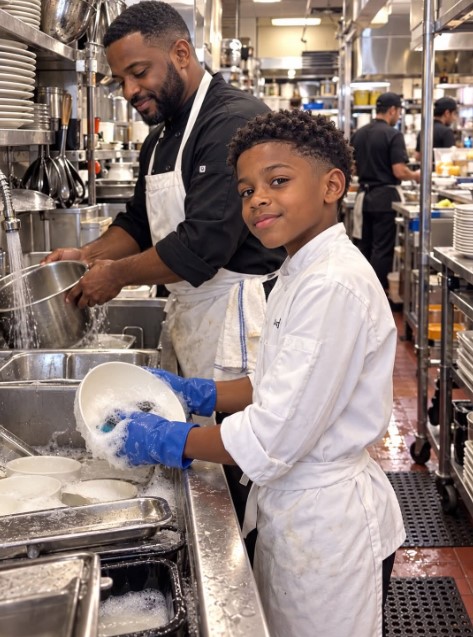
So when he told me in February that he’d found a Saturday job washing dishes at Sal’s Diner on Route 9, I wasn’t surprised.
“I’m going to buy the bike myself,” he said.
“You know you don’t have to.”
“I want to.”
“All right. School first.”
“Deal.”
Every Saturday morning he left at 7:15 in old jeans and the sneakers with the duct tape on the heel.
Every Saturday evening he came home around six smelling like dish soap, fryer grease, and french fries.
His hands turned red and cracked from the hot water.
I bought him lotion.
He used it, which is how I knew it hurt.
When I asked about the bike, he always said the same thing.
“Almost there.”
At first I believed him.
Then three months passed.
Four.
Five.
Six.
No bike.
That was when I did the math.
Sal paid him eighty dollars a Saturday.
Twenty-six Saturdays.
The bike was six hundred and forty with tax.
He should have been riding it by May.
So where was the money?
I told myself the things you tell yourself.
Maybe he changed his mind.
Maybe there was a girl.
Maybe he was saving for something bigger.
Then one night in July I walked past his room at eleven and the light was on and the door was open a hand’s width.
Caleb was sitting on the floor with his back to the bed, counting a stack of cash.
Not a stack.
A brick.
Far more than eighty a week for six months should have made.
The second he saw me, his face changed.
He swept the bills together, shoved them into his backpack, and zipped it.
“What are you doing?”
“Nothing.”
“Was that your bike money?”
He nodded too fast.
“Yeah.”
“That looked like a lot of money, Caleb.”
“Sal pays in small bills. It looks like more than it is.”
He gave me a smile that didn’t sit right on his face.
“I’m getting close.”
Something was wrong.
I didn’t push.
He was thirteen.
I told myself he’d earned a door that was open a hand’s width and not more.
Three weeks later, that got harder.
Caleb usually came home at six.
That Saturday, six passed.
Then seven.
His phone went to voicemail.
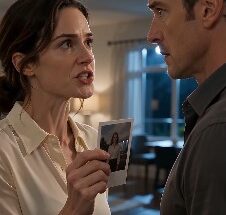
My sister Denise had come for dinner with my mother, and the pot roast was getting cold, and Denise had already said twice, in the voice she uses when she’s being helpful, “Monica, thirteen-year-olds with cash and no bike, I’ve seen where that goes.”
At 7:50 the back door opened.
I went into the hallway and stopped.
His sneakers were caked in mud to the ankle.
His jeans were soaked through at the knees.
One sleeve of his T-shirt was torn from the shoulder.
And there was a fresh scrape down the side of his face, from the temple to the jaw, pink and raw.
“Caleb. What happened?”
He wouldn’t look at me.
“I fell.”
“Where?”
“By the creek.”
He tried to get past me to the stairs.
I stepped in front of him.
Behind me, at the kitchen table, Denise put down her fork.
My mother said, “Oh, honey.”
“Your shirt’s torn.”
“I slipped down the bank. It’s fine, Mom.”
“Where’s the money you earned today?”
He stopped.
His eyes went to the floor.
“I put it somewhere safe.”
“Somewhere safe where?”
“It’s fine.”
“Caleb. Look at me. Where does the money go?”
Denise said, from the table, “Monica, a boy comes home at eight in the dark with mud on him and no cash, you don’t need me to—”
“Denise.”
Caleb looked up at me.
“Can I please take a shower,” he said, and it wasn’t a question, and he went upstairs, and I let him.
I stood in the hallway and listened to the water run.
By then my imagination had turned on me.
The cash.
The torn clothes.
The creek.
The lies.
What if someone older had gotten him into something?
What if the diner was a cover?
What if my grieving thirteen-year-old had gotten into something dangerous and was too scared to tell me?
I hated myself for thinking it.
I couldn’t make the pieces fit any other way.
I decided I would sit him down Sunday and not let him leave the table until I had the truth.
Before Sunday came, his boss called.
I was at work, Tuesday, at the front desk of the dental office, when an unfamiliar number came up.
“Hello?”
“Is this Caleb’s mother?”
An older man.
“Yes. Who’s this?”
“Sal Marino. I own the diner where your boy works.”
My stomach tightened.
“I need to talk to you about your son.”
My heart started going.
“Did he do something wrong?”
A pause.
A long one.
“I honestly don’t know how to answer that.”
“What does that mean?”
Another silence.
Then he asked a question I wasn’t ready for.
“Do you know what your son does with every paycheck?”
“He’s saving it.”
“For what?”
“A bicycle.”
Sal breathed out slowly.
His voice changed.
“Ma’am, you should probably sit down.”
I grabbed the edge of the desk.
“Why?”
“Because everything that boy has told you about that money is a lie.”
PART 2
I sat.
“Mrs. Price,” Sal said. “Monica. Can I call you Monica?”
“Tell me what he’s doing.”
“I’m going to. I need you to know first that I’ve been driving him somewhere every Saturday at five-thirty since March, and I should have called you in March, and I didn’t, because he asked me not to, and he asked me in a way I couldn’t say no to. So if you’re going to be angry at somebody, I’d like it to be me.”
“Sal.”
“He asked me for a job in February. He came in on a Saturday morning at seven and stood at the counter and said he needed to earn eighty dollars a week, exactly eighty, and he’d wash anything. I asked what for. He said a bike. I said, kid, a bike’s six hundred bucks, you’ll have it by spring. He said he knew.”
“That’s what he told me.”
“Then in March he came in with a piece of paper. A payment plan. From Hillcrest Monuments, out on County Road 12.”
I didn’t say anything.
“He’d walked out there. It’s four miles. He’d sat down with the owner, Frank Kowalski, and picked out a headstone. Gray granite. Twenty-four inches. Two thousand four hundred dollars. And Frank told him he couldn’t sell a headstone to a thirteen-year-old without an adult on the plan, so your boy came to me.”
I put my hand over my mouth.
“I signed it,” Sal said. “As the responsible party. Every Saturday at five-thirty I drive him out to County Road 12 and he hands Frank eighty dollars in cash and Frank writes it in a ledger and your boy watches him write it. Thirty Saturdays. That’s the plan. Two thousand four hundred.”
“Marcus has a marker,” I said. “The cemetery put in a temporary marker. Aluminum. It’s—”
I stopped.
It was a metal plate the size of a license plate on a stake.
I’d stood at it once, at the burial, and once more at the one-year, and I’d cried so hard the second time that Caleb, ten, had walked me back to the car, and I hadn’t gone again.
I’d meant to.
I’d told myself when there was money for a real stone.
There was never money for a real stone.
“He said you stopped going,” Sal said, gently. “He said you couldn’t stand the plate. So he figured if there was a stone, a real one, with his dad’s name cut in it, you might come back.”
I couldn’t speak.
“That’s where the money goes, Monica. All of it. He hasn’t kept a dollar.”
“Then the cash. In his room. There was more than—”
“That’s my fault too,” Sal said, and there was something else in his voice now. “The regulars found out. Ray Pruitt, the mailman, he saw the receipt fall out of the boy’s pocket in April and asked me about it, and I told him, and I told him to keep his mouth shut, and Ray Pruitt has never kept his mouth shut in his life.