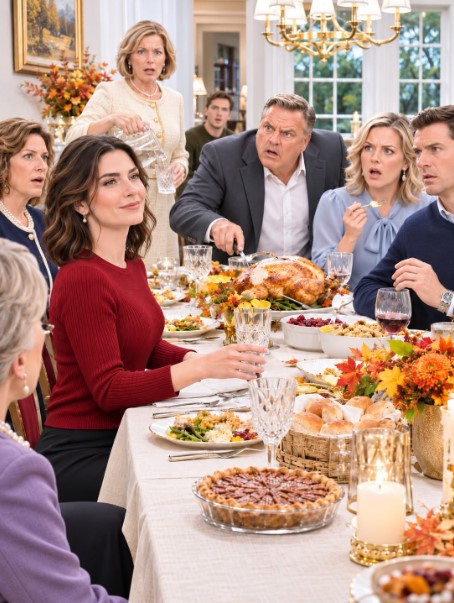
Thanksgiving dinner at my parents’ house always followed an unspoken script.
The turkey was roasted to perfection, crystal wineglasses shone under the lights, and Dad entertained everyone with stories as effortlessly as champagne flowed.
And, inevitably, he found an opportunity to talk about her.
My sister.
The family’s greatest achievement.
“Your sister just bought a gorgeous home!” he declared with the excitement of someone announcing a royal accomplishment. “When will you catch up, Stella?”
Everyone burst into laughter.
Everyone except me.
I didn’t look away or reach for my wine.
Instead, I held his gaze and smiled calmly.
“I did,” I said. “I just didn’t invite anyone who doubts me.”
An immediate silence settled over the dining room.
Forks stopped moving.
Every face turned toward me.
And just like that, their assumptions about my life began falling apart.
Thanksgiving in our family had always resembled a carefully staged performance.
Every person seemed assigned a role, and every celebration followed the same familiar routine we’d repeated for decades.
The table never changed much.
Cream-colored linen covered it, crystal glasses stood beside polished silverware, and everything looked arranged for a magazine photograph.
Mom moved briskly between the kitchen and dining room, straightening napkins and adjusting cushions that were already perfectly placed.
Her smile remained fixed throughout the evening.
But beneath it was an unmistakable instruction.
“Stay in character.”
Dad performed his own role with equal enthusiasm.
He was the charming host with a powerful voice and an endless collection of entertaining memories.
Yet his favorite stories rarely celebrated the family as a whole.
They invariably centered on one person.
Cara.
My sister had long since stopped pretending she disliked the attention.
She entered every gathering as though she were walking onto a red carpet.
Perfectly styled hair.
Expensive heels.
A fashionable designer coat.
And why wouldn’t she behave that way?
The entire family made her the center of attention whenever she appeared.
As for me?
I was Stella.
The daughter who brought a bottle of wine and carried extra folding chairs inside from the garage.
The one who listened quietly while everyone else talked.
The one relatives greeted with familiar questions.
“Still working that same job?”
Or sometimes:
“Did you ever finish that certification thing?”
Perhaps they weren’t deliberately trying to hurt me.
At least, I preferred to believe they weren’t.
But those questions rarely reflected genuine curiosity.
They were conversational shortcuts.
Convenient ways to avoid learning about the parts of my life they didn’t understand—or weren’t interested in understanding.
It had been that way for as long as I could remember.
Cara received the celebrations.
Graduation speeches.
Engagement announcements.
Housewarming parties.
I received courteous smiles, occasional compliments, and sometimes an additional slice of pie.
As though that balanced everything.
For years, I convinced myself the difference didn’t matter.
I called it humility.
I told myself I was taking the mature approach by refusing to compete.
Yet every holiday brought the same quiet ache, like music playing continuously in another room.
This year, however, something was different.
My family hadn’t changed.
I had.
I didn’t attend Thanksgiving hoping to impress anyone.
I had no intention of competing with Cara or announcing my achievements.
I went because I finally understood my own worth.
And perhaps more importantly, I’d stopped confusing my family’s opinions with the truth.
So when Dad proudly raised his glass and started praising Cara, his words didn’t wound me the way they once had.
And when he turned toward me with that familiar teasing smile, asking when I planned to catch up, I was ready.
Cara had always been the daughter who appeared to do everything correctly.
From childhood art exhibitions to college applications, she collected praise as easily as other children collected stickers.
By twenty-eight, she was married, paying a mortgage, and maintaining a beautifully coordinated Instagram account filled with golden-toned photographs.
Dad frequently described her as exceptionally intelligent.
Mom called her the family’s little powerhouse.
Everyone else openly admired her accomplishments.
At gatherings, Cara never needed to compete for attention.
It gathered around her naturally.
Someone would compliment her outfit.
Another relative would ask about her career.
“How’s the new marketing role?”
“Did you redecorate again?”
“Didn’t you just get back from Paris?”
She handled the attention effortlessly.
Smiling modestly, laughing softly, and dismissing compliments as though her successes were ordinary.
But she enjoyed every moment.
That much was obvious.
Meanwhile, I remained an afterthought.
When Cara purchased property, people automatically assumed I was still renting.
When she received a promotion, they imagined I was still struggling to establish my career.
When she celebrated her bridal shower, I was the sister arranging cupcakes and folding napkins.
I don’t believe Dad intended to be malicious.
I truly don’t.
He simply viewed success through a narrow set of achievements.
And Cara had checked every item on his list.
During one family barbecue, he proudly rested a hand on her shoulder and announced:
“Now, this is what building a future looks like.”
That same week, I’d secured a valuable contract with a new client.
Nobody asked about it.
Sometimes I wondered whether my family genuinely couldn’t see me or whether I’d made overlooking me too convenient.
I didn’t need constant attention.
I wanted acknowledgment.
Not applause or lavish celebrations.
Just the feeling that someone understood what I was working toward.
And I didn’t consider Cara a terrible person.
She hadn’t demanded to be placed above everyone else.
She’d simply accepted her position because nobody ever questioned it.
Eventually, some exhausted part of me began wondering whether I truly belonged beneath her.
Until I decided to stop participating in that arrangement.
Because the truth was, I hadn’t merely caught up with my sister.
I’d already achieved far more than my family believed possible.
Quietly, I’d created financial stability and built something entirely my own.
And I’d accomplished it without borrowing money or posting glamorous announcements online.
They knew nothing about it.
But that was about to change.
My transformation hadn’t happened suddenly.
There was no dramatic confrontation or single revelation that changed my entire life.
Instead, I gradually began making different decisions.
Small choices accumulated until I finally understood that I no longer needed anyone’s permission to feel important.
The process began during a Thanksgiving I chose not to attend.
I told my family that a professional deadline prevented me from flying home.
The truth was simpler.
I couldn’t bear another holiday spent pretending I didn’t mind being treated as less important.
That evening, I stayed alone in my apartment.
I wore leggings, ate Thai takeout, and watched television programs featuring strangers enjoying emotional family reunions.
It might have sounded lonely.
But it wasn’t.
I felt peaceful.
Without expectations or comparisons, I could finally relax.
And in that quiet apartment, I began making choices for myself.
Not to earn compliments.
Not to compete with Cara.
Simply because I wanted a different future.
I expanded the freelance work my family had never taken seriously.
Gradually, those assignments became a dependable source of income.
Then I established a consulting business and secured my first client on a retainer agreement.
Three months later, I moved out of my cramped walk-up apartment.
And bought a house.
I handled everything carefully.
Privately.
Without announcing the purchase to anyone.
There were no social media posts.
No housewarming celebration.
No photographs showing me holding the keys.
No carefully edited tour of the property.
It wasn’t that I was deliberately keeping a secret.
I simply wanted the achievement to belong to me.
It felt personal.
Precious.
Every time I reached another milestone, I wondered how Dad might react if he knew.
Would he finally express pride in me?
Would he pretend he’d always expected me to succeed?
But then I’d remember something important.
He’d never asked.
Throughout nearly two years of my absence from family gatherings, Dad hadn’t called once to ask how my career was progressing.
He never expressed interest in my consulting business.
Never offered advice.
Never even asked, “How are you holding up?”
That realization used to hurt.
Eventually, it became useful information.
My family overlooked me because my achievements didn’t resemble Cara’s.
They had a particular definition of success, and anything outside it barely registered.
They recognized visible accomplishments.
Engagement rings.
Expensive homes.
Luxury vacations.
But I’d constructed something more meaningful to me.
A stable, independent life that didn’t require anyone else’s applause.
When this year’s Thanksgiving invitation arrived, I considered declining again.
Then something inside me insisted, “No. Go.”
Not because I needed to demonstrate my success.
Not because I wanted to outshine my sister.
But because I was tired of feeling small in a family home where I’d always deserved to belong.
So I accepted.
I wore a burgundy sweater, purchased a bottle of Pinot Noir, and walked through my parents’ front door with renewed confidence.
This time, I wasn’t planning to disappear into the background.
I wanted to be acknowledged.
Dinner was already underway when I arrived.
The familiar table looked exactly as it always had.
Candlelight reflected off polished silver gravy boats.
Hot dishes filled the room with delicious aromas.
Conversations and laughter continued between wine refills.
Fresh rolls sat neatly arranged.
Dad occupied his usual chair at the head of the table, carving the turkey with the authority of a military commander.
Mom hurried between dishes, topping up glasses and serving bowls that hardly needed attention.
Cara sat beside her husband, Trevor, looking effortlessly radiant.
Trevor laughed a little too enthusiastically whenever Dad told a joke.
I took the vacant chair at the far end of the table, opposite my cousin Abby.
She smiled warmly.
“You look amazing.”
I silently mouthed, “Thank you,” before spreading my napkin over my lap.
I already knew what was likely to happen.
The moment arrived shortly after dessert was served.
Pecan pie.
Dad’s favorite.
He wiped the corner of his mouth, relaxed into his chair, and raised his voice just enough to capture everyone’s attention.
“Well, your sister has some big news,” he announced proudly, turning toward Cara with an almost smug grin.
“She just closed on a gorgeous new home. Four bedrooms, a wraparound porch, granite, everything.”
“Oh, wow!” Aunt Carol gushed.
“That’s amazing,” chimed in Clara, Trevor’s mom.
Dad continued praising her.
“She’s just always ahead of the curve,” Dad added.
Then he turned toward me.
His voice sounded playful, but the familiar comparison was unmistakable.
“Stella, when are you going to catch up, huh?”
There it was.
Every person at the table seemed to look in my direction.
Some appeared amused.
Others waited expectantly.
Even Clara tilted her head, seemingly anticipating another of my vague, noncommittal responses.
For a brief moment, I studied Dad’s face.
I wasn’t angry.
I simply looked at him with an unfamiliar composure.
Something about my expression made him shift slightly in his chair before I spoke.
Then I smiled.
There was no bitterness behind it.
No effort to disguise hurt feelings.
I was simply at peace with myself.
“I did,” I said evenly, my voice carrying across the table.
Dad blinked in surprise.
“You did?”
I lifted my water glass, took a small drink, and slowly glanced around the room.
“I just didn’t invite anyone who doubts me.”
That was the moment the atmosphere changed.
There was no shouting or dramatic outburst.
My words simply settled over the gathering.
An immediate silence followed.
It was quiet but unmistakably tense.
Cara stopped with her fork suspended above her plate.
Trevor’s forehead creased.
Aunt Carol appeared puzzled, as though she’d missed the important part of a joke.
I offered no explanation.
For once, I resisted the impulse to make everyone comfortable.
I allowed the silence to continue.
They could experience what it felt like not to know everything about my life.
It’s remarkable how much influence a simple statement can have.
Not because it’s delivered loudly.
But because it disrupts an assumption everyone has accepted for years.
“I did. I just didn’t invite anyone who doubts me.”
I hadn’t intended those words to create such a powerful reaction.
Yet the silence proved they had.
Dad’s eyes narrowed slightly.
Cara lowered her fork.
Her lips parted in surprise.
Even Mom, who generally avoided participating in these uncomfortable exchanges, stopped halfway through pouring sparkling cider.
I remained composed.
I didn’t attempt to soften what I’d said with an apologetic smile.
Instead, I let everyone consider it.
Dad eventually gave a short laugh.
It was the strained, dismissive sound he often made when someone disrupted his expectations.
“Well,” he said, waving a hand like he was brushing away a fly. “That’s cryptic.”
“It’s not,” I said calmly. “You asked a question. I answered it.”
He looked around, apparently trying to regain control of the conversation.
“So what? You’ve bought a house?”
The way he emphasized the word suggested he thought the idea was almost ridiculous.
“I have,” I replied, taking a sip of wine. “About a year ago, actually.”
Mom stared at me.
“A year?” she echoed. “Why didn’t you say anything?”
I met her eyes.
“I guess,” I said, meeting her gaze, “it never came up.”
There was no cruelty in my answer.
Only a simple fact.
And everyone at the table seemed to understand its meaning.
Cara appeared to be searching her memory for signs she’d overlooked.
But there hadn’t been any public announcements.
I hadn’t shared photographs online.
Nobody had received a housewarming invitation.
There were no pictures of me holding a set of keys or celebrating the closing.
I’d purchased my home for myself.
Not for their approval.
And perhaps that was what unsettled them most.
Trevor cleared his throat…