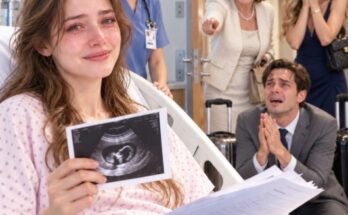
I was carrying triplets at six months when I discovered my husband had assured three separate families that each baby would belong to them.
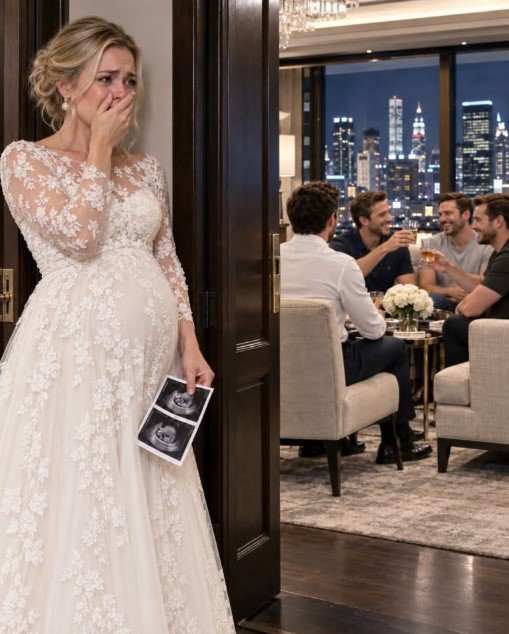
Until then, I believed our children fulfilled a wish Peter and I had shared for years. Fertility treatment meant endless appointments, daily injections, and anxious nights, but I endured them while picturing three small beds in our nursery outside Boston. I never imagined the truth would emerge in a hotel corridor, ultrasound prints falling from my fingers as my husband laughed behind a door.That afternoon, I visited the Fairmont Copley Plaza hoping to surprise Peter during lunch with his college friends. He had mentioned their plans the previous evening. I thought he might enjoy seeing me, especially with the newest ultrasound images showing the three babies’ tiny profiles. I felt proud of our growing family, unaware how false the idea of “us” had become. The images were meant to be a simple gift: three reminders of the life we believed we were making together. I expected an affectionate welcome.Near the private lounge, I heard someone mention Peter and laugh.
“You actually got your wife to carry three embryos from three different women?”
I stopped walking.
Another man replied, “You have to admit, it was clever. One woman didn’t want to risk pregnancy, another couldn’t carry, and the third’s family wanted a child in her memory. Peter found a way to make it happen.”
My grip tightened until the pictures creased.
Peter answered in the reassuring voice I knew so well.
“Nora thinks they’re ours. The clinic handled the paperwork, and she never questioned a thing.”
I couldn’t immediately comprehend it. I kept trying to reconcile the familiar voice behind that door with the man who attended appointments beside me, who knew exactly how much every test and injection had cost me emotionally. Those three heartbeats had represented the family we’d spent years hoping for. I’d wept at ultrasounds, chosen nursery colors and blankets, and watched Peter touch my stomach while promising the babies how eager he was to meet them. Now he spoke about me as though I’d been hired to provide a space.
A friend asked, “What happens after they’re born?”
Peter laughed again.
“Each family gets the child they were promised. Nora’s doing what she’s useful for.”
The ultrasound pictures fell. One landed with its image against the carpet.
Someone else sounded concerned. “And if she finds out?”
“She’s six months pregnant with triplets,” Peter said. “Where’s she going to go? Besides, she wants to be a mother so badly she’ll believe whatever I tell her.”
Birthdayparty planning
I covered my mouth, wondering whether I’d somehow misunderstood words that seemed impossible. Part of me wanted to walk inside and demand an explanation immediately. Another part could barely bear the possibility that every word had meant precisely what it sounded like. A sudden tightening spread through my abdomen. I braced against the wall, breathing through pain just as the brass handle turned.
I hastily gathered the photographs and slipped through a narrow STAFF ONLY doorway. Hidden beside folded tablecloths, I heard footsteps in the lounge.
“Did someone leave?” Peter asked.
“Probably an employee,” someone answered.
After their door closed, I followed the service passage toward the kitchen and emerged onto the street without being stopped. Another contraction struck, stronger this time. When a hotel worker offered assistance, I nodded; there was no use pretending otherwise.
Inside the ambulance, I asked the paramedic not to contact Peter and called my older sister, Rachel, instead.
At the hospital, doctors checked the three babies and watched my contractions. I watched each medical worker carefully, desperate for reassurance that the shock and pain had not harmed them. The babies were the one part of my world I still needed to believe was safe. They said the triplets remained stable but wanted me hospitalized for observation. Rachel arrived and listened as I recounted the conversation in broken sentences, keeping hold of my hand.
Finally, she asked what I had avoided considering.
“Did you ever see the original paperwork from the clinic?”
“I signed forms,” I said. “I thought they were for our embryos.”
“Did you read every page?”
“I read what they put in front of me. Peter was there. The nurse said everything was in order.”
Rachel fought tears but spoke firmly.
“You had every reason to trust him. This is not your fault.”
When a nurse announced Peter was outside, I refused him entry. Rachel drew her chair closer and promised not to leave.
Messages from him quickly accumulated:
I’m worried about you.
Please tell me where you are.
I can explain everything.
I placed my phone screen down. His apparent concern now felt staged, and I wouldn’t participate.
That evening Rachel and I requested my entire fertility-clinic record, including signed consents, laboratory and embryo identifiers, transfer notes, and account-access logs. I submitted it shortly before midnight.
The following morning, a records coordinator telephoned to confirm my identity. I had expected a routine response about how long copies would take. Instead, her tone changed as she studied what appeared on her screen. She mentioned something in my file that made me dizzy.
“It appears there may be a third-party reproductive arrangement attached to your account,” she said.
“What does that mean?”
“I’m not authorized to interpret the file over the phone. We’ll send the records as soon as we can.”
I requested an account-access audit as well. She agreed to include it. Her cautious assurances suggested the clinic might already suspect trouble.
Later, hospital nurse Tessa privately mentioned that my chart had been accessed three weeks previously, with no appointment scheduled. Unable to name the person, she suggested requesting its access history.
Before she could add anything, security delivered a folder Peter had left at reception, claiming it established my prior knowledge of the agreement.
On its opening page sat a signature resembling mine, beneath my name. The date was two months before Peter and I had first entered the fertility clinic.
PART 2: A Signature From Before We Met
Rachel contacted Naomi Blake, a lawyer experienced in reproductive and family law. Naomi visited that afternoon, examined the document and protected it in a sleeve.
“Don’t sign anything else, and don’t send this document back to the clinic yet,” she said. “We need to preserve what you were given and find out where it came from.”
I stared at the handwriting.
“I didn’t sign it.”
“Then we’ll establish that.”
Asked about the date, I recalled attending a family wedding with Peter in Portland, Maine. Rachel possessed photographs, my credit-card record would confirm our hotel, and the wedding program named both of us. Naomi noted each detail before asking about Dr. Alan Whitaker, who supervised fertility treatment.
“Peter chose him,” I said. “He told me Dr. Whitaker had a strong record with high-risk pregnancies.”
“Did you ever meet with him alone?”
“No.”
“Did he explain the embryo transfer himself?”
“Peter was always there.”
Naomi instructed the clinic to preserve all material related to my treatment and barred Peter from obtaining my hospital information or making decisions about my care. Those precautions frightened me, yet the limits also offered relief. I had spent so long allowing Peter to speak during appointments that claiming the authority to decide who could see me or my records felt unfamiliar. Naomi treated that authority as something unquestionably mine.
Records arrived the next day. Most seemed routine: prescriptions, appointment summaries, bills, and scans. But the embryology pages were different. Three embryo identification numbers were obscured as “confidential third-party information.” My transfer was described as a gestational-carrier procedure, and an electronic consent was connected to an email address I’d never owned.
“That isn’t my account.”
Naomi zoomed in. The profile originated on a device assigned to Peter’s office. A later entry documented a username change; the initial access details had disappeared from the active account.
Clinic compliance director Martin Cole arrived with the coordinator. When Naomi demanded preservation of earlier versions, he acknowledged that some old lab entries had been removed from the active record. One explicitly stated that the embryos came from my eggs and Peter’s sperm, precisely as I’d requested.
The newer documents contradicted it, assigning three family-linked letters to those embryos and identifying them as third-party material.
“Who changed those labels?” Naomi demanded.
Martin said an investigation was underway.“And why was the original note removed?”
He couldn’t explain. The absence of an answer was almost as disturbing as the altered labels. Documents that should have provided certainty were turning into evidence that someone had rewritten the history of my own treatment.
The coordinator, Mara, appeared distressed. She said Dr. Whitaker claimed the documentation was handled privately between the “intended parents.” On transfer day, Mara had questioned whether I’d signed a third-party consent, but he assured her everything was signed. She hadn’t personally examined it and had allowed the procedure to continue.
“I should have asked you,” she said quietly.
“You should have,” I replied. “But you didn’t create this.”
Naomi discovered another impossible date in an agreement involving Audrey Miller’s relatives. Audrey had died years before the contract was supposedly signed. Her parents, Ellen and George, joined Naomi on video that night. According to Peter, Audrey’s preserved eggs had produced an embryo and I’d volunteered to carry their grandchild. He’d even mailed them an ultrasound photo labeled with Audrey’s name.
Ellen struggled to speak.
“He told us our daughter’s final wish was to have a child. We wanted to believe we could help make that happen.”
I answered with difficulty.
“He used my pregnancy to make you believe that.”
“We’re so sorry,” Ellen said.
They’d saved all of Peter’s paperwork. A laboratory notification among it confirmed Audrey’s preserved material had never been used. Her purported agreement was fabricated. Ellen and George had held onto those papers because they thought they preserved a connection to their daughter. I realized Peter had exploited not only my desire to become a mother but also their longing to remember Audrey.
Birthdayparty planning
The clinic also identified three more embryos made from my eggs and Peter’s sperm. Although records marked them discarded, inventory couldn’t establish their destruction. The most recent transfer request involving them used an unfamiliar name.
That night, the contractions intensified and quickened. Doctors monitored me, administered medicine intended to postpone birth, and warned premature babies might require intensive care. Peter’s lawyer meanwhile petitioned the court urgently, alleging I’d agreed to carry children for three different families and should not make decisions concerning them without notifying those families.
His petition portrayed me as confused and emotionally unstable, omitting the original laboratory evidence, altered records, and impossible contract dates. Seeing my own circumstances described that way was exhausting. I was fighting premature labor while another version of me, invented on paper, was being presented to a court. I couldn’t finish reading.
“He’s trying to make it sound as if I don’t know my own life,” I said.
“Then we keep the record factual,” Naomi replied. “We don’t let him pull you into a fight that belongs in evidence.”
Another woman, Harper, soon called Naomi. Peter had assured her that one transferred embryo contained her genetic material and she’d receive a baby after delivery. He’d collected money from her for purported legal and administrative costs. Harper had also received a clinic notice saying an embryo associated with her was transferred under my name.
“I never wanted to take a baby from another woman,” she told me, close to tears.
“Neither of us caused this,” I said.
We’d been fed different stories and deliberately kept apart, preventing us from comparing them.
A stronger contraction interrupted everything. My doctors said labor was advancing and an emergency birth might be safest. They offered a medical consent in case the babies’ conditions changed. I examined each line. Because it concerned only my care and their delivery, I signed knowingly.
Peter’s lawyer arrived with proposed temporary custody terms before the birth. Naomi blocked his entry, while he argued from the doorway that signing would “protect the babies from uncertainty.”
I studied the document.
“I’m not signing a custody agreement while I’m in labor.”
He continued protesting until hospital security removed him. Obstetrician Dr. Ortiz returned.
“We’re going to deliver the babies now,” she said.
Terrified, I agreed. I was consenting to care for my children, not accepting Peter’s invented arrangement. Nothing about the hospital room felt under my control, yet I understood the choice being offered and why it mattered. That distinction had become essential.
PART 3: The Truth in the Records
The operating theater shone with bright lights and purposeful movement. Rachel waited outside; Naomi remained near my head as the team prepared. While anesthesia took effect, I heard monitors ticking steadily and doctors speaking in composed voices.
A faint cry suddenly broke through. Another followed, and then a third.
“Are they breathing?” I asked.
“They’re receiving support,” a nurse said. “All three are here.”
I awoke with Rachel beside me. My babies were in neonatal intensive care, tiny beneath their equipment, watched constantly by nurses.
“Can I see them?”
“Soon,” Rachel said. “The doctors want you to rest first.”
Naomi had obtained electronic-signature evidence from the district attorney. The contract sent to Audrey’s family contained a digital copy of my signature assembled from a legitimate medical form I’d signed months afterward. Peter had added his own signature and inserted the copied image of mine.
Investigators located Dr. Whitaker. Clinic logs showed he approved the suspicious agreements via his physician portal despite the authentic laboratory report identifying Peter and me as the genetic parents.
Both men were arrested that morning. The three supposedly missing embryos were discovered in a storage unit linked to a business associated with Peter’s employer. A court ordered their preservation while investigators determined their future.
Days later, an investigator described the scheme. Peter approached Whitaker before fertility treatment and arranged to create embryos using our own sperm and eggs, while manufacturing agreements that might grant him control of the children after divorce. Harper and Madison, another woman, each heard different claims. Audrey’s grieving parents were falsely told her frozen eggs had been used.
Peter had also opened a second patient account with my personal information. A transfer request dated before my first clinic visit belonged to that account, intended to suggest I’d approved the false agreements from the beginning.
“He knew the babies were ours?” I asked.
“Yes,” the investigator said. “The records show that all three were genetically yours and Peter’s.”
I shut my eyes. They had always been my children. Peter knew the truth even while promising them to others.
The triplets spent almost three months in intensive care. Their improvement came in tiny increments: breathing independently a little longer, crying more strongly, managing a few more milliliters of milk. Rachel tracked every gain in a notebook beside my chair. When progress was slow, we returned to those small entries and reminded ourselves that a stronger breath or a successful feeding still counted. The notebook gave shape to days that otherwise seemed filled with waiting.
Harper and Madison wrote letters. When medical staff permitted visits, Ellen and George brought the yellow blanket they’d made for the child they thought came from Audrey. Instead, they gave it to me.
“We want the babies to have it,” Ellen said. “And someday, if you’re comfortable, we’d like them to know Audrey’s name.”
I agreed. Audrey wasn’t their biological parent, but she had been dearly loved, and her memory mattered independently of Peter’s falsehoods. I did not want the truth about the babies to erase the kindness of people who had also been deceived. Their grief was real even though the promises made to them were not.
DNA testing verified that all three babies were genetically mine and Peter’s. A court invalidated the fraudulent agreements and awarded me primary custody, restricting Peter’s contact during the criminal proceedings. I retained control of the remaining embryos and postponed decisions about them while healing.
When the doctors finally brought all three babies to my room, I held one against my chest; Rachel held another, while Naomi watched the nurse settle the third into my arms. Their eyes blinked open and their tiny hands curled around my fingers.
I’d deliberately waited to name them until Peter no longer had a voice in that choice.
“Courage,” I whispered to the first. “Truth,” I said to the second. “And Hope.”
Discover more
Family party decorations
Order Takeout
Birthday cake recipes
Rachel laughed, crying.
“You’ve been saving those names for a while, haven’t you?”
“I wanted them to belong to the babies.”
Months later, we returned to the nursery prepared long before the deception surfaced. I removed Peter’s chosen decorations and hung Rachel’s three paintings instead: sunrise, a trail through green hills, and three stars over a peaceful house. Ellen and George’s yellow blanket covered one crib.
Naomi brought the completed custody order and left it on my kitchen counter.
“Keep this somewhere safe,” she said. “I hope you never need it again.”
For months, paperwork had been used to undermine my confidence in my memory. I remembered how helpless I had felt looking at signatures, dates, and labels that contradicted everything I knew. Now there was a record that reflected the facts instead of replacing them. This document recorded the opposite: the evidence proved Peter’s contracts fraudulent, and I would raise the children.
On their first birthday a year later, the babies were surrounded by everyone who’d helped us survive. Harper and Madison attended virtually. Ellen and George brought a little cake; Rachel decorated with flowers. Naomi gave storybooks the triplets attempted to chew before anybody could begin reading.
After the gathering, I carried them upstairs. Courage drifted off first. Truth resisted sleep fiercely, and Hope held onto my finger. Standing between the cribs, listening to their breaths, I remembered myself outside that hotel lounge, convinced my life had been destroyed.
I wished I could tell that woman how frequently fear would return, how slowly healing would unfold, and how gradually the truth would emerge. Rachel would come. Naomi would listen. Women deceived by Peter would help me. The babies would eventually understand I’d loved them long before anyone debated what to call them.
Morning sunlight stretched across the nursery. I lifted each baby and brought them, one by one, toward the window.
Peter had spent months claiming the power to decide to whom they belonged. I no longer needed anyone’s documents to answer.
They were my children. I was their mother. Our future was ours.
Birthdayparty planning