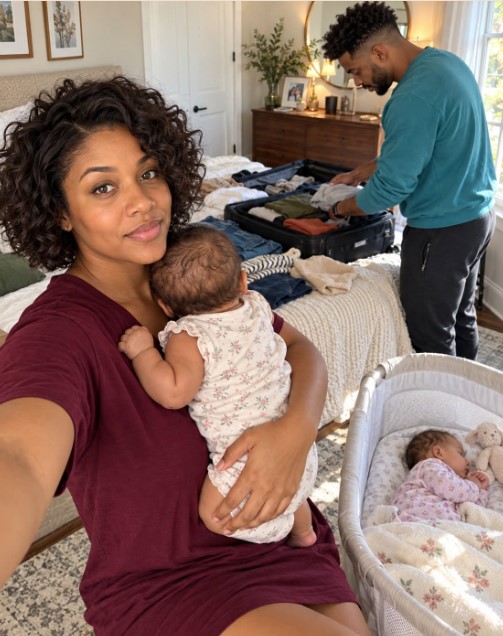
“You wanted to be a mother. So act like one.”
My husband said that to me in our own bedroom at about nine o’clock at night, with a duffel bag open on the bed and a baby crying down the hall.
My name is Ingrid Donnelly. I am thirty-four.
Marsh and I married in 2017 and we started trying in the spring of 2018.
It took six years.
I am not going to set the whole of that out on this page. It is not what this is about, and anybody who has been through it does not need one word of it described to them.
Four rounds. Three of them did not work. There were about eleven appointments a year for six years and I can still tell you which room at Fennimore has the window that does not shut.
Mirren and Tess were born on the eleventh of November. Thirty-six weeks, by section, at twenty past four in the afternoon.
Mirren first, Tess four minutes later. Four pounds eleven and five pounds one.
By the May they were six months old and I was tired in a way I did not know was available to a person.
My day was feeds, diapers, laundry, bottles, and two babies crying at different times about entirely different things.
And about four hours of broken sleep that was not sleep — forty minutes at a go, then up, then forty more.
I did that from the eleventh of November to the eleventh of May without one night off.
Tess would not take a bottle from anybody but me until about the March, which meant I could not leave that house for more than two hours at a stretch for four months.
And Mirren had reflux until about the April, which meant that after every single feed somebody had to hold her upright for twenty minutes.
Eleven feeds a day between the two of them. Do that arithmetic.
I did not complain much, and I did not ask for much. I want that on the page because it matters later and not because I think it makes me good.
I did not complain because I had wanted this for six years.
And because there is a particular thing that happens to women who get there the hard way, which is that you feel you have used up your entire allowance of being permitted to find anything difficult.
You asked for it. You went back four times. You do not now get to be tired about it.
Marsh is thirty-five. He works in commercial fit-out and he is genuinely good at it, and people ask for him by name.
He was doing something. I am not going to stand here and pretend that man did nothing.
He did the bins. He dealt with the car and the insurance. He got up with them maybe twice a week and he did it without being asked on those two nights.
But the shape of it was that I was holding the whole thing and he was helping with parts of it.
There is an enormous difference between those two and anybody who has done one of them knows it.
And then on a Tuesday night in the May, with both of them finally down and me standing in the kitchen at ten past nine, I asked that man for one thing.
Could he do the bottles.
There were eleven of them stacked on the drainer. I had counted them, because by the May I counted everything.
And he let out a breath through his nose.
And then he looked round that kitchen — properly looked, the way you look at a room you are building a case about — and said he was sick of it.
Sick of coming home to crying. Sick of bottles everywhere. Sick of the state of the house.
And sick of a wife who looked the way I looked.
That is close to his actual words and I have not improved them in either direction.
He did not shout any of it. That is the part people get wrong when I tell it. He said all of it in a completely normal voice, standing by a bed, folding a shirt.
And then, about four minutes later — while I was still standing at that sink with a bottle brush in my hand and had not answered any of it —
he told me he had a fishing trip booked.
Four days. Thursday morning to Sunday evening. With Dov and two others, up at a lake near Carrow.
Four hours away. No signal for most of it.
A cabin. Paid for.
He needed a break.
I actually laughed.
Not nastily. I laughed the way you laugh when somebody says something that cannot possibly be what you just heard.
I thought it was a thing he was saying to make a point and that he would take it back in about four minutes.
And I said: Marsh, how exactly do you think I am going to do four days on my own with two six-month-olds when I have not slept properly since November?
And my husband did not stop packing. He did not even look up.
He carried on putting socks into a duffel bag while his wife asked him that question.
And then he straightened up and shrugged at me.
“You wanted to be a mother. So act like one.”
I did not say anything.
I stood in that bedroom and looked at him and I did not say one word, and I have thought about that silence for a year.
I did not argue with him. I did not ask that man to stay.
And I did not cry, which I am fairly certain he was expecting and which I have since worked out would have been considerably easier for him than what I actually did, which was nothing at all.
I let that man pack a bag and walk out of that house on the Thursday morning at twenty past seven.
He kissed both girls on the top of the head on his way past. I watched him do it from the kitchen doorway with a cup in my hand.
And in those four days something changed in me that has not changed back and is not going to.
He came home on the Sunday at about six in the evening. I heard the car on the drive.
He put his key in the door the way you do when you are walking back into exactly the life you left.
And then he stepped into that hallway.
And he stopped dead four feet inside his own front door.
PART 2
His mother was sitting in my front room with Tess asleep on her shoulder.
Pearl Donnelly is sixty-two years old.
She lives four hours away, outside Rennick. She has a 2011 Corolla and she does not drive on highways. She has not driven on a highway since her husband went in 2016.
She had been in that house since Tuesday night.
I rang that woman on the Tuesday night at about half past ten.
Forty minutes after her son said it to me. With my hands going so badly that I had to put the phone flat on the counter and use the speaker.
I did not ring my own mother, who is eleven minutes away.
I did not ring my sister Hedda, who would have been in a car inside nine minutes and in that kitchen inside twenty, and who has not entirely forgiven me for it.
I rang his.
And I told that woman exactly what her son had said to me. Word for word, in his voice, without softening any of it.
And then I stopped talking.
I did not add one thing. I did not explain how tired I was or how long it had been. I did not cry on that phone and I have no idea how I managed it.
And Pearl Donnelly said: “Say that to me again, Ingrid.”
So I said it again.
And then that woman said: “Don’t move. I’ll be there.”
She drove four hours. On highways. At sixty-two years old, in the dark, in a 2011 Corolla, having not done it in nine years.
She arrived at my door at about half past four on the Wednesday morning with one bag and a packet of biscuits.
And she was still sitting in that chair on the Sunday evening, five days later, when her son came through his own front door with a cooler in one hand.
Marsh had two bags of his own already packed and standing by the stairs when he walked in.
I had done those on the Friday afternoon while both girls were down.
Properly. Not thrown in — folded the way that man likes things folded, which I have done for eight years.
His work boots in a carrier bag. His charger. His good jacket on a hanger over the top.
And in the hallway, about four feet inside that door, he stopped.
And nobody in that house said one word.
Pearl says it was about ten seconds. It did not feel like ten seconds to me and I would have guessed at a minute.
And then his mother said it. Without getting up out of that chair. Without shifting her arm. Without waking that baby.
“Marshall. Sit down in that chair.”
He did not sit down.
He said something about what was going on, and then something about the bags, and both of those came out at the wrong pitch.
And Pearl Donnelly said:
“Your wife rang me Tuesday night and told me what you said to her.”
And then: “I want you to tell me, standing right there, whether she had it right.”
And my husband stood in his own hallway, at thirty-five years old, in front of his mother and his wife and a sleeping six-month-old —
and said: “She’s taken it out of context.”
That is what my husband came back with.
Four days at a lake. A four-hour drive home to think about it. And that is the sentence.
And his mother said: “Then give me the context.”
And he could not.
He stood in that hallway for about four seconds with his mouth doing something and he did not produce one word.
That is the whole of the doorway.
There was no shouting. Nobody threw anything and nobody swore and the babies did not even wake up.
A thirty-five-year-old man stood four feet inside his own front door for about ten seconds.
And could not produce one sentence in front of his mother.
PART 3
Now the four days, because the thing that changed is not what people assume.
Everybody assumes I had some sort of revelation on day two and came out of it a different woman.
Four people have asked me what the moment was. There was no moment.