But it didn’t.
It was a notarized letter from Grandpa’s lawyer, attached to an older sealed statement written by Grandpa himself.
And the first line was enough to make my knees weaken.
“If you are reading this, then the truth your parents buried for fourteen years can no longer be hidden.”
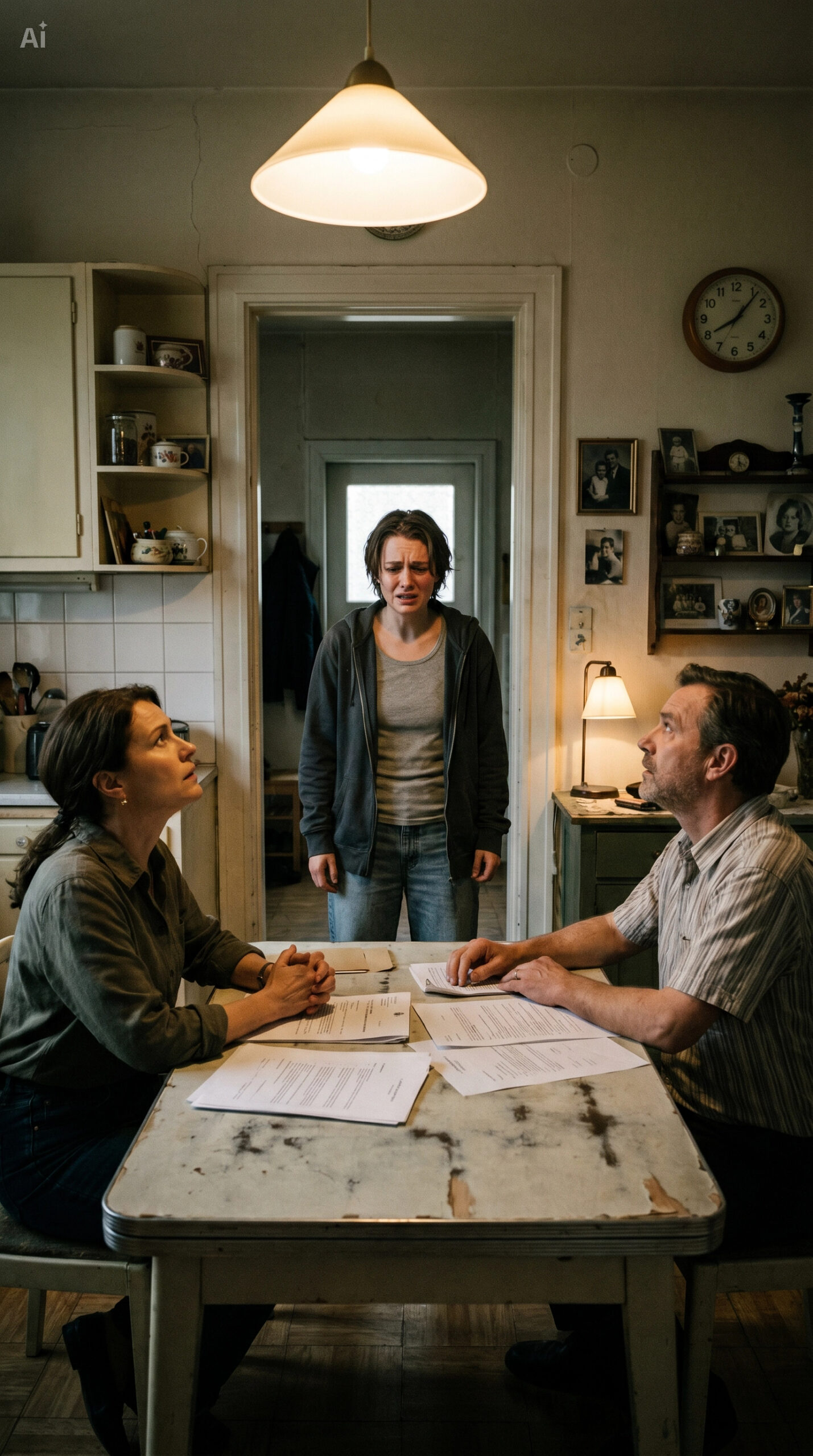
I looked up at them.
My mother’s smile was gone now. Dad’s confidence had cracked slightly at the edges.
“What is that?” he demanded.
I didn’t answer. I kept reading.
“The child they called their ‘daughter’—Melissa—is not biologically theirs.”
My breath stopped.
The room felt smaller.
“And the child they cast out—my granddaughter—is.”
My vision blurred for a second.
Grandpa’s words continued, precise and devastating.
My mother had been unable to conceive when she was younger. In desperation, my parents had adopted Melissa privately through a closed arrangement—one they later tried to erase from memory and records, pretending she was their biological miracle.
But when my mother finally became pregnant years later, everything changed.
They didn’t just have a new child.
They had a replacement.
And I… was the one they didn’t know what to do with.
Except Grandpa knew.
He had known from the beginning.
That’s why he took me in.
That’s why he fought for me.
That’s why he quietly ensured every record, every legal protection, every piece of inheritance pointed only one direction.
I looked up slowly.
“My entire life…” my voice barely worked, “was based on a lie?”
My mother stepped forward, panicked now. “That’s not— you don’t understand—”
But I did understand.
For the first time.
Grandpa hadn’t just left me a house.
He had left me proof.
And in the final paragraph, one last line sealed everything shut:
“If they attempt to claim the house, this document activates full legal transfer review and exposes the adoption concealment to court authorities.”
The silence that followed felt different now.
Not empty.
Final.
I folded the paper and placed it back on the table.
My father looked at me, but his voice was no longer demanding.
“Give us the house,” he said weaker now, “we can fix this quietly.”
I shook my head.
“No,” I said.
For the first time in my life, I wasn’t temporary.
I wasn’t replaceable.
And I wasn’t theirs anymore.