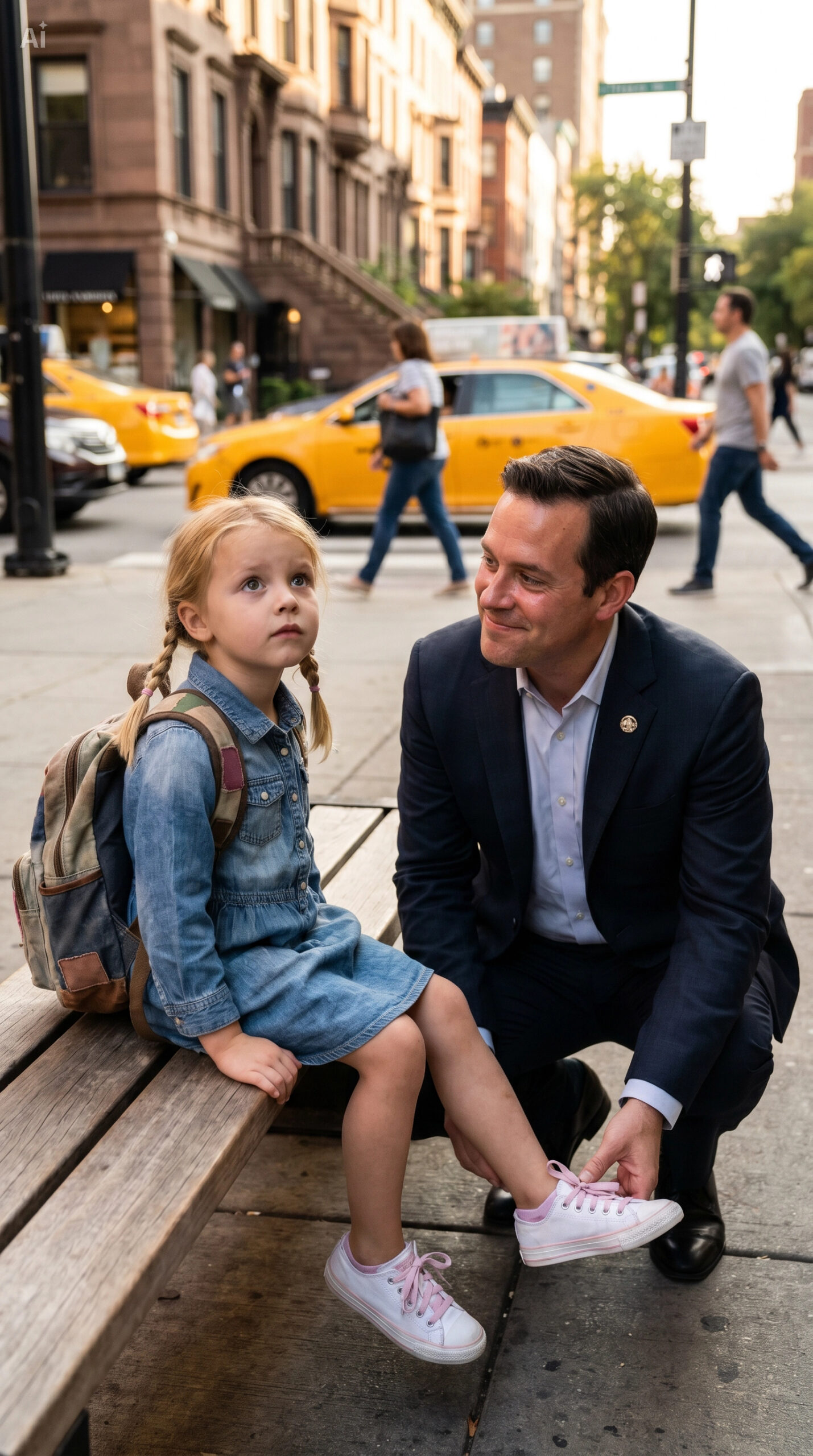
I didn’t sleep that night.
The messages stayed burned into my mind like a warning I couldn’t ignore.
“She thinks I’m getting better.”
That line repeated itself over and over until morning.
By dawn, I had already made a decision I couldn’t explain even to myself.
I had to find Sophie.
And her mother.
I called my assistant and used every connection I had—hospital records, city directories, private contacts. Within hours, I had an address: a public hospital on the south side of Chicago.
When I arrived, the smell of antiseptic and exhaustion hit me immediately.
I found her room at the end of a narrow hallway.
Sophie was sitting beside the bed, swinging her new shoes gently under her chair like she was afraid to let them get dirty.
When she saw me, her eyes widened.
“You came back!”
She smiled like I had just kept a promise I never made.
Her mother lay in the bed behind her. Pale. Weak. Tubes running quietly beside her face.
But her eyes were open.
She looked at me with something between fear and gratitude.
“You’re the man from the street,” she whispered.
I nodded.
“I didn’t mean to interfere,” I said quickly. “I just—”
“You gave her hope,” she interrupted softly. “That’s not interference.”
Sophie tugged my sleeve.
“See? I told you he was nice.”
The mother tried to sit up, but failed. I stepped closer instinctively.
“I didn’t know,” I said. “About the hospital. About you.”
She gave a faint smile.
“Most people don’t see past the shoes.”
Silence filled the room.
Then she reached under the pillow and pulled out a folded piece of paper.
“I wrote something for Sophie,” she said. “In case I… don’t get the chance.”
My chest tightened.
“But now I think I need to say it myself.”
She turned to her daughter.
“Sweetheart, you have to be brave for me, okay?”
Sophie nodded immediately. Too quickly.
“I am brave.”
The mother’s eyes filled with tears.
“Yes. You are.”
Then she looked at me.
“I don’t have anyone else.”
That sentence hit harder than anything I had ever heard in a boardroom, a negotiation, or a deal.
And in that moment, something inside me made a choice I didn’t overthink.
“You do now,” I said.
She blinked.
“I don’t understand.”
I looked at Sophie—small, hopeful, holding onto a promise she barely understood but refused to abandon.
“I’ll make sure she’s taken care of,” I said.
Not as charity.
Not as a gesture.
But as something I suddenly knew I couldn’t walk away from.
Sophie smiled.
“See, Mom? I told you. Promises matter.”
Her mother closed her eyes for a moment, like she was finally allowing herself to believe the world wasn’t only endings.
And for the first time in years, I realized something that terrified me more than any business failure ever could:
My life hadn’t been empty because I lacked success.
It had been empty because I had never let myself be needed.
Until a child with worn-out shoes walked into it… and changed everything.