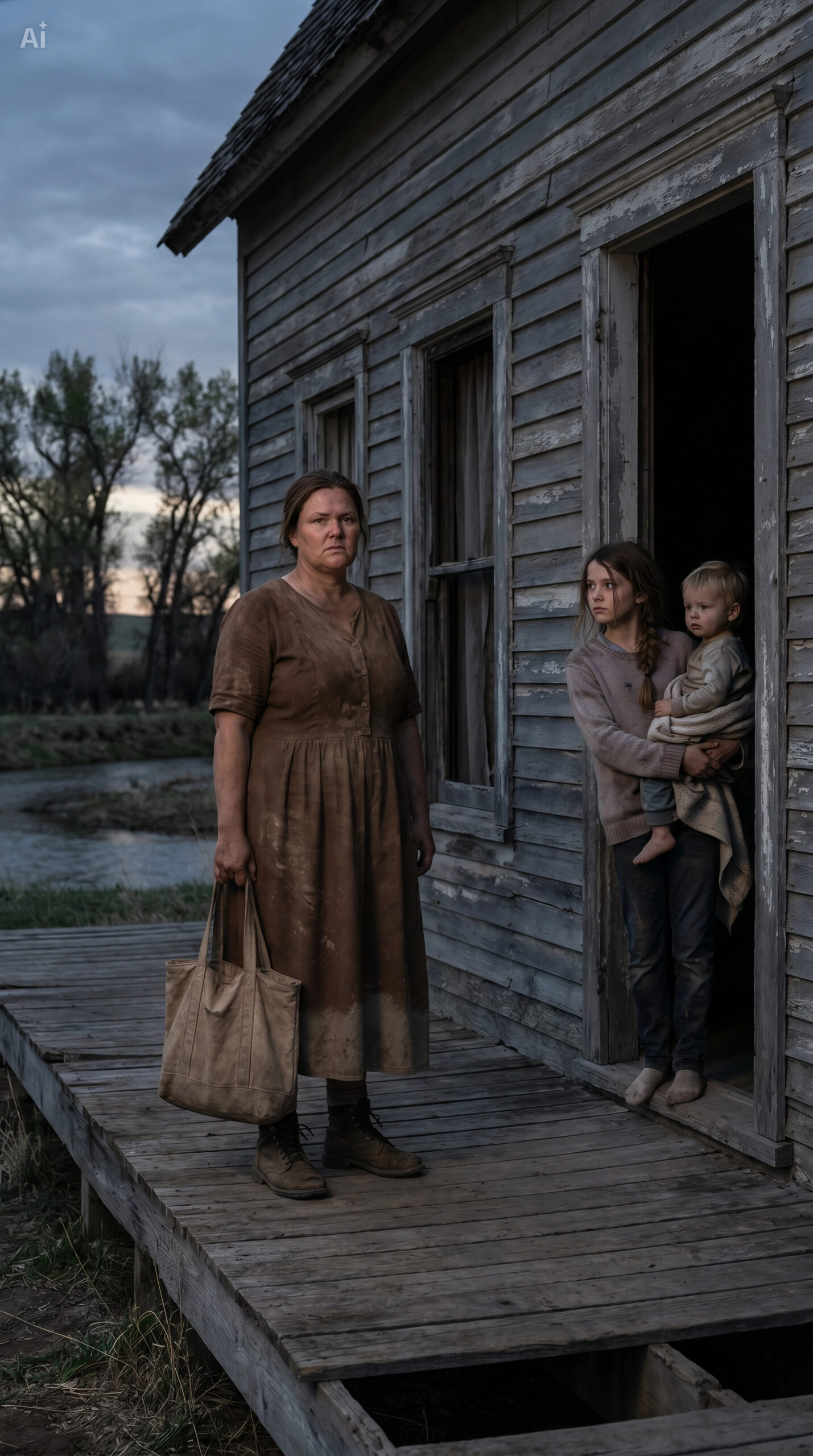
That night, Caleb Walsh sat at his own table like a stranger.
Ruth broke the cornbread with steady hands and placed it in front of the children first. Not because she was told to, not because she was kind in a way people wrote in letters—but because she understood something Caleb had forgotten:
Children do not survive on promises.
Eli ate like he was afraid the food would disappear if he blinked. Clara ate slower, watching every bite as if she was memorizing it in case it never came again.
Caleb did not touch his plate.
He watched his son instead.
Watched the way hunger left Eli’s face in small pieces, as if warmth itself was rebuilding something that had been breaking for too long.
And something inside Caleb cracked—not loudly, not dramatically.
Quietly.
Like wood giving way under too much winter.
Ruth worked without asking to be seen. She moved through the kitchen as if she had always belonged to labor more than to comfort. When there was nothing left to cook, she stood by the counter and ate only because she knew she had to keep strength in her body.
Not because she believed she deserved rest.
Caleb noticed that.
He noticed everything now.
“You walked from Mill Haven?” he finally asked.
Ruth didn’t look up. “Yes.”
“All that way… for this?”
Ruth paused.
Then she said, “No. I walked because no one there would hire me. I stayed because your children were already being left alone in a house that still had a roof.”
Silence settled again.
Not empty this time.
Heavy.
Meaningful.
Clara fell asleep first, her head resting against the table. Eli followed soon after, his small body finally surrendering to something softer than hunger.
Caleb watched them both like a man trying to memorize what peace looked like before it disappeared again.
Then he looked at Ruth.
Really looked.
Every rumor he had ever heard about the town’s “hated widow” did not fit the woman standing in his kitchen now. They never had.
“You could leave,” he said quietly. “Most people would.”
Ruth wiped her hands on a worn cloth.
“I already left once,” she said. “I know what leaving costs.”
The stove hissed softly behind them.
Outside, Cottonwood Creek kept moving like time pretending it was patient.
Caleb finally spoke the words that had been stuck in his throat since the moment he walked in.
“If you stay… what do you want from me?”
Ruth met his eyes without hesitation.
“A fair wage,” she said. “And honesty. Nothing else.”
He nodded slowly, as if that was the first agreement he had made in years that didn’t feel like surrender.
But when Ruth turned toward the door to check the lock, Caleb added something lower—almost like it was pulled out of him unwillingly.
“And if I can’t give you that yet?”
Ruth stopped.
For the first time that night, her voice softened.
“Then we start with tonight,” she said. “And we work forward from there.”
And in that quiet farmhouse on Cottonwood Creek, a man who had been drowning in responsibility…
watched a stranger bring life back into his children’s eyes.
Not with miracles.
Not with promises.
But with bread.
And the unbearable mercy of someone who chose to stay.