Chapter 1: The Intruder
“I want you to bathe her in our tub. And please, do not call the house staff. I want you to do it yourself.”
I stared at him, convinced my husband’s sanity had finally, spectacularly snapped.
My name is Mariana. I am thirty-six years old, and until that suffocating Tuesday afternoon, I operated under the absolute delusion that I understood every corner of the man I had been married to for fifteen years. Alejandro was a titan of industry. He owned a sprawling syndicate of commercial construction firms that dominated the Chicago skyline. We possessed a level of wealth that insulated us from the grit of the real world, but Alejandro harbored a persistent, occasionally infuriating habit: whenever a philanthropic crusade seized his imagination, he pursued it with a bulldozer’s subtlety.
That particular week, he had decided his corporate checkbook wasn’t enough. He wanted to get his hands dirty. He announced he was personally volunteering at a grim, overcrowded soup kitchen near the downtown Greyhound terminal. He claimed he was sick of the sterile photo opportunities at charity galas and wanted to look the recipients of his aid directly in the eye.
I did not share this sudden, bleeding-heart enthusiasm.
“Some people genuinely just need a ladder to climb out of a hole,” I had scoffed that morning over my imported espresso. “But let’s be honest, Alejandro. Plenty of others just prefer the view from the bottom.”
How effortlessly those toxic, arrogant words slipped from my glossed lips. I sat wrapped in a cashmere robe inside my climate-controlled fortress, a private chef preparing my egg-white omelet, a chauffeur idling in the driveway. I understood absolutely nothing about gravity or how fast a life could fall.
Late that afternoon, I returned from a champagne luncheon at the club to find Alejandro standing in the center of our immaculate, marble-floored grand foyer. Beside him stood a woman who looked as though she had been excavated from a landfill.
Her hair was a solid, matted helmet of graying knots. Her skin was spackled with thick layers of dark, oily grime, and she wore a threadbare, oversized men’s coat that emitted an odor so viscerally foul—a mix of stale urine, wet dog, and decay—that I instinctively threw a hand over my nose and stumbled backward.“Alejandro, what on earth is that doing in our house?” I demanded, my voice shrill and echoing off the vaulted ceiling.
The woman immediately shrank into herself, her shoulders curving inward as she fixed her gaze on the tips of her ruined, soleless shoes.
Alejandro met my hysteria with an infuriating, rock-steady calm. “Her name is Lucy.”
“Is that her actual name, or did you just decide to name her like a stray cat?”
“She doesn’t remember her legal name, Mariana.”
I let out a harsh, incredulous laugh, assuming he was setting up a very poor joke.
The woman spoke then. Her voice was raspy, like dry leaves scraping across pavement. She quietly explained that she had spent the last two decades existing in the shadows—transit stations, public parks, the hollowed-out shells of abandoned buildings. She remembered waking up twenty years ago amidst the jagged debris of a construction site with a throbbing head, but the timeline before that was a total, terrifying blank. No family. No surname. No address.
Nothing.
Alejandro had served her a bowl of stew that afternoon and decided he was her savior.
“I’m going to leverage my legal team to help her track down her identity papers and secure a decent, safe place to live,” Alejandro announced, his tone brooking no argument. “Until we sort that out, she will be staying in the east wing guest suite.”
My blood pressure spiked, a hot flush crawling up my neck. “In our home?! You want her sleeping on Italian linen?!”
“Yes.”
“What is the next phase of this project, Alejandro? Are we converting the tennis courts into a triage center?”
The woman took a timid, shuffling step backward toward the heavy oak front doors. “Please, I don’t want to cause any trouble between you. I can leave. I’m used to the cold.”
Alejandro reached out, gently wrapping his hand around her filthy, trembling forearm. “You aren’t going anywhere, Lucy.” He then turned his dark eyes onto me, pinning me to the floor. “Mariana, I was just running the water in the master garden tub upstairs. Go help her wash up.”
My entire body went rigid. “Me?”
“Yes.”
“We have a full staff, Alejandro! I pay a housekeeper to clean up messes!”
“Exactly,” he said, his voice dropping to a low, dangerous whisper. “If you truly believe that helping people is a noble endeavor, start by treating this woman like a human being instead of a mess you can outsource.”
His words hit me like a physical blow. They stung because I knew they were laser-targeted at my own hollow arrogance.
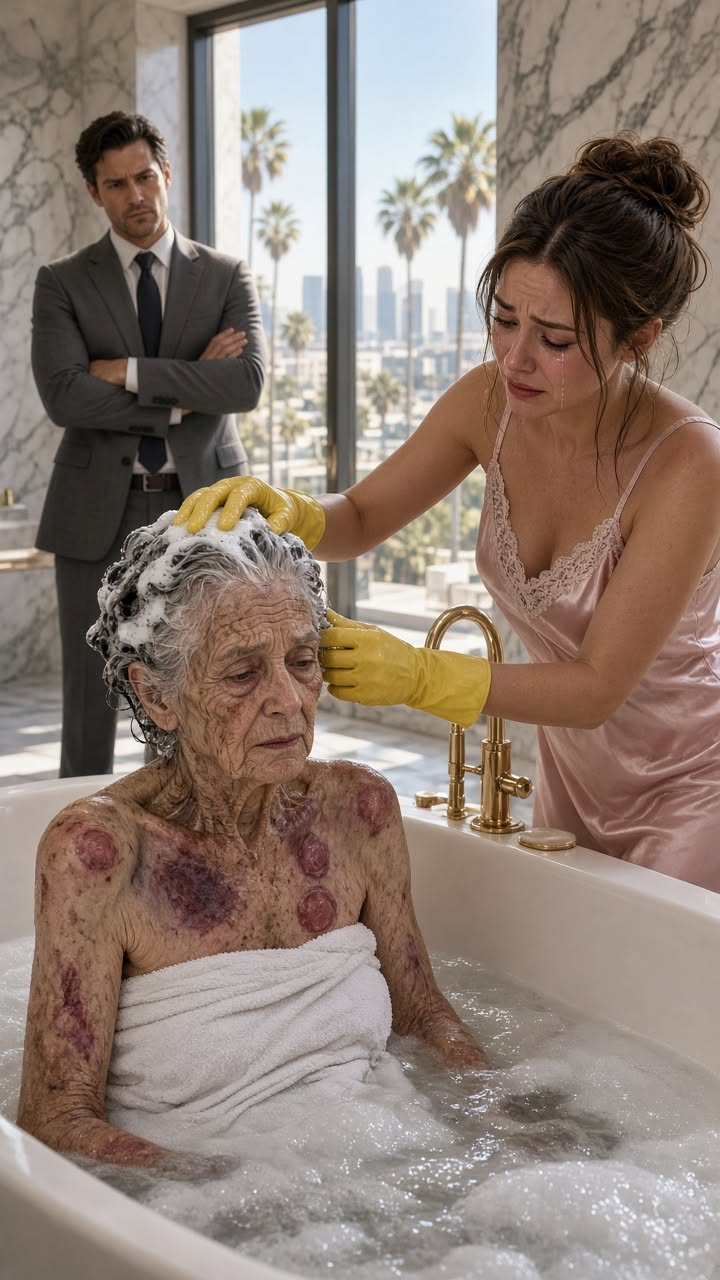
Muttering a string of furious, venomous curses under my breath, I gestured sharply for the woman to follow me up the sweeping staircase to the master bath. I yanked open a cabinet and snapped heavy, yellow rubber cleaning gloves over my manicured hands before turning to face her.
“Take those disgusting rags off and put them directly into that heavy-duty trash bag,” I ordered, my voice a block of ice. “We are incinerating everything you brought in here.”
“I… I can wash myself, ma’am,” she offered. Her tone was surprisingly polite, holding a ghost of a cultured cadence beneath the rasp.
“I would prefer to supervise and ensure you don’t permanently stain the imported marble,” I snapped.
Even now, years later, my chest tightens with a profound, sickening shame when I remember how casually cruel I was to her in that bathroom.
The woman stripped off the horrific coat and stepped gingerly into the steaming water. Almost instantly, the crystal-clear bath turned a dark, opaque brown, a liquid testament to years of neglect. I grabbed a soft sea sponge, forced myself to swallow the bile rising in my throat, and began scrubbing the thick grime from her right shoulder.
As years of accumulated dirt and dead skin lifted away, a detail caught the harsh bathroom lighting.
A tiny, crescent-shaped birthmark. Right on the curve of her collarbone.
The sponge slipped from my gloved fingers, hitting the murky water with a heavy splash.
The oxygen evaporated from my lungs. The room began to spin.
“Turn around,” I whispered, the command barely audible.
“Is something wrong, ma’am did I do something wrong?” she panicked, clutching a washcloth to her chest.
I didn’t answer. I grabbed a wet hand towel and began scrubbing the grime from her face with desperate, frantic, manic strokes. Beneath two decades of street dirt, sun damage, and exhaustion, a worn, aged face emerged. It was a face that the rest of the world would look right past on a subway train.
But not me.
My hands began to shake so violently I dropped the towel.
I sprinted to my vanity, yanking open the bottom drawer. I dug past expensive creams until my fingers closed around a small, tarnished gold locket. I had kept it locked away in the dark for twenty years. I rushed back to the tub and snapped the locket open, shoving it directly in front of her wet face.
Inside sat a faded, slightly water-damaged photograph. A young, vibrant woman with dark hair was smiling brilliantly, her arms wrapped protectively around a ten-year-old girl missing her front teeth.
“This woman was my mother,” I sobbed, the sound tearing out of my throat as tears blinded me. “She had that exact same crescent birthmark on her shoulder.”
The woman stared blankly at the tiny photograph. Then, slowly, she lifted her eyes and looked into the massive vanity mirror.
I fell to my knees on the wet tile, uttering a name I hadn’t dared speak aloud since I was a child.
“Mom… your name is Lucile.”
But my mother didn’t smile back.
Chapter 2: The Stranger in the Locket
Lucile didn’t throw her arms around my neck. She didn’t weep with sudden, joyous recognition.
She simply sat in the murky water, holding the small gold locket in her trembling, water-pruned hands, and stared at the smiling woman in the picture as if looking at a stranger in a magazine.
“I’m so sorry, ma’am,” she whispered, her voice cracking, completely devoid of connection. “I don’t remember this little girl.”
It felt as though a serrated blade had been dragged directly through my sternum.
For twenty agonizing years, my family had fed me a narrative I accepted as absolute truth: my mother had perished in a catastrophic house fire in our old, working-class neighborhood. The firefighters had sifted through the smoldering debris and never recovered a body, but the structure had been reduced to a pile of toxic ash. The authorities, and my extended family, assumed the fire had simply consumed everything. No one could have survived that inferno.
I was only ten years old. I didn’t question the adults.
After the smoke cleared, I was taken in and raised by a strict aunt. At twenty-one, I met Alejandro, married into his empire, and tried to bury the trauma under layers of silk and marble. But I never truly stopped wondering about the mechanics of that awful night.
Now, the woman who gave me life was sitting in my bathtub.
Alive. Breathing. Real.
Yet, to the woman I had mourned for two decades, I was nothing more than an arrogant, wealthy stranger forcing her to bathe.
When I finally managed to walk downstairs, my knees weak and my eyes swollen shut from crying, Alejandro was waiting in the living room, holding a tumbler of scotch.
I marched straight up to him, my fists clenched at my sides. “You knew, didn’t you? You didn’t just pick a random woman at the soup kitchen. You brought her here on purpose!”
Alejandro set the glass down, his expression somber. “I wasn’t completely sure, Mariana.”
He confessed that while ladling soup, he had noticed two highly specific details. First, Lucile’s approximate age matched the timeline. Second, when she reached for a piece of bread, her sleeve slipped back, revealing a long, jagged burn scar slashing across her left wrist. Years ago, after too much wine, I had told him a story about how my mother had horribly burned that exact wrist pulling a roasting pan from the oven when I was a child.
“I thought it might just be a bizarre, cruel coincidence,” he explained softly, reaching out to touch my arm. “That’s why I brought her here, disguised as a charity case. I needed you to see her with your own eyes before I gave you false hope.”
I collapsed against his chest, the anger evaporating, leaving only a hollow, echoing grief.
The following morning, Alejandro used his connections to bypass a three-month waiting list and bring Lucile to a top-tier private neurologist downtown. After a grueling series of MRI scans and cognitive evaluations, the doctor called us into his office. He explained that the severe physical trauma from the fire, combined with the catastrophic emotional shock of whatever preceded it, had triggered a profound state of psychogenic amnesia. Her brain had literally built a firewall to protect itself from the pain of her past.
“Do not force her memories,” the doctor warned us gently, handing me a stack of pamphlets. “Don’t interrogate her. Old photographs, familiar places, smells, childhood songs… any sensory stimulus tied to her past life might unlock a door. Let it happen naturally.”
Over the next several weeks, I transformed our sprawling suburban estate into a living museum of my childhood.
I hauled out dusty photo albums I hadn’t opened in decades. Every morning, I woke at dawn to bake hot cinnamon rolls topped with thick vanilla glaze, using the exact recipe she used to make for me every Sunday before church. I filled the house with the soft, warm strains of old jazz records—Duke Ellington and Miles Davis—that used to spin on her turntable while she cleaned our small kitchen. I even persuaded Alejandro to let me drive her back to the little neighborhood park where she used to buy me lemon Italian ice after school.
Nothing worked.
Lucile would offer me polite, gentle smiles, but the light of true recognition never broke through the haze in her soft brown eyes. She remained a quiet, timid guest in my home, treating me with the formal deference one reserves for a generous stranger.
One rainy afternoon, she stood in front of the fireplace mantle in the formal parlor, her gaze lingering on a framed black-and-white photograph. It showed a handsome man with kind eyes and a crooked smile standing beside a young, radiant Lucile.
“Who is he?” she asked softly, touching the glass frame with a trembling finger.
A heavy, suffocating knot tightened in my throat. “That is my father,” I managed to say, my voice raspy. “Robert.”
“Where is he?” she pressed, turning her head to look deeply into my eyes. “Mariana… what happened to him?”
I couldn’t breathe. I stepped forward, reached out, and quickly turned the photograph face-down on the marble mantle.
“That can wait, Mom,” I whispered, shielding my face from her gaze.
I couldn’t bring myself to tell her. Because for twenty years, I had carried a dark, crushing secret locked inside my heart: I believed my father had died entirely because of me.
Chapter 3: The Shattered Mirror
A week later, desperation drove me to take a drastic step. I loaded Lucile into the passenger seat of my car and drove back to the working-class street where our old house used to stand.
When we pulled up to the curb, my heart sank. The wood-frame home of my childhood was completely gone. In its place stood a sterile concrete strip mall anchored by a twenty-four-hour pharmacy and a dry cleaner.
Lucile stared out the passenger window, her eyes vacant and unblinking. “I’m so sorry, sweetheart,” she murmured, her voice dripping with sorrow. “I don’t recognize any of this. It’s just concrete and glass.”
“It’s okay, Mom,” I lied, swallowing the bitter lump of heartbreak in my throat. “Let’s get some fresh air.”
We stepped out of the car and began walking down the cracked concrete sidewalk toward a small, neglected public square half a block away. The autumn wind was crisp, blowing dry leaves across our path.
Suddenly, the deafening scream of a horn shattered the afternoon quiet, followed immediately by the violent, gut-churning screech of burning rubber.
A heavy commercial flatbed truck had run a red light at the intersection. The driver, distracted or reckless, overcorrected, mounting the curb and barreling straight down the sidewalk toward us at forty miles an hour.
Panic seized my limbs. I froze, paralyzed by pure terror, staring into the grille of the oncoming beast.
Lucile didn’t hesitate for a single microsecond.
With a fierce, guttural cry, she lunged forward, her hands slamming into my chest with extraordinary force.
I was hurled backward through the air, hitting the concrete pavement hard. The truck missed my boots by mere inches, plowing violently into a heavy steel utility pole just down the block with a sickening crunch of metal and shattering glass.
I scrambled up on my hands and knees, my palms scraped and bleeding, my heart hammering like a trapped bird against my ribs.
“Mom!” I screamed, terrified of what I would find.
My mother was kneeling on the concrete a few feet away, gasping for air, her entire body violent with tremors.
Then, she began to weep.
It wasn’t the shallow, frightened crying of someone who had just narrowly cheated death. It was a deep, racking, soul-cleansing sob that seemed to tear out from the very depths of her spirit.
Slowly, she lifted her head. She turned her eyes toward me—and the distant, lost gaze of the homeless woman was entirely gone. In its place was an intensity, a sharp, fierce clarity I hadn’t seen since I was ten years old.
“Marianita…”
My blood ran cold. My breath hitched. No human being on earth had called me Marianita since the day my childhood ended.
Lucile clutched both of her hands to her temples, tears streaming down her weathered cheeks, washing clean tracks through the dust on her face.
“I remember…” she gasped, her chest heaving as the floodgates opened. “Dear God, Marianita… I remember what happened to your father.”
Chapter 4: The Truth on the Curb
“Your father didn’t die because of you, Marianita. He chose to save you.”
Those were the very first words that broke through the twenty-year fog as we sat together on the cold curb, surrounded by the acrid smell of burnt rubber and leaking radiator fluid.
I was trembling violently, my scraped knees bleeding into my jeans, my tears blinding me. “Mom… what are you talking about?”
Lucile reached out with her calloused, worn hands and cupped my face, forcing me to look directly into her clear, beautiful eyes.
“You were only ten years old,” she wept, her voice strong and steady despite her tears. “You were just a little girl who loved her papa.”
Sitting on that curb, while siren wails began to echo in the distance, she finally unravelled the tragic mystery of the day my father died.
Twenty years ago, Robert had picked me up from elementary school. I had been bouncing on my heels, eager to cross the busy six-lane avenue because I saw my mother standing outside the grocery store on the far side, holding a bag of fresh fruit.
When the pedestrian signal flashed, I had foolishly darted into the crosswalk without looking. A speeding delivery van had blown straight through the red light.
My father saw the van before anyone else did. He didn’t think; he reacted. He sprinted forward, hurled his body through the air, and shoved me out of the vehicle’s path with every ounce of strength he possessed. I hit my head on the concrete curb as I fell, knocking me instantly unconscious.
Robert took the full, devastating impact of the van. He was killed instantly, dying before his body even hit the pavement.
My mother had watched the entire gruesome tragedy unfold from thirty yards away.
For twenty agonizing years, I had carried the suffocating, secret guilt that my childhood impatience had murdered my father. Hearing the absolute truth from the only witness left alive lifted a weight from my spirit so immense I felt like I was floating.
“Your father jumped because you were his entire world, Marianita,” Lucile whispered, pressing her forehead against mine. “He would never, ever want you to use his final act of love as a whip to punish yourself.”
I buried my face in her shoulder, sobbing like the ten-year-old girl who had been waiting twenty years to be held by her mother.
“But what about the fire, Mom?” I asked through my tears. “How did you end up on the streets?”
Lucile closed her eyes as the tragic dominoes of her past fell into place.
After Robert’s death, she had collapsed into a severe, paralyzing clinical depression. Yet, she fought through the dark fog every day to keep working at the local bakery to support me. On the night of the fire, I wasn’t in the house; I was attending a birthday sleepover at my aunt’s home on the other side of town.
Lucile had returned home late from an extra shift and found heavy gray smoke pouring from the kitchen vents. Instead of running outside, she rushed into the burning house to retrieve a small steel box hidden in the bedroom closet—a box that held our birth certificates, our family photographs, and the small gold wedding ring Robert had left behind.
A sudden gas line explosion tore through the kitchen, throwing her violently against the bedroom wall. She managed to crawl out through a shattered rear window, severely burned, suffering from massive smoke inhalation, and struck on the head by falling timber.
She drifted away from the blazing structure in a state of absolute shock and agony. A long-haul truck driver found her collapsed near an interstate rest stop twenty miles away and dropped her off at a rural county facility.
She possessed no identification. When she woke up from a coma weeks later, her mind was a complete blank. The trauma of losing her husband, combined with the brain injury from the explosion, had sealed her past away in a vault.
What followed was a heartbreaking, twenty-year odyssey of institutional failure, bureaucratic neglect, and sheer survival. Homeless shelters, temporary day jobs, freezing nights in transit stations, and predatory people who preyed on a woman who didn’t even know her own name. She drifted across three states, until an invisible, sub-conscious tether gradually pulled her back to the streets of Chicago.
“Something deep inside my soul knew my baby was still here,” she whispered, her hands stroking my hair.
Twenty years. For an entire decade, we had lived less than three miles apart in the same sprawling city, completely unaware that our hearts were calling out to each other across the divide.
Chapter 5: The Gift of Grace
When we finally returned to the estate that evening, Alejandro was pacing frantically on the front porch. The moment he saw us walking up the driveway arm-in-arm, his eyes shining with tears, he stopped dead in his tracks.
“What happened?” he asked, his voice thick with emotion.
I looked up at him, tears of unspeakable joy pouring down my face. “She came back, Alejandro.”
“Who came back?”
Lucile stepped forward, offering my husband a radiant, beautiful smile that erased twenty years of hardship from her face. “Lucile came back.”
Over the next three months, our home—and my heart—was completely remade.
My mother’s memory didn’t return all at once; it came back in precious, quiet trickles. She remembered that I used to despise the texture of tomatoes. She remembered the exact melody of the Spanish lullaby she sang when I had chickenpox. She remembered hiding dollar bills in an empty coffee tin behind the flour sack so she could surprise me with new patent-leather shoes every autumn.
And as her memory returned, I was forced to confront the ugly, arrogant monster I had become before she entered my life.
The cold woman who, just weeks ago, had pulled on rubber gloves and wrinkled her nose in disgust at a helpless soul in her foyer was the daughter of a woman who had survived on those very same streets. I felt a profound, burning shame for the shallow, superficial life I had built.
One bitter Tuesday morning, I asked Alejandro to drive me back to the soup kitchen near the bus terminal.
I wore plain jeans, a simple cotton sweater, and no jewelry. I brought no news cameras, posted no updates to social media, and made no grand announcements. I simply walked into the steaming kitchen, tied a linen apron around my waist, and picked up a heavy metal ladle.
I stood behind the stainless-steel counter for four hours, serving piping-hot stew to a long, shivering line of men and women who had spent the night in the freezing cold.
A frail elderly woman approached the counter, extending a dented plastic tray with trembling, soot-stained hands. Her coat was torn at the elbows, her hair matted beneath a soiled knit cap.
Instinctively, the phantom memory of the disgust I had felt toward my mother flashed through my mind. A sharp, searing pain pierced my heart.
I looked the woman directly in her tired, bloodshot eyes and offered her a warm, genuine smile. “Would you like a second ladle of stew, ma’am? And perhaps some extra bread?”
The woman blinked in shock, her eyes filling with tears. “Yes, please, daughter. If it isn’t too much trouble.”
“It’s no trouble at all,” I whispered, piling her tray high.
Across the busy serving line, Alejandro caught my eye. He didn’t say a word. He didn’t need to. He just offered me a soft nod of absolute pride.
Chapter 6: The Final Debt
My mother still had one final debt of honor to settle with her painful past.
During dinner one evening, she set her fork down and looked across the candlelit table at Alejandro and me. “I need to ask a favor. I need to find someone.”
“Who, Mom?” I asked, reaching for her hand.
“Theresa.”
My mother explained that for the past three grueling years, an elderly woman named Theresa had worked the overnight shift cleaning the public restrooms at the central Greyhound bus terminal. Theresa earned minimum wage, lived in a damp, windowless basement apartment, and suffered from severe arthritis.
Yet, despite her own poverty, Theresa had been my mother’s guardian angel.
Theresa had secretly saved leftover bread from the terminal coffee shop for her. Theresa had unlocked warm supply closets on sub-zero winter nights so my mother wouldn’t freeze to death on the metal benches. Theresa had bought her hot coffee out of her own meager tips.
And it was Theresa who had insistently nudged my mother to go to Alejandro’s soup kitchen that fateful Tuesday afternoon.
“If Theresa hadn’t forced me to go get a warm bowl of soup that day, I never would have crossed paths with your husband,” my mother said softly, her eyes glistening. “I would still be sleeping on a sheet of cardboard behind the dumpster.”
Alejandro set his napkin down and stood up. “Then let’s go get her.”
The next morning, we drove to the terminal. My mother led us through the noisy, tiled corridors until she spotted a frail woman with graying hair pushing a heavy mop bucket near the rear baggage claim.
“Theresa!” my mother called out, her voice ringing across the terminal.
The woman turned slowly, squinting through thick glasses. It took her several agonizing seconds to process the tall, elegant, beautifully dressed woman walking toward her with open arms.
Lucile laughed—a rich, joyful sound. “What, Theresa? You don’t recognize the old rag-lady who used to beg you for extra sugar packets?”
Theresa dropped her mop with a loud clatter. “Lucy?!”
They collided in the middle of the busy terminal, sobbing openly, holding each other tight as travelers hurried past.
“I thought you were dead!” Theresa wept, pressing her weathered cheek against my mother’s soft sweater. “I looked for you everywhere! I thought the cold got you!”
“Something miraculous happened, Theresa,” my mother cried, pulling back to frame her friend’s face. “I found my baby. I found my daughter.”
Theresa looked over at me, then at Alejandro. When my husband gently explained who he was and how Theresa’s simple act of kindness had reunited our family, the poor woman nearly collapsed from shock.
Alejandro caught her arm gently. “Theresa, we owe you a debt we can never fully repay. But we’d like to try.”
Alejandro had spent the previous forty-eight hours quietly investigating Theresa’s background. He discovered that in her youth, before poverty crushed her dreams, she had been a master seamstress, altering clothes for her entire neighborhood. She had always dreamed of owning a small tailor shop, but had never possessed the capital to buy professional machinery.
Alejandro didn’t just hand her a check. He gave her a brand-new life.
He leased a charming, sunlit storefront in a bustling neighborhood plaza, fully furnished it with three industrial sewing machines, stocked it with bolt upon bolt of fine fabrics, and secured a lucrative commercial contract for her to alter uniforms for three local private schools. He also paid the lease on a bright, fully furnished one-bedroom apartment located two blocks from her new shop.
When we brought Theresa to the storefront and handed her the brass keys, the old woman fell to her knees on the hardwood floor, weeping uncontrollably into her hands.
“I can’t take this,” she sobbed. “I didn’t do anything special, sir. I just gave her some bread.”
My mother knelt beside her lifelong friend, wrapping her arms around her shoulders. “You shared your only piece of bread with me when you barely had enough to survive, Theresa. Now, please, let my family share our blessings with you.”
Epilogue: The Real Fortune
That afternoon permanently rewritten my understanding of human existence.
I had spent my entire adult life believing that homelessness was simply the inevitable result of laziness or bad personal choices. My mother’s tragedy proved to me that a human life can be completely dismantled in a single hour—by an industrial accident, a sudden illness, a house fire, or an unbearable trauma—and that it can take decades for someone to extend a loving hand to help rebuild it.
Together, Alejandro and I established the Lucile & Robert Foundation, a non-profit organization dedicated to helping unhoused individuals recover their stolen or lost legal identities, reconnect with estranged family members, and access mental health care.
My mother never had any interest in adopting my lavish lifestyle.
When I tried to buy her designer dresses, expensive diamonds, and luxury sports cars, she gently took my hands and asked me to stop.
“I don’t need twenty years of luxury to compensate for twenty years on the street, Marianita,” she told me one morning as we sat on the back patio sipping simple black coffee.
“I just want to spoil you, Mom,” I admitted, my eyes stinging. “I want to make up for lost time.”
She smiled, reaching across the table to pat my hand. “Then just sit here and talk to me. Tell me about your childhood. Tell me how you fell in love with Alejandro. That is the only treasure I care about.”
Her humble request shook me to my absolute core. She didn’t want shopping sprees on Fifth Avenue; she wanted my presence. She wanted Sunday dinners. She wanted to be a mother again.
A year after the truck accident, my mother and I walked back to the quiet street corner where her memory had finally returned.
We stood together on the sidewalk under the autumn sun, holding hands.
“This is where I finally woke up from the nightmare,” she said softly, looking at the quiet street.
“And this is where I almost lost you a second time,” I whispered.
“No, Marianita,” she said, turning to face me with a radiant smile. “This is where we both finally came home.”
My father had sacrificed his life to save mine. My mother had endured twenty years of living hell to find her way back to me. Alejandro had stepped into a grim soup kitchen seeking purpose. Theresa had shared her last crust of bread expecting nothing in return. And I had received my own mother back into my arms while holding my nose in disgust.
We had all stumbled. We had all carried immense burdens. The only thing that truly mattered was what we chose to do once the light of truth illuminated our path.
As we turned to walk back to the car where Alejandro was waiting, my mother stopped and looked at me with a mischievous, playful glint in her brown eyes.
“Marianita?”
“Yes, Mom?”
“Do you happen to remember the very first afternoon you bathed me in your giant marble garden tub?”
My face instantly turned a violent, bright shade of crimson. “Oh, please, Mom! Do not bring that up!”
She burst into a warm, booming laugh that echoed down the block. “You wore bright yellow rubber gloves!”
“Mom… I was an arrogant, foolish idiot! I’ve apologized two hundred times!”
“Well,” she winked, elbowing me playfully in the ribs, “two hundred and one never hurts.”
We ended up laughing together right there on the sidewalk, our voices mingling in the cool autumn breeze. Alejandro stood by the open passenger door, watching us with a soft, warm smile, shaking his head.
“What on earth are you two laughing about over there?” he called out.
“About your wife!” my mother shouted back, her arm wrapped tightly around my waist. “She just remembered that the homeless stranger she didn’t want to touch was the exact same woman who carried her in her belly for nine months!”
I felt a fresh flush of embarrassment, but this time, I didn’t hide my face. I wrapped my arm around my mother’s shoulders and laughed right along with her, tears of pure gratitude streaming down my cheeks.
Some truths cause immense pain. Others bring profound embarrassment. But a precious, sacred few arrive just in time to wake us up to what truly matters in this life.
The dirty, exhausted, forgotten woman who shuffled into my grand foyer that fateful Tuesday afternoon didn’t need my condescending pity. She simply needed someone to look at her long enough, and closely enough, to recognize who she really was.
And ever since that day, whenever I pass a stranger sitting alone on a cold park bench or walking with worn, holy shoes, I remember the priceless lesson my mother gave me:
You never know what incredible, sacred story is hidden beneath the grime, what desperate family is searching for them, or what unspeakable tragedy led them to that curb.
Sometimes, all it takes is a warm meal, an open door, or a tub full of warm water for a life that everyone else gave up on to finally find its way back home.