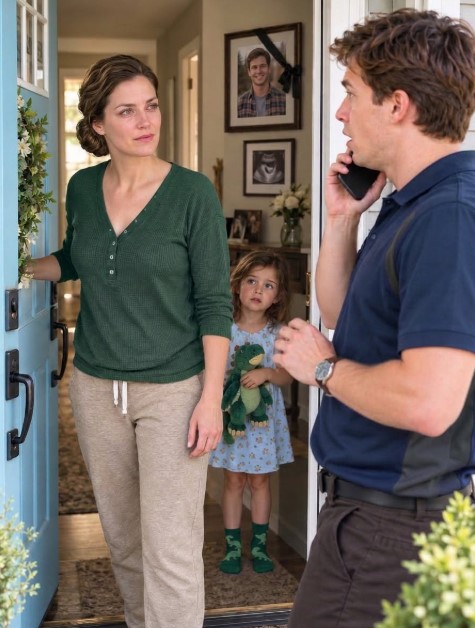
There’s a house in Asheville, North Carolina, with a robin’s-egg blue front door. I painted it myself the week we moved in—three coats with a cheap brush in good light. The final coat went on the day I stopped apologizing.
Inside lives my three-and-a-half-year-old daughter, Marin, who believes pancakes are a food group. I work twelve-hour shifts in the intensive care unit downtown, sometimes sixteen. I can recite eight patients’ medication schedules from memory and still forget to eat lunch.
I’ve watched people pass quietly.
My family taught me how.
That’s a joke I only make while driving home alone, where nobody has to decide whether to laugh.
Our life is small and intentional.
Daycare. Work. Pancakes. The library on Saturdays.
First there was rent. Then somehow a mortgage.
I painted every wall myself, but the front door was the only color I agonized over. Blue like the sky at the end of a night shift, when the world is quiet and briefly feels like it belongs to you.
For four years, nobody from Dayton, Ohio, had crossed that threshold.
That was deliberate.
It was also not the story my family told.
They said I disappeared.
Here’s the problem with that word.
Disappeared is passive.
Fog disappears.
Keys disappear.
The word erases whoever did the erasing.
What actually happened was simpler.
I stopped sending money home.
My family stopped being able to see me.
The money is where this story begins.
It isn’t where it ends.
If I’m being exact—and nurses are trained to be exact—it started ten years earlier with an envelope at my nursing-school graduation dinner.
I was twenty-four, the first Ives to finish college. I had paid for my degree with loans and double shifts at a diner.
My mother, Carol, held dinner at our house in Dayton.
Pot roast. A folding table pushed against the kitchen table. A sheet cake with my name spelled correctly. My diploma propped beside the gravy boat like an honored guest.
My father, Ray, said grace.
Danny, nineteen at the time, ate most of the cake.
For about two hours, I was the pride of that kitchen.
I would have done almost anything to stay that way.
Remember that.
My mother did.
After dinner, she slid a cream-colored envelope across the table. My name was written on it in the tidy handwriting she used for church bulletins.
I assumed it was a card.
It was empty.
“For the house,” she said, patting my hand. “You’re the one who made it out.”
She said it warmly, almost casually, like passing down a family recipe.
Nobody at the table reacted.
Dad stared into his coffee.
Danny looked at the cake.
I laughed because I thought I understood.
One envelope.
One favor.
The least I could do.
New nurses made decent money. Their furnace was old. I had made it out.
So I filled the envelope from my first paycheck and mailed it back.
The following month, another envelope arrived at the apartment I shared with two other nurses.
Same handwriting.
Same expectation.
Then another.
Nobody asked aloud again.
The asking had already happened once at a celebration in front of witnesses, wrapped in pride.
That envelope had never been intended as a one-time favor.
It was a subscription.
I simply hadn’t read the terms because I’d been taught to call those terms love.
By my second year, I switched us to Zelle because mailing envelopes had become ridiculous.
On the first of every month, money left my account before sunrise.
Usually $1,400.
Sometimes $2,000.
There was always another emergency.
A furnace.
Dad’s truck transmission.
A roof after a hailstorm.
I paid for that roof and felt proud.
A daughter keeping rain off her father’s head from three states away.
Then Danny needed a used Honda because his job required a car.
Christmas money came on top.
So did birthdays and Easter.
On my side of the ledger, the money looked like night differential and holiday pay.
Six straight Christmases at work because Christmas paid double.
I became the nurse who never refused overtime.
My coworkers assumed I was saving for something.
I was.
I just couldn’t have told them what.
I kept the total in a notebook down to the dollar.
Not because I expected repayment.
Because numbers were the only thing in my family that stayed still.
Words like borrow, help, and just this once changed shape depending on who was speaking.
Numbers didn’t.
By year six, the total had reached six figures.
I’ll tell you the exact number later.
I have spoken it aloud exactly once.
When you hear where, you’ll understand why once was enough.
And about that roof.
A year after the hailstorm, Danny sent a Thanksgiving photo. In one corner, I could still see a blue tarp covering part of the house.
I told myself contractors were slow in Ohio.
I told myself many things then.
It was cheaper than asking my mother questions.
Back then, I believed I couldn’t afford the answers.
Around that time, the east entrance of my hospital needed rebuilding.
The man doing the work was Caleb Brand.
Twenty-eight.
A builder.
Always with sawdust somewhere in his hair.
One morning after my shift, he stopped me outside and asked:
“What railing height worked best for patients who’d just relearned to walk?”
Half asleep, I gave him the rehab unit measurements from memory.
He wrote them down as though they mattered.
Then he rebuilt the entrance better than the blueprints required.
Afterward, he asked me to breakfast because dinner, as he pointed out, happened in the middle of my night.
For three years, he packed my lunches and labeled them by shift.
When he proposed, there was no diamond.
He tied a brass key to a ribbon.
It belonged to a sagging little fixer-upper he’d made an offer on, with a porch where he said he planned to drink coffee until he was ninety.
A house key instead of a ring.
I said yes to the key.
I took Caleb to Dayton once.
My mother asked his hourly wage before she asked his middle name.
Then whether builders received benefits.
Then who carried his health insurance.
He answered everything with his usual patience.
On the drive home, he said:
“Your mom sure loves numbers.”
He had no idea how right he was.
I didn’t tell him because I still hadn’t let myself count what those numbers meant.
That night, while he slept, my phone lit up.
My mother.
“He seemed steady, honey. Also, a small loan this month. Don’t tell your father.”
I stared at the message for a long time.
Apparently even my engagement had a price of admission.
I paid it.
I need to be honest about that.
For six years, I always paid.
That fall, flu season hit early and hard.
Half my unit was gone, and those of us left worked brutal hours.
After one sixteen-hour shift, I slept through an alarm for the first time in my adult life.
I woke on the fourth of the month.
The transfer went out three days late.
Three days.
I remember pressing send and thinking nobody would even notice.
My phone rang at seven the next morning.
My mother didn’t yell.
I almost wish she had.
Her voice was flat and efficient, like a bill.
The mortgage had been due.
She’d had to move money around in front of my father.
It had been humiliating.
Then she said the sentence I carried for the next five years.
“You don’t get to be tired. You’re the one who made it.”
I stood in my kitchen wearing scrubs I’d had on so long the fabric felt soft.
I looked down at my hands.
And apologized twice.
She accepted once.
I promised to set up an automatic transfer so it would never happen again.
She said that would be best.
Then we hung up like a bank and its customer.
What embarrasses me now isn’t that she said it.
People reveal themselves all the time.
That part costs nothing.
What shames me is that I spent the drive to work agreeing with her.
Planning better alarms.
Better systems.
Ways to make sure my exhaustion never inconvenienced anyone again.
I was twenty-nine, apologizing for sleeping after spending the night keeping strangers alive.
It would take something catastrophic to make me finally put the phone down.
Life had one ready.
It was a Tuesday in November.
I was midshift when the charge nurse came looking for me.
I knew before she spoke.
I’ve been the person who goes looking for families.
A scaffold had failed on a commercial job downtown.
A cable that inspection paperwork said was fine.
Caleb Brand, thirty-one years old, was gone before the ambulance reached the second light.
I’ve watched critically ill strangers receive more ceremony than the universe gave the man who used to label my lunches.
Eight builders from his crew carried him at the funeral in borrowed ties, crying openly.
My family didn’t come.
Seven hours, they said, was too far.
They sent carnations with a card signed to the Ives family in my aunt Sharon’s handwriting.
Meaning my mother had delegated the flowers.
Four days after the funeral, she texted:
“So sorry about everything, honey. Will this month’s transfer be late with all this going on?”
I was standing inside Caleb’s closet holding one of his flannel shirts.
It still smelled like cut lumber.
I sent the money on time.
I’m not proud of that.
Grief makes you obedient before it makes you anything else.
Two weeks later, I fainted at work.
My friend Dena marched me to the drugstore.
In a fluorescent bathroom, two pink lines appeared.
Night shifts had wrecked my cycles for years.
I had assumed stress explained the rest.
The ultrasound said sixteen weeks.
I did the math alone in a dark room with cold gel on my stomach.
Five months from becoming somebody’s mother.
One phone call from becoming nobody’s daughter.
I didn’t know that second part yet.
I found out on a Sunday.
I planned the call carefully.
Like medication administration.
Sequence. Dose. No surprises.
In the shower, I rehearsed.
Mom, Caleb passed away.
Mom, I’m pregnant.
Mom, the doctor says my blood pressure is dangerous and I have to stop sending money and keep every dollar and every heartbeat calm.
Three facts.
Simple.
True.
But in what order do you give your mother a death, a grandchild, and a boundary?
I chose wrong.
I led with the boundary.
She answered on the second ring.
“Mom, I have to stop sending money.”
That was all I got out.
The line erupted.
Ungrateful.
After everything they had done.
The mortgage.
My father’s heart.
Who did I think had paid for my ambition?
Then the call ended.
I dialed again.
Voicemail.
Again.
Voicemail.
I sat on the bathroom floor with everything I had never been allowed to say—Caleb, the baby—lodged inside me like swallowed glass.
That week, my blood pressure earned me a specialist.
The specialist talked about preterm risk and treated stress like a controlled substance.
Reduce it or spend the pregnancy in bed.
So I tried one last door.
My father.
I could hear his radio in the garage when he answered.
“Dad, please. Something’s happened.”
Ray Ives, the man who once drove four hours for one of my choir concerts, answered quietly:
“Don’t upset your mother.”
Not:
What happened?
Not:
“Are you okay?”
Every road into that family ran through Carol.
Carol had closed the road.
I set my phone face down on the counter.
I stopped picking it up.
They could have asked one question.
Any question.
They never did.
Seven hours north, my mother started telling a different story.
It just wasn’t mine.
If you’ve ever been the family ATM, the person they remember on the first of the month and forget on your birthday, tell me in the comments where you’re watching from. I read everyone. It reminds me none of us were ever as alone as they made us feel.
You need to understand how the word disappeared was created.
Nobody in my family told the kind of lie you could quote cleanly.
It began with my aunt Sharon, my mother’s sister and unofficial broadcasting department.
Two months after that phone call, Sharon posted on Facebook:
“Praying for my sister through a heartbreaking season. Some children forget the people who raised them.”
No name.
None was needed.
Then came coffee hour at First Grace, the small Dayton church where my mother had run the women’s committee since before I could walk.
Someone asked where I had been because I’d missed the harvest dinner.
According to what Danny later told me, my mother stared down at her shoes.
She let the silence sit long enough to spoil.
Then she touched her eyes with a tissue and said:
“We don’t really know anymore.”
Technically true.
She didn’t know because she had hung up before knowing was possible.
That was the genius of it.
By the next coffee hour, someone in the choir was saying I had disappeared.
My mother never corrected her.
And in a small church, something left uncorrected becomes scripture by Christmas.
My mother never had to lie.
She simply declined to provide the truth, cried at the right moments, and allowed two hundred well-meaning people to write the rest.
In the only court that mattered to her—the one meeting every Sunday—her grief became evidence.
The absent daughter was tried without ever being called.
I knew none of this then.
I was seven hours south, watching my ankles swell and counting down toward delivery.
Danny told me the details years later at my own kitchen table, ashamed.
But keep this with you through the next part.
While I was learning to become a mother, my mother was teaching an entire congregation that I had vanished.
So let me answer the question I opened with.
Why did I really stop sending money?
Not spite.
Not revenge.
The explanation fits in one sentence.
I had one salary, one dangerous blood-pressure reading, one baby coming, and nobody left to split the world with.
That was it.
That was the scandal.
During the final months of pregnancy, I built a quiet life.
I assembled a crib alone while watching an instructional video propped on a paint bucket.
Dena covered my worst shifts and told the unit manager I needed light duty before I had the nerve to ask.
The money that used to leave my account on the first stayed.
It became a car seat.
A cushion for maternity leave.
And the final piece of a down payment on a little brick house in West Asheville.
At first, seeing my own money stay in my own account felt obscene.
Almost selfish.
That’s what six years of envelopes will do to your arithmetic.
I moved into the house eight months pregnant, with Dena carrying anything heavier than a lamp.
Before unpacking the kitchen, I painted the front door blue.
That same month, I wrote one letter by hand to my grandmother June—my father’s mother, and the only person in that family I still believed might prefer a hard truth to a comfortable story.
I wrote everything.
Caleb.
The scaffold.
The pregnancy.
The transfers.
The phone call.
I told her my mother had ended the conversation before it even began.
I gave June my new Asheville address.
She was the only person in Ohio who got it.
I asked for nothing.
Just that she know.
Then I watched the mailbox.
Two weeks.
Six.
My ankles swelled.
The baby dropped.
Nothing came.
I told myself the letter had been lost.
The alternative—that even June now believed them—was too heavy.
So I left it alone.
I had other things to carry.
Marin Brand Ives arrived on an April morning three weeks early and completely unimpressed by the drama surrounding her.
My blood pressure held.
Barely.
The delivery was fast.
My daughter has never waited politely for anything.
I hope she never learns.
Dena stood where family should stand.
She held my hand through the hardest hour and narrated the whole thing like a golf announcer until I laughed.
When it was over, she cut the cord because someone who loved us should.
Then they placed six pounds of furious black-haired girl on my chest.
I want to tell you something about myself.
At work, I was famous for not crying.
Six years of codes, final breaths, and families folding in half in hospital corridors.
I stayed calm because somebody in the room always had to.
That nurse cried.
Not delicately.
The kind of crying that startles medical staff.
Because she was here.
Because she was safe.
Because the two people who should have been pacing the waiting room with terrible gas-station coffee had no idea she existed.
One because he was gone.
The other because she had hung up before I could tell her.
We named her Marin.
Years earlier, Caleb had tried the name aloud on the porch of the fixer-upper he never got to buy.
When he reached that one, he grinned and said:
“Her, someday.”
So the name had always belonged to her.
It took a lawyer and a patient stack of documents, but Caleb’s name is on the birth certificate of the daughter he never met.
And the brass key he gave me instead of an engagement ring now hangs in a little frame beside our blue door.
I came home with Marin four days later.
Then I did the thing my family would eventually call disappearing.
I lived.
Here is four years of peace compressed into a night-shift handoff.
You breathe surprisingly well once you stop financing another household.
The mortgage became easier each year.
The dogwood in the yard grew taller.
My daughter learned to walk on a sloping West Asheville street.
The door stayed blue.
Touched up every spring.
Never changed.
When Marin started preschool, I moved to day shifts.
I learned how to make pancakes shaped like mildly terrifying dinosaurs.
Dena became Marin’s godmother and then something simpler.
Family.
The kind you choose awake.
Every December, I sent exactly one thing north.
A Christmas card to June.
Marin’s school photo inside.
My return address clearly printed.
No phone number.
No request.
One card every year into the silence because some part of me refused to let the road disappear entirely.
I never knew whether June read them.
I didn’t know if she believed my mother’s version.
I would eventually get that answer.
It would be hiding inside a sewing box.
But I’m getting ahead of myself.
What matters about those peaceful years is quieter.
At some point, I stopped flinching when my phone rang on the first of the month.
I stopped mentally drafting apologies.
Being needed is not the same as being loved.
It took me thirty years to learn the difference and four more to believe it.
Marin will learn it for free.
I thought that chapter was finished.
I thought peace was something you got to keep.
Then, one Tuesday in September, somebody knocked on my blue door.
To understand that knock, you need to know what had been happening back in Dayton.
Over four years, the word disappeared had gathered entire stories around itself.
One version said I had gotten involved with substances.
Whispered, never confirmed.