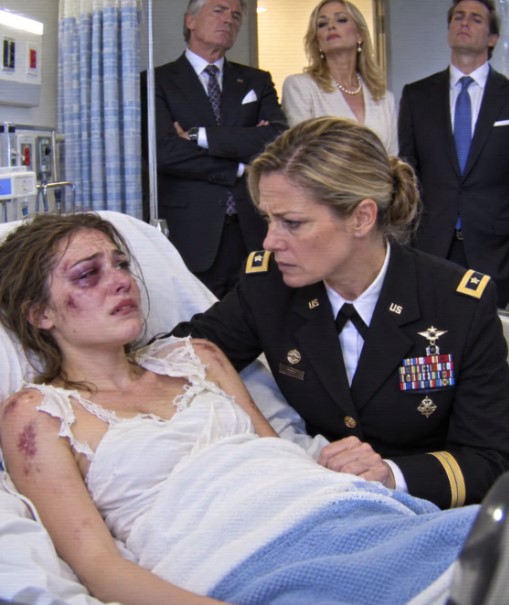
I did not tell Gregory to wipe the smirk off his face. I did not remind Nicholas that a wedding ring was not a deed of ownership. I did not ask Abigail to repeat what she had already forced herself to say through a swollen lip and a trembling body.
Instead, I turned toward the nurse standing just outside the observation room.
“Please call the attending physician,” I said. “And hospital security.”
Patricia’s smile thinned.
“That won’t be necessary.”
I looked at her then, really looked at her. She had the kind of face that was used to doors opening before she touched them. Perfect hair, perfect pearls, perfect posture. A woman who had learned long ago that wealth could soften ugly truths until they became misunderstandings.“My daughter is injured,” I said. “It is necessary.”
Nicholas took one step forward. “You’re making this worse.”
Abigail flinched.
It was small, almost invisible, but I saw it. I saw the way her shoulders pulled inward at the sound of his voice. I saw the way her fingers clutched the edge of the blanket, as if the thin cotton could become a wall between them.That one movement told me more than Nicholas ever could.
I placed myself between him and my daughter.Do not come any closer.”
My voice was quiet. Not soft. Not uncertain. Just quiet.For the first time, Nicholas hesitated.
Gregory chuckled, but the sound did not carry the same confidence it had moments earlier. “This is ridiculous. We came here to check on her.”
“No,” Abigail whispered behind me.
Her voice was fragile, but it cut through the room like a match struck in darkness.
“You came here to make sure I stayed quiet.”
The nurse returned with two security officers and a doctor in a white coat whose badge read Dr. Elaine Morris. She had kind eyes, but they sharpened the moment she took in the room.
“Everyone who is not immediate medical support needs to step out,” Dr. Morris said.
Patricia lifted her chin. “I am her mother-in-law.”
“I said immediate medical support.”
Gregory’s face hardened. “Do you know who we are?”
Dr. Morris looked at him with the tired patience of someone who had been asked that question too many times by too many people who thought it mattered.
“I know this is my patient’s room,” she said. “And I know she appears frightened. Please leave.”
Nicholas looked past me toward Abigail. “Think very carefully before you do this.”
Abigail closed her eyes.
I felt something in me strain against its own restraint. It would have been easy, dangerously easy, to answer him in the language of command. To fill the room with a voice that had crossed deserts, briefing rooms, and battle lines. But Abigail did not need a commander right now.
She needed her mother.
So I reached back without looking and found her hand.
“She is thinking clearly,” I said. “You need to leave.”
For a moment, no one moved. Then Patricia exhaled, smooth and controlled.
“Fine. We’ll let the hospital do its job.” Her eyes settled on Abigail. “But lies have consequences, dear.”
Security escorted them out.
The room seemed to expand after they left, as if the air itself had been holding its breath.
Abigail’s hand went limp in mine.
“Mom,” she whispered, “I’m sorry.”
Those two words nearly undid me.
I sat carefully on the edge of the bed, close enough for her to feel me there, not so close that she would feel trapped.
“You have nothing to apologize for.”
Tears slid into her hairline. “I should have told you.”
“Yes,” I said gently. “But we are not starting with what should have happened. We are starting with what happens now.”
Dr. Morris moved closer, her voice low and steady. “Abigail, I need to examine you properly. We can document your injuries, take photographs for your medical record, and discuss options. Nothing happens without your consent unless there is an immediate medical emergency. Do you understand?”
Abigail swallowed. “Will they find out?”
“They may know you were treated,” Dr. Morris said carefully, “but your medical details are protected. We also have a social worker who can help with safety planning.”
Abigail looked at me then, and for the first time since I had entered the hospital, I saw the woman she had been fighting to remain. Terrified, yes. Hurt, yes. But still there.
“I don’t want to go back,” she said.
“You won’t,” I answered.
I said it before I knew every detail. Before I knew where we would sleep that night, what calls would need to be made, what legal steps would follow, or how far the Fergusons’ influence truly reached.
But some promises were made before the plan existed.
This was one of them.
Dr. Morris asked if Abigail wanted me to stay during the examination. Abigail nodded immediately, and I stayed. I held her hand while the doctor noted bruising, tenderness, swelling. I kept my face calm while every observation landed inside me like a stone.
When the social worker arrived, she introduced herself as Marisol Vega. She was a short woman with silver-streaked hair and a canvas bag full of folders, but she carried herself with a grounded seriousness that made the room feel less unstable.
“Abigail,” Marisol said, “I know tonight is overwhelming. I’m not here to push you. I’m here to make sure you know your choices.”
Choices.
The word had weight.
Abigail had once had choices everywhere: what color to paint her apartment, what city to visit on vacation, what charity to volunteer with on weekends, whether to put cinnamon in her coffee. Somewhere along the way, Nicholas Ferguson had narrowed her life until every option felt like a hallway with a locked door at the end.
Marisol spoke calmly about protective orders, police reports, safe housing, documentation, and trusted contacts. She did not make it sound simple. She did not make it sound hopeless either.
“Do you have your identification?” she asked.
Abigail shook her head. “Nicholas kept most of my documents in the home office. Passport, birth certificate, some financial paperwork. He said it was safer that way.”
Patricia’s voice returned to me.
Our family has judges, politicians, and reporters who owe us favors.
I watched Abigail’s face as she admitted each small loss. The phone. The documents. The bank access Nicholas had slowly persuaded her to combine with his. The old friends who had stopped calling because she had canceled plans too many times. The way he had complained whenever she visited me at Fort Liberty, not with anger at first, but wounded disappointment.
You’re always choosing your mother over your husband.
That was how control entered a life, I realized. Not always as a locked door. Sometimes as a hurt expression. A sigh. A favor requested again and again until refusal felt cruel.
By midnight, Abigail was discharged with instructions, pain medication, and a packet of resources. Her injuries were serious, but not life-threatening. The phrase should have comforted me. It did not.
In the parking garage, the fluorescent lights hummed overhead. Abigail wore hospital scrubs because her dress had been placed in an evidence bag. She moved slowly, one arm wrapped around her ribs.
I opened the passenger door of my truck and helped her in.
She looked smaller under the harsh lights.
“I don’t want to go to your house,” she said.
I paused. “Why?”
“They know where it is.”
“They also know I am not easily startled.”
A faint, broken laugh escaped her, then disappeared. “Mom.”
“I know.” I closed the door gently, walked around, and got behind the wheel. “There’s a place near base. A furnished apartment I’ve used for visiting officers’ families in transition. It’s quiet, private, and secure enough for tonight. Tomorrow, we make better arrangements.”
Abigail leaned her head against the window. “You already have a plan?”
“I have the beginning of one.”
She watched the hospital disappear behind us. “I forgot what that felt like.”
“What?”
“Someone making a plan that wasn’t meant to trap me.”
I tightened my hands around the steering wheel, then loosened them deliberately.
Charlotte’s lights blurred past us. The city looked almost peaceful from the road, as if people were not breaking apart in quiet rooms behind bright windows. Abigail closed her eyes, but I knew she was not sleeping. Every few minutes, her breathing hitched as if some thought had caught her by the throat.
At the apartment, I checked the hallway before unlocking the door. Habit, some would call it. Survival, others. To me, it was simply the way my body had learned to enter unknown spaces.
The apartment was plain but clean: gray sofa, small kitchen, two bedrooms, a lamp with a crooked shade. Abigail stood just inside the doorway, staring as though she did not know what to do without someone telling her where to stand.
“You can take the bedroom on the left,” I said. “Bathroom is across the hall. I’ll make tea.”
“I don’t think I can sleep.”
“Then we won’t call it sleeping. We’ll call it resting.”
She gave another faint laugh.
In the kitchen, while water heated, I sent three messages. One to my commanding officer, requesting emergency personal leave. One to a trusted civilian attorney I had known for twelve years, asking for a confidential call at first opportunity. One to my younger brother Marcus, a former detective turned private investigator, asking only: Are you awake?
He replied within seconds.
For you? Always.
I stared at the screen for a moment, then typed back: Abigail is safe with me. I need advice, not action.
His response came quickly.
Understood. Tell me where and when.
I made chamomile tea and carried it to the living room. Abigail sat curled in the corner of the sofa, knees drawn to her chest, the blanket around her shoulders.
She accepted the mug with both hands.
“Did Dad know?” she asked.
Her father had been gone five years, taken by a heart attack on an ordinary Tuesday morning while fixing a cabinet hinge. Some griefs never became less strange. They simply became more familiar.
“No,” I said. “I don’t believe he did.”
“He would’ve hated Nicholas.”
“He might have hidden it politely for the first dinner.”
Abigail’s mouth trembled.
“Then he would’ve asked him too many questions about tire pressure and retirement accounts,” she said.
“And whether he knew how to change a breaker.”
“And Nicholas would’ve pretended he did.”
“And your father would’ve known he was lying.”
The memory settled between us, tender and painful.
For a few minutes, neither of us spoke.
Then Abigail said, “I think I married him because I was lonely.”
That confession came out so softly I almost missed it.
“You don’t have to explain tonight.”
“I do,” she said. “Maybe not to you. Maybe to myself.”
She stared into the tea.
“When Dad died, you went back to work so fast. I know you had to. I never blamed you. But the house got so quiet. Everyone kept saying I was strong because I was your daughter, and I tried to be. Nicholas showed up like he had studied exactly what I needed. Flowers on Dad’s birthday. Coffee when I worked late. He listened. At least I thought he did.”
I sat beside her, leaving space between us.
“At first, Patricia was kind,” Abigail continued. “Too kind. She bought me clothes for events, introduced me to people, said I had such natural grace. Then slowly, everything was a test. Was my dress appropriate? Had I spoken too casually? Why did I mention my job when Nicholas was clearly under pressure? Why did I laugh too loudly at dinner?”
She swallowed.
“And Nicholas would comfort me afterward. He’d say, ‘She’s difficult, but she means well.’ Then later, he started saying the same things she did.”
Outside, a car passed slowly down the street. Abigail stopped talking until the sound faded.
“Tonight was because of a fundraiser,” she said. “I heard Gregory talking to someone in the library. He said a woman named Lena had become a problem again. Nicholas saw me in the hallway. After we got home, I asked who Lena was.”
Her fingers tightened around the mug.
“He smiled at me like I was being silly. Then he asked if I had been listening at doors like hired help.”
“Lena,” I repeated.
Abigail nodded. “I don’t know her last name. I only know Gregory said she had ‘kept the wrong envelope.’”
That detail landed in the room with a quiet heaviness.
An envelope.
A woman named Lena.
A family with favors from judges, politicians, and reporters.
I did not say what I was thinking. Abigail had given enough of herself for one night.
“Drink your tea,” I said. “We’ll write down what you remember tomorrow.”
She shook her head. “I might forget.”
“You won’t.”
“I forgot myself for two years.”
The words broke open something in both of us.
I reached for the notebook on the coffee table. “Then we write tonight.”
So we did.
Not a formal statement. Not a legal document. Just memory, captured before fear could rearrange it.
Nicholas hiding her phone after arguments.
Patricia correcting her in front of guests, then insisting she was only trying to help.
Gregory making comments that sounded like jokes unless you were the one being measured by them.
The guest house.
The fundraiser.
Lena.
The envelope.
At 3:16 in the morning, Abigail finally slept.
I did not.
I stood in the kitchen beneath the low yellow light and read her notes again, each line written in her uneven hand. The temptation to move fast was powerful. Make calls. Confront people. Force doors open. Demand answers.
But speed was not the same as strategy.
I had spent my life learning the difference.
At dawn, Marcus arrived with coffee, breakfast sandwiches, and a face that went still the moment he saw me.
He did not ask if I was all right. He knew better.
“Where is she?”
“Sleeping.”
He nodded and placed the food on the counter. Marcus was six years younger than me, broader through the shoulders, with a beard gone mostly gray at the chin. He had the same eyes our mother had given us, dark and searching.
I handed him a copy of Abigail’s notes.
He read in silence. The longer he read, the more his expression changed from concern to something colder and more focused.